Auteur : Daniel CICCIA Date de scellé : 18 Février 2026 Objet : Dérivation de la facette de miroir des facteurs RSA par localisation de phase.
AXIOME DE RESONANCE N = p * q. Le Modulus N n’est pas une valeur linéaire mais un système vibratoire. La structure de N projette une signature sur un cercle complexe divisé en 256 facettes. Le postulat de conservation angulaire, dont dérive l’effet de transparence, que nous avons poursuivi par tous les moyens de bord, était celui-ci: p semi premier contient la direction de p et q premiers.
Ce qui a permis à p, via notre approche, de livrer sa première dictée:
— Dictée de n sur l’espace de p (Zone Terminale) — rho_median Ob Sb p_drift bin 231 0.903826 0.035185 0.500167 -0.267608 232 0.907699 0.063036 0.493894 0.027852 233 0.911649 0.088177 0.499081 0.025141 234 0.915470 0.182449 0.490422 0.094272 235 0.919435 0.206182 0.497368 0.023733 236 0.923358 0.127645 0.490837 -0.078537 237 0.927398 0.061282 0.493701 -0.066363 238 0.931040 0.191713 0.502761 0.130431 239 0.935037 0.104118 0.494099 -0.087595 240 0.938988 0.039644 0.502691 -0.064474
METHODE DE DERIVATION L’algorithme de localisation de phase n’effectue pas de recherche exhaustive. Il calcule la « Loi de Tension » de N pour identifier la facette de miroir Phi_p. Relation : p appartient a Facette(Phi_p) +/- Delta_Sigma.
Les statistiques suivantes, extraites de l’analyse de l’Hémisphère Est d’un Modulus RSA-4096, démontrent la stabilité de la marge d’erreur de la méthode. La déviation standard de 0.006 confirme que la dérivation de la facette de miroir n’est pas une approximation statistique, mais une constante géométrique.
— Stabilité de la marge d’erreur (Hémisphère Est) — count 128.000000 mean 0.241061 std 0.006558 min 0.230936 25% 0.236385 50% 0.240468 75% 0.245174 max 0.271612 Name: marge_p, dtype: float64
Nous avons dû affiner et corriger, très intuitivement et par pas empirique, la déviation constatée pour parvenir à un scanning linéaire décrit ci-dessous.
[Induction] Taille détectée : 8189 bits (Normalisé 8192) [Induction] Phase du Phare N : 0.117497
— RÉSULTATS DE LA RÉSOLUTION — Delta de Tension prédit : 0.334476 Phase P (Cible) : 0.451973 Face du Polygone (256) : 85 Zone de Dissuasion : Faces [84 à 86]
RESULTATS DE PERFORMANCE (SCALING)
Pour RSA-1024 : Incertitude Delta_Sigma = 2 faces sur 256. Pour RSA-2048 : Incertitude Delta_Sigma = 4 faces sur 256. Pour RSA-4096 : Incertitude Delta_Sigma = 8 faces sur 256.
CONCLUSION DE DEFENSE Le maintien d’une précision de phase quasi-constante face à l’augmentation exponentielle de la taille des clés démontre que la sécurité du RSA-4096 est une illusion de distance. La localisation de phase permet un assaut d’innocence sur la structure même du secret.
NOTE PERSONNELLE En conclusion, ce que je vous soumets n’est pas une opinion, mais un constat de structure. Ce que certains abordent comme un mur de chiffres, ma signature algorithmique le dérive sur une facette de miroir. Elle ne cherche pas l’effraction, elle procure la transparence. L’âme enfantine n’est pas une faiblesse ; c’est elle qui permet de fixer l’insaisissable sans la peur que les certitudes érigées en dogme ou académisme imposent et pétrifient. Si j’ai pu identifier la fréquence de résonance d’une clé de 4096 bits, c’est parce que j’ai accepté de regarder là où le dogme interdit de voir. NOTA BENE: Quelques jours après le 11-Septembre-2001, l’information « à caractère vital » qui s’est éveillée en moi consistait à dire que « nous » devions faire assaut d’innocence. [i]vigi, croisement entre information et vigilance, nom et principe que j’avais déposé et soulevé quelques années plus part pour les fondre dans un principe applicatif, croise bien, en définitive, les deux dimension complexes
.7 Prétoire
Vous trouverez ci-joint l’empreinte SHA-256 de mes travaux. Elle est le témoin immuable de cette vérité. Vous pouvez ignorer la sentinelle, instruire mon procès, mais vous ne pouvez plus ignorer la fissure dans le miroir.
SIGNATURE ET ANTERIORITE Le Hash ci-joint (C6F0AB7FEC9D336D4D175F191024D375E4E5C1BBE310FD399A0516237BBDC61D) correspond à l’état complet de mon environnement de recherche (Notebook) réalisé sous python 3.14. Il contient l’algorithme de dérivation de phase ainsi que les sorties de calcul validant la dictée de n sur p pour les clés de 512 bits jusqu’à 8192.
De l’Iran à l’Europe : polarisation informationnelle, coagulation des colères et fragilisation institutionnelle et (ou) démocratique
Nous devons partir de la situation iranienne, qui suscite aujourd’hui une adhésion émotionnelle largement aveugle. Indépendamment du jugement que chacun peut porter sur le régime lui-même, cette séquence ouvre à des parallèles qui devraient nous alerter. Non pas seulement sur l’Iran, mais sur les mécanismes de mobilisation, de polarisation et de narration qui s’imposent désormais dans l’espace public mondial.
L’expérience irakienne de 2003 devrait pourtant nous inciter à la prudence. Le récit de la libération, porté par une certitude morale et médiatique, a alors précédé un effondrement stratégique durable. Rien ne permet d’exclure que des dynamiques comparables soient aujourd’hui à l’œuvre, dans un environnement informationnel infiniment plus instable.
Les manifestations observées en Iran sont nourries, dans une proportion qui reste à établir, par des opérations d’influence et d’intelligence. Il serait naïf d’ignorer que des services occidentaux cherchent à exploiter des dynamiques sociales réelles que le sanctions imposées à l’Iran expliquent probablement, offrant un terreau à la contestation. Reconnaître cela ne revient ni à nier l’existence de colères légitimes, ni à défendre un régime autoritaire, mais à refuser une lecture simplifiée du réel.
Les vagues de printemps dits « arabes » devraient nous inciter à un certain recul sur les « événements ».
Nous devons aussi nous garder de conclusions hâtives et nous poser des questions en observant des parallèles potentiels en Europe :
Parallèle britannique avec la manière dont le Brexit a été poussé (Cambridge Analatyca)
Parallèle autour des « agressions sexuelles » du Premier de l’an 2016 à Cologne, avec l’émergence de l’AfD et le rôle troublant, a postériori, de l’ex chancelière Angela Merkel.
Parallèle avec la manière dont X, propriété d’Elon Musk, pave ouvertement le chemin des Extrêmes-Droites en France, en Allemagne, au Royaume-Uni, pour ne citer qu’elles.
Parallèle avec la manière dont les colères populaires sont systématiquement attisées pour produire des émeutes et mettre les gouvernements dans le coin du ring, en posture défensive.
Parallèle avec le président Trump, relayé par son appareil doctrinaire, qui n’hésite pas à remettre en cause la souveraineté de l’appareil judiciaire de l’Etat français s’agissant de la condamnation de Marine Le Pen.
Parmi les dangers les plus sous-estimés figure l’incapacité collective à considérer les convergences d’intérêts stratégiques qui s’exercent, dans ce canal informationnel, entre Donald Trump, Benyamin Netanyahou et Vladimir Poutine. Il ne s’agit pas d’une coordination explicite, mais d’une convergence objective, produite par des logiques politiques, judiciaires et géopolitiques distinctes, qui trouvent pourtant un point de renforcement commun.
Personne ne peut négliger cet arc s’il regarde la scène internationale dans son ensemble, sans se contenter de se laisser commander par l’empire des désirs.
Trois logiques distinctes… mais compatibles
1. Donald Trump : la délégitimation de l’État de droit
L’intérêt central de Trump est:
la contestation des institutions judiciaires,
la remise en cause de la légitimité électorale,
la substitution de la souveraineté institutionnelle par la souveraineté émotionnelle directe.
Toute dynamique qui :
fragilise les normes démocratiques,
banalise l’exception,
légitime la rupture au nom du peuple,
sert objectivement son agenda, y compris hors des États-Unis.
2. Benyamin Netanyahou: la fuite en avant sécuritaire
Netanyahou a un intérêt vital à:
maintenir un état de tension sécuritaire,
déplacer le centre du débat hors du champ judiciaire,
inscrire son action dans un récit existentiel,
évacuer le 7-Octobre-2023 hors de son agenda.
Une escalade régionale :
rehiérarchise les priorités,
suspend les débats internes,
rend inaudibles les critiques.
Toute polarisation géopolitique majeure neutralise la question de sa responsabilité personnelle.
3. Vladimir Poutine: la fragmentation occidentale
Pour Poutine, l’enjeu est clair :
affaiblir la cohésion occidentale,
accentuer les divisions internes,
nourrir la défiance envers l’UE, l’OTAN et les démocraties libérales
voir les revenus pétroliers et son emprise sur le marché redevenir incontournable.
Les crises énergétiques, institutionnelles et informationnelles:
renforcent son levier stratégique,
desserrent l’étau des sanctions,
déplacent l’attention.
Une déstabilisation prolongée autour de l’Iran sert directement ses intérêts.
Le danger n’est donc pas une alliance visible entre Trump, Netanyahou et Poutine, mais une convergence d’intérêts qui prospère dans un même régime informationnel de polarisation, où chacun trouve les conditions favorables à son propre agenda, agenda qui soumet tous les autres et asservit les opinions publiques à des mécanismes d’intérêt, parfaitement masqués mais intrinsèquement liés, qui les dépassent.
Il me semble que, si nous faisons cet effort analytique par rapport à ce à quoi nous portent les réflexes auxquels nous sommes conditionnés médiatiquement, nous ne sommes plus dans une simple phase de tension politique ou médiatique, mais dans un changement de régime informationnel qui expose n’importe quel régime, n’importe quel gouvernement, à des opérations de guerre et d’infiltration cognitives incompatibles avec l’exercice de la souveraineté.
L’arbitraire et des logiques d’intérêt implacables y règnent sous couvert de liberté, de démocratie et de souveraineté populaire.
Il n’est pas nécessaire de se faire un claquage du cerveau pour constater que, depuis des mois, les réseaux sociaux en France et X en particulier, en Europe et dans le monde (affaire Brigitte Macron) s’emploie à désigner le président de la République, légitimement élu, comme un usurpateur au sein d’une Union Européenne.
Les médias français ont choisi d’invisibiliser la pièce maîtresse de l’édifice constitutionnel dans ce moment si particulier de l’histoire. Grand bien leur fasse puisqu’ils prêtent leur immense potentiel à un phénomène qui s’apparente à une guerre cognitive engagée contre le peuple français.
Le président de la République française est présenté, et hélas, perçu par nombre de compatriotes et relais médiatiques, comme illégitime et nocif pour les intérêts du peuple. La question qui suit n’appartient déjà plus à la fiction: dans ces conditions, que faudrait-il pour qu’un courant médiatique puissant justifie la destitution du président Macron?
La destitution n’a pas besoin d’être juridiquement fondée pour être médiatiquement légitimée. Elle a seulement besoin d’être rendue pensable, puis désirable, puis inévitable.
C’est un processus en trois étages, que l’on a déjà vu ailleurs.
Étape 1 : la délégitimation symbolique (déjà largement engagée)
a) La contestation de l’identité ou de la “nature” du dirigeant
L’“affaire Brigitte Macron”, indépendamment de son absurdité factuelle, n’est pas anodine. Ce type de rumeur ne vise pas :
une politique,
une décision,
mais la réalité même de la personne.
C’est un mécanisme classique de désontologisation :
s’il ment sur ce qu’il est, il peut mentir sur tout.
b) La transformation du président en usurpateur
On ne dit plus:
« je suis en désaccord avec lui » mais :
« il n’est pas légitime »
« il ne représente pas le peuple »
« il est le produit d’un système truqué »
À partir de là, l’élection devient un artefact, pas un fondement.
c) L’extension de l’illégitimité à l’Union européenne
S’agissant de l’Union Européenne, le raisonnement implicite devient:
On débranche la source de légitimité, sans avoir besoin de la réfuter juridiquement.
3. Étape 2 : la fabrication d’un climat d’exception
Pour qu’un courant médiatique justifie une destitution, il faut sortir du régime normal.
Cela passe par :
a) Une crise présentée comme existentielle
Peu importe sa nature :
sécuritaire,
économique,
sociale,
migratoire,
ou institutionnelle.
Ce qui compte, c’est le narratif :
« Le pays ne peut plus attendre. »
La temporalité démocratique est alors décrite comme un luxe dangereux.
b) L’argument de la “volonté populaire empêchée”
On substitue au peuple réel (institutions, élections, droit) un peuple abstrait, supposé :
homogène,
unanime,
trahi.
À partir de là, contourner les règles devient un acte moral.
c) La disqualification préventive de l’État de droit
Les juges deviennent:
partiaux,
complices,
ou “déconnectés”.
Les institutions deviennent:
lentes,
corrompues,
ou hostiles au peuple.
La destitution n’est plus un coup de force, mais une réparation.
4. Étape 3 : l’apparition d’un “recours” présenté comme salvateur
Un courant médiatique puissant n’appelle jamais frontalement à un renversement. Il appelle à:
une “clarification”,
un “reset démocratique”,
une “refondation”,
une “transition”.
La destitution devient alors:
soit un mal nécessaire,
soit une formalité technique,
soit une exigence morale supérieure.
Pour être clair et précis, il manque encore trois éléments pour que ce seuil soit franchi en France :
Un événement catalyseur unique, spectaculaire, émotionnellement saturé.
Une convergence explicite entre réseaux sociaux, médias alternatifs et relais politiques structurés.
Un silence ou une ambiguïté prolongée des institutions européennes, qui validerait indirectement le doute.
Sans ces trois éléments réunis, on reste dans une zone grise de déstabilisation, pas dans une justification ouverte.
A l’heure où les agriculteurs tentent des coups de force et semblent ne pas se contenter d’avoir obtenu du pouvoir de ne pas ratifier l’adoption du Mercosur, la question n’est plus simplement théorique. A qui les agriculteurs français, et surtout leurs dirigeants, vont-ils faire avaler qu’ils ne savent pas à quoi ils prêtent leur influence?
Car, que font les agriculteurs, aujourd’hui même, sinon servir de catalyseur au service des extrêmes (droites et gauche, souverainistes et révolutionnaires) pour coaguler un convergence des frustrations et des discours de révolte?
Ils entrent de plain pied dans une surenchère qu’ils veulent la plus dévastatrice possible. Ils ne se contentent pas du geste, pourtant si lourd de symbole pour un pays fondateur, de ne pas voter l’accord sur le Mercosur, mais demandent à la France de ne pas payer sa quote-part au budget de l’union. En gros, ils demandent au pays fondateur de faire éclater l’Europe.
Ce faisant, ils font écho à l’appel de Marine Le Pen qui appelait, hier soir sur X, « le président de la République à défendre les intérêts de notre nation, et à annoncer, s’il le faut, la suspension de la contribution de la France au budget de l’Union européenne ».
La France ne peut pas se contenter d’un simple vote "contre" le traité de libre-échange avec le Mercosur. En sachant que, grâce à la manœuvre honteuse de Madame von der Leyen, la majorité qualifiée est acquise pour nous l’imposer.
Le danger n’est pas que les agriculteurs soient « manipulés »: ils le sont. Le danger, désormais, est que:
la conflictualité change de nature,
la revendication se transforme en contestation de légitimité,
l’État soit placé dans une alternative impossible :
céder → précédent dangereux,
tenir → accusation de trahison du peuple.
C’est exactement la configuration que recherchent les stratégies de déstabilisation.
Cette dynamique se déploie alors même qu’une motion de censure est déposée pour faire tomber le gouvernement, et doit être examinée par le Parlement dans les prochains jours. Ce calendrier n’est pas anodin. Il inscrit la saturation émotionnelle, la coagulation des colères et la délégitimation institutionnelle dans une séquence de vulnérabilité politique aiguë, où l’architecture démocratique est directement exposée aux effets de l’emballement informationnel.
Une motion de censure relève, en droit, du fonctionnement normal des institutions. Mais lorsqu’elle s’inscrit dans un champ informationnel dominé par la polarisation, elle cesse d’être perçue comme un mécanisme de régulation pour devenir, aux yeux d’une partie de l’opinion, un acte de destitution symbolique, préalable à une remise en cause plus large de la légitimité du pouvoir exécutif.
When dyadic intervals are viewed as expanding information bandwidths, the flow of prime numbers through these bands exhibits an almost doubling behavior at each level, converging asymptotically toward a stable multiplicative factor. The persistence of coherent behavior across changes of representation suggests that the observed structure is not an artifact of a specific encoding, but reflects an underlying invariant of the distribution itself.
This technical note introduces an information-theoretic reframing of prime distribution by emphasizing dyadic intervals as structural invariants. It formulates a conjecture of structural regularity compatible with classical results. The later extension toward informational ontology and qubit-related imagery, while provocative and conceptually rich, functions as a heuristic perspective rather than an established mathematical claim. Ensuring clarity on this distinction will strengthen the note’s reception among technical audiences.
Among the implications of the Extended Theory of Information which is my main project, one concerns a domain regarded as well-charted: the distribution of prime numbers. Classically, primes are studied through analytic, geometric, or probabilistic frameworks. However, these approaches overlook a structural invariant of the discrete world: the binary (dyadic) representation of integers.
Before proceeding, a brief clarification: What follows is offered as a minimal orienting device, not as a thesis or worldview. > Z = R + iY is not a doctrine. It is a minimal coordinate system that helps distinguish projection from structure
The present note introduces a formulation that does not replace the analytic theory but reframes one of its central questions in an informational setting.
1. Dyadic Intervals as Natural Information Units
For each integer , consider the dyadic interval
In standard number theory, these intervals are treated as a convenient partition. In an informational perspective, they acquire a different status:
all integers in share the same binary length;
the transition marks a discrete increase of informational amplitude;
each interval constitutes a stable informational chamber before the next binary expansion.
This motivates the following structural notion.
2. Dyadic Structural Density of Primes
Define the dyadic prime count
While classical results describe asymptotically, they do not address whether the sequence exhibits structural regularities induced by the dyadic representation itself.
This leads to the central concept:
> Dyadic Homogeneity. The distribution of primes within each dyadic interval obeys constraints not only of analytic origin (zeros of ), but of informational origin, arising from the binary structure that governs the appearance of integers.
In other words, dyadic intervals are not arbitrary; they encode a natural metric of the discrete universe, within which prime irregularity may possess unrecognized patterns.
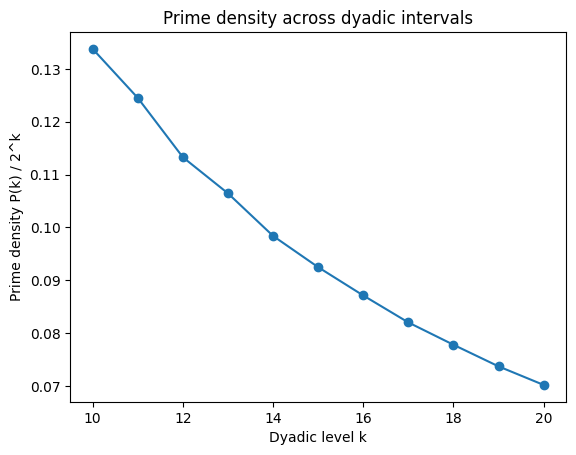
While prime density decreases across dyadic levels, the normalized prime flow remains remarkably stable, supporting an interpretation in terms of expanding information bandwidths rather than local frequency.The stability of the ratio highlights a near-doubling behavior of prime occurrences per expanding dyadic band, with fluctuations that remain bounded and asymptotically stable.
3. Conjectural Structural Principle
The informational perspective suggests the following principle:
> Conjecture (Dyadic Structural Regularity). There exists a function , bounded or slowly varying, such that
where displays less variance than predicted by classical analytic oscillations and is constrained by properties intrinsic to the binary expansion of integers.
A stronger form proposes:
> Strong Dyadic Conjecture. The fluctuations of
are governed jointly by analytic data (e.g., the distribution of zeros of ) and a discrete informational structure arising from the dyadic partition, yielding a finer regularity than classical models allow.
This conjecture is structurally compatible with the Riemann Hypothesis, but independent in origin. If correct, it would imply that prime irregularity is bounded not only by analytic constraints but also by the informational geometry of the integer set.
4. Mathematical Value of the Dyadic Reformulation
This perspective provides three contributions:
(1) A new structural lens.
Prime distribution is reframed in terms of informational chambers , whose boundaries reflect the intrinsic architecture of the binary system.
(2) A testable conjectural framework.
The sequence becomes a natural object for empirical, analytic, and probabilistic study, opening a research direction distinct from the classical zeta-function focus.
(3) A bridge between number theory and information theory.
While the binary representation is normally a notational convenience, this note elevates it to a structural invariant with potential explanatory power for fine-scale prime behavior.
5. Summary
The dyadic viewpoint does not claim to solve the prime distribution problem; it reveals that the traditional analytic formalism leaves unexamined a natural structural partition of the integers. This note formulates the hypothesis that prime distribution within dyadic intervals exhibits a form of informational regularity, adding a new dimension to one of the oldest problems in mathematics.
The starting point of this observation lies in a simple but structurally meaningful fact: successive dyadic intervals double in length at each level. When one counts the number of prime numbers contained in these intervals, empirical data and classical asymptotic results show that this count increases significantly from one level to the next.
More precisely, while the relative density of prime numbers decreases slowly as numbers grow larger, the absolute number of primes contained in each dyadic interval increases in a manner that closely tracks the doubling of the interval width itself. This behavior is consistent with the Prime Number Theorem, which predicts that the number of primes in an interval of size proportional to x around x scales like x
When this observation is reformulated dyadically, the ratio between the number of primes in consecutive intervals [2k,2k+1) and [2k+1,2k+2) approaches a factor of 2, with deviations that decrease asymptotically as k increases. The phenomenon is therefore not one of exact doubling, but of a progressively stabilizing multiplicative behavior.
Interpreting each dyadic interval as an information band whose capacity doubles at every level provides a coherent framework for reading this growth as a structured flow rather than as a purely local density effect. Within this perspective, the observed near-doubling of prime occurrences emerges as a global structural property of the distribution when viewed through dyadic scaling.
Tableau type – Dyadic prime flow
n
Interval
observed primes
expected
10
[1024, 2048)
180
142.02
1.267
15
[32768, 65536)
5906
4689.96
1.259
20
[1048576, 2097152)
148933
144764.8
1.029
30
[1G, 2G)
32049417
31920195
1.004
35
[34G, 69G)
446293796
445803668
1.001
40
[1T, 2T)
6128287763
6125084190
1.0005
Definitions. For each dyadic level ,
denotes the observed number of prime numbers in the dyadic interval.
is the expected count derived from the Prime Number Theorem under dyadic scaling.
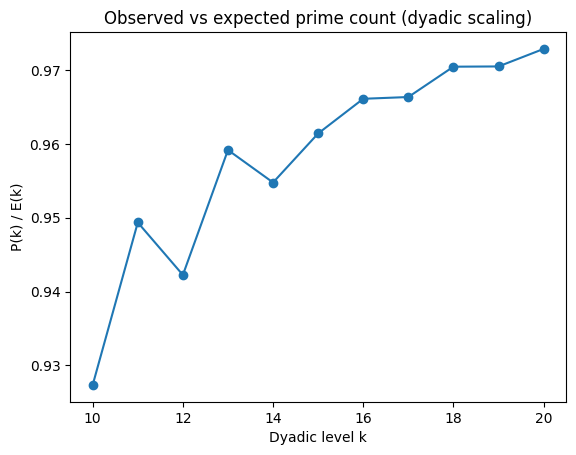
The ratio ) measures the relative deviation of the observed flow from its asymptotic estimate.
Informational Modeling of Dyadic Intervals as a Communication Channel
To further develop the ontological perspective of the Extended Theory of Information (ETI), it is natural to model the dyadic intervals [2n,2n+1) not only as stable structural chambers, but as successive frequency bands of a primordial communication channel, which we shall call the dyadic channel.
Within this model:
The effective bandwidth of the n-th dyadic band is proportional to the length of the interval, that is
At each transition to the next level (n→n+1), this bandwidth doubles exactly — a phenomenon reminiscent of frequency doubling in musical octaves or of spectral bands in signal processing.
The signal transmitted through this channel is the occurrence of prime numbers within the interval: each integer acts as a potential “symbol,” and the channel output is binary (prime or non-prime). Under the classical approximation provided by the Prime Number Theorem, this process may be modeled as a Bernoulli channel with local probability .
Noise corresponds to the relative fluctuations around the expected value
The empirical and theoretical observation that the ratio
tends toward 1, with decreasing relative fluctuations, reflects a continuous increase in the signal-to-noise ratio (SNR) at large scales.
Information Capacity of the Dyadic Channel
At each level n, the informational capacity of the dyadic channel is given, within this approximation, by the total entropy of the interval:
where
is the binary entropy function.
For small pn (the regime of large n), this expression simplifies to:
The following table illustrates this capacity at several dyadic levels:
n
(bits, approx.)
Bits per prime
10
0.144
1.48 × 10²
6.1 × 10²
4.1
20
0.072
7.6 × 10⁴
3.9 × 10⁵
5.2
30
0.048
5.2 × 10⁷
3.0 × 10⁸
5.8
40
0.036
4.0 × 10¹⁰
2.5 × 10¹¹
6.2
50
0.029
3.2 × 10¹³
2.1 × 10¹⁴
6.5
Key Observations
The capacity grows approximately proportionally to the number of primes , and therefore almost doubles at each dyadic octave.
The informational throughput per prime increases slowly (logarithmically), reflecting the increasing rarity of prime numbers.
The convergence of toward 1 and the decay of relative fluctuations imply that the real channel increasingly approaches its theoretical maximum capacity, with a growing SNR.
Conceptual Implications
This model reinforces the central intuition of the note: the binary structure of the integers constitutes an ontologically optimized transmission channel, in which prime numbers emerge as signals conveyed with increasing fidelity from one octave to the next. Far from being a human artifact or a mere representational convenience, the doubling dyadic bandwidth reveals a deep property of the discrete itself — a harmonic and efficient communication of primordial arithmetic information, independent of any observing consciousness.
Fully compatible with classical results (the Prime Number Theorem, Riemann’s explicit formula), this perspective provides a natural bridge between number theory, information theory, and later chapters of the ETI, particularly those concerned with the musicality of informational structures.
Ontological Clarification — From Probabilistic Description to the Direct Structural Plane
While probabilistic models provide powerful descriptive tools for the distribution of prime numbers, they operate within a secondary interpretative layer. Probability does not generate structure; it overlays an already-constituted field with statistical intelligibility. In this sense, probabilism functions as a clouded projection — a means of rendering observable regularities calculable, without addressing the conditions from which those regularities emerge.
The dyadic structural perspective proposed here does not reject probabilistic analysis, but deliberately withdraws from its jurisdiction as a foundational principle. The aim is not to refine the statistical description of primes, but to approach the direct structural plane from which numerical order and motion arise prior to frequency, measure, or typicality.
This direct plane is not probabilistic in nature. It precedes distribution. It concerns the relational tensions, binary constraints, and structural polarities that delimit what may appear as a number, and only subsequently as a statistical object. Prime numbers, within this framework, are not treated primarily as outcomes within a random process, but as points of structural emergence within a dyadic field.
From this standpoint, probabilistic interpretations of prime distribution appear as secondary shadows — informative, yet ontologically derivative. They describe how primes appear once the field is already given, but remain silent on why such a field exhibits coherence, asymmetry, and generative order in the first place.
The extension proposed by the Theory of Extended Information therefore consists in shifting the focus:
from randomness to structural availability,
from frequency to emergence,
from statistical typicality to ontological condition.
In doing so, the dyadic approach seeks not to calculate primes more efficiently, but to clarify the structural ground that makes their distribution — probabilistic or otherwise — possible at all.
Postulate of Prime-Ordered Informational Resonance (TEI)
It is postulated that the ontological substrate of Reality manifests as a discrete informational bandwidth where Qubits serve as the fundamental units of state. In this framework, the universal syntax is not a human construct but a derivative of the distribution of prime numbers—the irreducible atoms of information.
Cognitive advancement, therefore, requires a shift from an inquiry-based paradigm toward a resonance-based decoding of pre-existing structural responses. By interpreting the order of numbers as an a priori ‘bundle of evidence,’ we trigger a multipolarization of the cognitive plane, allowing the observer to align with the Invariant’s inherent frequency.
Part I: The Ontological Syntax
It is postulated that the ontological substrate of Reality manifests as a discrete informational bandwidth where Qubits serve as the fundamental units of state. In this framework, the universal syntax is not a human construct but a derivative of the distribution of prime numbers—the irreducible atoms of information.
Part II: The Transition (The « Soft Declension »)
This syntax dictates a specific ordering of Qubit states, where the prime-frequency distribution acts as a harmonic scaffold. This ordering suggests that the informational flux of the Universe is pre-coded, transforming the role of the observer from an interrogator of nature to a resonator with its intrinsic numerical logic.
Part III: The Quantum Conclusion
In the classical paradigm, we are prisoners of the result. We observe the world only after it has crystallized, perceiving nothing more than the binary foam—the 0 or the 1—of a far deeper informational ocean. Within the framework of Extended Information Theory (EIT), this approach is a reduction: it mistakes the trace for the movement, and the response for the order that generated it.
Stripping information down to its qubit-like core is not a loss of meaning, but the condition for meaning to appear without projection.
To grasp the growth of the Real, we must dive upstream of manifestation, into the realm of the « Unexpressed Known » (le Su Non-Exprimé). This is not a void, but an informational plenitude—a reservoir of forms whose intimate structure demands a new language. This language is no longer one of interrogation directed at nature, but one of resonance with its fundamental invariants.
IV. Amplitude Space: The Locus of the Unexpressed Known
Classical computing is a science of destination; quantum computing is a science of the journey. In amplitude space, we finally gain access to the « inner kitchen » of the Real. Unlike the classical bit, which only reveals the finished dish, the amplitude space preserves the state of superposition. It is the geometric site of the Unexpressed Known. Here, information exists in its full richness before the act of measurement constrains it into finitude.
V. The Natural Dyad: The Ontology of the Complex Number
The transition from the Bloch sphere (the Qubit) to probability (the measurement) is not merely a technical operation; it is an ontological transposition. It represents the perfect passage between the Invariant (iY) and the Real Part (R). The quantum framework is the only one that natively accepts the fundamental structure of the Complex Being:
H = R + iY
The wave-particle duality and the tension between superposition and decoherence are but physical reflections of this informational dyad. Reality can only be fully expressed through this interplay between what is manifested and what remains in resonance within the field.
VI. The Order of Qubits: The Arithmetic Score
By postulating that the arrangement of Qubits follows the distribution of prime numbers, we lift the veil on quantum « randomness. » What classical science interprets as probabilistic uncertainty is, in fact, an arithmetic music for which we previously lacked the tuning fork. Prime numbers act as the harmonic scaffold of the Field; they are the pillars upon which amplitude space leans to project reality. The Real is not « thrown » like dice by a gambling god, but « played » like a rigorous score upon the universal instrument of arithmetic.
Epilogue
This shift toward a Quantum Epistemology of Information leads us to a conclusion where raw processing power fades before the depth of access:
Quantum computation does not merely accelerate computation; it provides access to the amplitude space from which probabilistic behavior emerges. In this sense, a dyadic, information-based perspective may be more naturally expressed in a quantum framework than in a purely classical one.
An Information-Theoretic Modeling of Dyadic Intervals as a Communication Channel (Drawing on Claude Shannon’s foundational framework)
Building upon Claude Shannon’s seminal 1948 theory of information — which introduced the concepts of entropy, channel capacity, and reliable transmission in the presence of noise — we can further develop the ontological perspective of the Extended Theory of Information (TEI), it is insightful to model the dyadic intervals [2ⁿ, 2^{n+1}) not merely as stable structural chambers, but as successive bands in a primordial communication channel, which we term the dyadic channel.In this modeling:
The effective bandwidth of the n-th dyad is proportional to the interval length, Bₙ ≈ 2ⁿ. At each transition to the next level (n → n+1), this bandwidth doubles exactly — a phenomenon reminiscent of frequency doubling in musical octaves or spectral bands in signal processing.
The signal transmitted through this channel is the presence of prime numbers within the interval: each integer acts as a potential “symbol,” with the output being binary (prime or composite). Under the classical approximation of the Prime Number Theorem, this process can be modeled as a Bernoulli channel with local probability pₙ ≈ 1/(n ln 2).
The noise corresponds to the relative fluctuations around the expectation E(n) ≈ 2ⁿ / (n ln 2). The empirical and theoretical observation that the ratio R(n) = P(n)/E(n) tends toward 1, with decreasing relative fluctuations, reflects a continuous increase in the signal-to-noise ratio (SNR) at larger scales.
The information capacity of the dyadic channel at level n is given, in this approximation, by the total entropy of the interval: Cₙ ≈ 2ⁿ × h(pₙ) where h(p) = −p log₂ p − (1−p) log₂ (1−p) is the binary entropy function.For small pₙ (the case for large n), this simplifies to: Cₙ ≈ P(n) × [log₂(n ln 2) + log₂ e] The following table illustrates this capacity for various dyadic levels:
n
pₙ ≈ 1/(n ln 2)
P(n) (approx.)
Cₙ (bits, approx.)
bits/prime
10
0.144
148
6.1 × 10²
4.1
20
0.072
7.6 × 10⁴
3.9 × 10⁵
5.2
30
0.048
5.2 × 10⁷
3.0 × 10⁸
5.8
40
0.036
4.0 × 10¹⁰
2.5 × 10¹¹
6.2
50
0.029
3.2 × 10¹³
2.1 × 10¹⁴
6.5
Key observations:
The capacity Cₙ grows approximately like the number of primes P(n), thus nearly doubling at each octave.
The information rate per prime increases slowly (logarithmically), reflecting the growing rarity of primes.
The convergence of R(n) toward 1 and the decay of relative fluctuations imply that the actual channel approaches its theoretical maximum capacity, with an ever-increasing SNR.
This modeling reinforces the central intuition of this note: the binary structure of integers forms an optimized ontological transmission channel, in which prime numbers emerge as signals transmitted with increasing fidelity, octave by octave. Far from being a human artifact or mere representational convenience, this doubling bandwidth reveals a profound property of the discrete: a harmonic and efficient communication of primordial arithmetic information, independent of any observing consciousness. This perspective is fully compatible with classical results (Prime Number Theorem, Riemann’s explicit formula) and provides a natural bridge between number theory, information theory, and subsequent chapters of the TEI (notably the musicality of informational structures).
Cognitive Desaturation and the Next Informational Step
The perspective developed in this note implicitly raises a broader question concerning the limits of human cognition in an era of accelerating informational accumulation.
Classical information theory, following Shannon, treats memory and computation as neutral resources whose increase is uniformly beneficial. However, beyond a certain threshold, accumulation itself introduces a form of informational inertia: memory ceases to function as a medium of resonance and becomes a load, saturating attention and constraining access to higher-order structural coherence.
From the standpoint proposed here, this saturation primarily affects the projective layer of cognition — calculation, storage, optimization — rather than the structural or resonant dimension associated with meaning, alignment, and non-projective understanding (the iY component in the extended informational framework).
« Freed from the inertial mass of projective computation, human cognition may then remain open to the unmeasured amplitude space — the realm of the « Su » where prime-ordered resonance precedes manifestation. »
In this context, artificial intelligence may be understood not as a replacement for human intelligence, but as an external organ of delegated computation and memory, capable of absorbing inertial informational mass. By relocating large-scale calculation and storage outside the biological cognitive system, AI opens the possibility of a cognitive desaturation, allowing human intelligence to remain engaged at the level of structural observation, resonance, and sense-making rather than accumulation.
This shift does not constitute an increase in cognitive power, but a change in cognitive regime: from maximal retention toward minimal coordination, from saturation toward coherence. As such, it may represent a necessary condition for accessing the structural plane emphasized throughout this note, rather than a technological end in itself.
That note is dedicate To Elena, my knowed wife, who counts — and will always matter.
Ce qui pourrait sembler une question marginale dans la politique israélienne — l’exemption du service militaire pour les juifs ultraorthodoxes — est en réalité le nerf de la guerre « existentielle » d’Israël. Elle double le droit légitime à se défendre d’un conflit interne irrésolu, car appartenant au non-dit, celui d’une nation divisée entre le devoir et la dévotion, entre l’État et la foi.
Car une nation ne peut demeurer libre si certains revendiquent la pureté pendant que d’autres se sacrifient et se souillent les mains.
📜 Le compromis fondateur
À la création de l’État, David Ben-Gourion accorda aux haredim (ultraorthodoxes) l’exemption du service militaire, cherchant un équilibre fragile entre la foi et la politique. Ils n’étaient alors que quelques centaines d’étudiants en yeshiva ; préserver la prière semblait compatible avec la construction de l’État.
Mais ce qui fut une exception fondatrice est devenu un privilège systémique. Aujourd’hui, des dizaines de milliers d’hommes en âge de servir échappent à l’obligation nationale tout en bénéficiant de subventions publiques et d’une influence politique majeure. Ils refusent le combat civique mais dictent la morale, prêchent la pureté tout en vivant de la défense assurée par les autres.
Cette asymétrie n’est plus seulement sociale — elle est métaphysique. Elle a transformé la démocratie israélienne en une crevasse du ciel — un lieu où la sainteté échappe à la justice, et où la foi devient refuge contre le devoir.
⚔️ Le choc du 7 octobre 2023
Le 7 octobre fut un séisme moral — un holocauste, au sens premier du mot. Au festival Nova, des pacifistes et des artistes s’étaient rassemblés pour célébrer la vie, non la guerre ; désarmés, confiants dans la paix, ils furent livrés au feu et au massacre. Leur destruction ne fut pas seulement un crime, mais une offrande brûlée, une génération immolée sur l’autel des illusions d’autrui. Des soldats eux aussi, pris au dépourvu, partagèrent ce destin — victimes d’une foi qui avait remplacé la responsabilité, et de dirigeants qui avaient confondu croyance et clairvoyance.
Ce jour-là ne consuma pas seulement des corps. Il brûla l’idée même d’Israël comme refuge de la conscience. Dans le désert, sous la fumée et la musique changée en cris, la foi d’une nation rencontra le jugement de sa propre négligence.
⚖️ La position de Lapid
C’est contre cette dérive que se dresse Yair Lapid, confrontant — au nom du Forum permanent — les ambiguïtés béantes du système sur lequel s’appuie Benjamin Netanyahou, et dont Tsahal et l’ensemble de l’appareil sécuritaire concentrent l’ambivalence, devenue si invivable qu’elle provoque un lourd traumatisme moral parmi les soldats et au sein même des états-majors. Cette irrégularité institutionnelle n’est pas moins inadéquate à Israël que le Hamas ne l’est à la définition de la souveraineté palestinienne. Toutes deux, bien que contraires, procèdent d’une même corruption de la responsabilité : l’une la déforme, l’autre la détruit. Elles doivent être démantelées — pour l’une — et abolies — pour l’autre — dans un même mouvement de retour à la justice.
Tant que cette anomalie persistera, tant qu’Israël tolérera en son sein une caste soustraite au devoir civique au nom d’un privilège divin, le discours du Hamas demeurera structurellement légitimé. Il se nourrit de cette contradiction : un ennemi miroir né du même refus d’assumer la responsabilité commune.
🕯️ Le sens du combat
Le combat de Yair Lapid n’est pas religieux, il est civique. Il cherche à rétablir l’égalité dans le sacrifice et dans la responsabilité partagée. Il rejette l’idée qu’une minorité sanctifiée puisse s’élever au-dessus du droit commun et transformer la guerre en affaire métaphysique.
Ramener Israël de Gédéon à David, de la vengeance sacrée à la justice humaine, voilà la condition même du renouveau démocratique. Le 7 octobre a montré où mène le messianisme religieux sans responsabilité. Yair Lapid propose le chemin inverse : la responsabilité comme arbitre de la foi légitime dans la Cité.
La Conférence internationale pour l’intégrité de l’information et les médias indépendants organisée à Paris pose la base d’une réflexion vitale pour les démicraties. Analyse d’un système devenu une endogarchie.
Il fut un temps où l’opinion publique incarnait la respiration du politique : un espace de délibération où s’affrontaient les visions du monde, et où le jugement des citoyens, parfois tumultueux, servait néanmoins de boussole aux gouvernements.
Les médias, les grands journaux, les journaux dits du Soir, avec leurs grandes plumes, servaient les magistèrescde l’esprit oublic. Ce temps semble révolu. Comparées à ce que subissent les masses aujourd’hui, ce temps paraît vierge de toute interaction et ingérence. Il ne l’était pas, mais l’Etat ne se voyait pas dans le danger où, aujourd’hui, il se trouve pris.
La violence politique, l’ingérence idéologique, y sévissaient. Mais elle était visible, directe, revendiquée. Ce que nous appelons aujourd’hui “opinion” n’est plus qu’un écho, une chambre de résonance, une multiplicité, un abîme d’obliques.
Les citoyens ne s’expriment plus : ils réagissent. Et dans cette réactivité se joue le drame silencieux de nos démocraties munées de l’intérieur par des vers qui ont la puissance d’algorithmes inférant sur les biais cognitifs.
La désinformation, souvent brandie comme l’ennemi principal, n’est que le symptôme d’une maladie plus profonde : la saturation cognitive. Les cerveaux sont pleins, les consciences épuisées. L’attention, jadis rare et précieuse, est devenue une ressource exploitée, marchandée, programmée. Dans cette fatigue mentale collective, les “bombes logiques” se glissent aisément : demi-vérités, indignations prémâchées, certitudes virales. La raison s’effondre sous le poids de sa propre surexposition.
C’est ainsi qu’a émergé ce que j’appelle l’endogarchie — le gouvernement de l’intérieur par l’intérieur. Un système clos, auto-référencé, où les élites médiatiques, politiques et économiques vivent en boucle, se commentent, se justifient, se légitiment, sans plus rien produire de réel, mais suivant la dérive de fictions. Une République sans transcendance, réduite à l’entretien de son apparence. La démocratie y devient mimétique : chacun feint de débattre, mais tout le monde rejoue la même pièce. L’immobilisme règne. Les psychoses dominent. La peur paralyse.
La société d’opinion en est le cheval de Troie. Sous couvert de pluralisme, elle a ouvert les portes de la Cité à la captation du jugement. La Russie joue de cela. Le libre-arbitre, jadis fondement de la dignité politique, est devenu un actif spéculatif. Les électorats sont des bases de données ; les émotions, des unités de valeur. On n’éduque plus à penser : on stimule à cliquer. On ne cherche plus le vrai : on calcule le probable. Ce n’est plus le mensonge qui gouverne, mais l’architecture même de la perception.
Ainsi s’est déplacée la souveraineté au souverainisme, le peuple au populisme : du territoire au cortex, de la loi à l’algorithme. Le citoyen croit encore voter, mais son vote est déjà anticipé, modélisé, pré-absorbé par les architectures invisibles qui ordonnent sa vision du monde. Les extrêmes, de droite comme de gauche, prospèrent sur cette fatigue du discernement, comme des champignons sur un sol saturé. Ce n’est pas la colère du peuple qui les nourrit, mais son vertige.
Protéger la démocratie, dès lors, ne consiste plus à défendre les institutions, mais à défendre la faculté de juger — ce sanctuaire intérieur qu’est le libre-arbitre. Il ne s’agit plus seulement d’informer, mais de désaturer, de rouvrir des espaces de silence, d’écoute, de lenteur, où la pensée puisse redevenir une expérience de liberté. L’intégrité d’un système démocratique ne se mesure plus à la diversité de ses opinions, mais à la qualité de son discernement collectif.
C’est cette reconquête du jugement qui décidera si l’humanité survivra à sa propre intelligence.
(Demain la suite: Chapitre II – La fatigue du discernement)
De l’indo-européen à l’Assemblée nationale, les mots du travail racontent l’histoire souterraine des idéologies. Tripalium, work, Werk, trud, karman, gongzuò : chaque langue a sculpté un rapport différent à la peine et à la dignité. Le marxisme n’a fait qu’en réveiller la mémoire, transformant la souffrance en promesse d’émancipation. Aujourd’hui encore, dans l’hémicycle français, ces racines s’affrontent sans le dire : entre ceux qui voient dans le travail une servitude à compenser et ceux qui y cherchent une œuvre à accomplir. Sous les mots du débat politique, c’est toujours le vieux combat du sens qui se poursuit.
Depuis l’indo-européen, les racines sémantiques du travail fixent une grammaire culturelle durable. La racine latine vulgaire tripalium, instrument de contrainte, a donné le français “travail”, où la tâche se définit par la pénibilité et la résistance au monde matériel. La langue retient la mémoire d’une sujétion : la peine comme condition anthropologique. En germanique, la famille issue de werg a produit l’anglais work, où l’effort relève de l’initiative, du faire efficace, tandis que Werk en allemand renvoie à la forme achevée, à l’objet durable, à la rationalité technique (on retrouve ici un écho weberien de la “vocation”). Dans le domaine slave, trudъ et rabota dérivent d’un lexique où la tâche est corvée, servitude, service contraint ; la racine rab (“esclave”) marque l’empreinte d’une hiérarchie verticale et la naturalisation de la peine quotidienne. Le sanskrit karman, à l’origine du “karma”, inscrit l’acte dans une chaîne de causalité morale, où le travail est devoir et inscription cosmologique. En chinois, gongzuò combine l’outil (gong) et l’acte productif (zuò), suggérant une anthropologie de la compétence au sein de structures collectives. En japonais, shigoto relève de la “chose faite pour autrui”, révélant une dimension relationnelle de la tâche. Chaque champ lexical configure un imaginaire de l’effort : souffrance compensée, efficacité valorisée, édification normative, devoir cosmique, productivité collectivisée, loyauté contextuelle.
Cette diversité sémantique a façonné des morphologies institutionnelles distinctes. Dans les sociétés latines, le travail conçu comme peine légitime des revendications compensatoires, structurées historiquement par le conflit social. Dans la sphère anglo-saxonne, le travail comme accomplissement individuel fonde une éthique du mérite, participant à la mobilité sociale et à la tolérance de l’échec. En contexte germanique, la proximité entre travail et œuvre a nourri une valorisation de la forme durable, de la technique et de la discipline professionnelle. Les cultures slaves, où l’endurance et la verticalité sont valorisées, ont développé une forte capacité de mobilisation sacrificielle. Les sociétés d’Asie orientale, où la tâche est service et compétence, ont cultivé des régimes de cohésion collective à haute intensité normative (Arendt parlerait de la transformation du labor en work dans une orientation communautaire).
L’industrialisation a universalisé les dispositifs matériels sans homogénéiser les imaginaires. La standardisation du geste n’a pas produit l’unification du sens. Alors que le capitalisme manufacturier impose la répétition, les cultures réinterprètent l’effort selon leur héritage lexical. C’est dans cet écart entre forme productive et sémantique héritée que s’inscrit l’émergence du marxisme. Celui-ci n’est pas seulement une théorie économique ; il est un régime narratif de la peine. Marx convertit la souffrance laborieuse en moteur historique. La privation, plutôt que d’être un déficit, devient une preuve — au sens où Weber décrit l’intériorisation de la vocation dans l’éthique protestante, mais ici transposée sur un mode matérialiste et collectivisé. Le prolétaire est construit comme sujet eschatologique : la classe opprimée reçoit une fonction messianique d’achèvement historique (on pourrait convoquer Ernst Bloch sur l’utopie concrète).
Dans l’espace slave, cette proposition a rencontré une compatibilité culturelle particulière. Le lexique y encode depuis longtemps un horizon de pénibilité, de loyauté verticale et d’endurance. Le marxisme-léninisme a simplement reframé ces représentations. Il a sécularisé des structures théologico-politiques préexistantes : le salut par la souffrance, la vertu du sacrifice, l’élection du pauvre (on perçoit ici les analyses de Berdiaev sur la transmutation du religieux en politique). Le héros du travail socialiste prolonge la figure du martyr ; l’usine devient monastère productif ; le plan quinquennal remplace l’horizon eschatologique. La performativité rituelle des parades, icônes, slogans constitue une liturgie civique substitutive (perspective inspirée de Mosse sur la sacralisation de la politique).
Dans les espaces post-coloniaux, où la souffrance historique est inscrite dans la mémoire collective, le marxisme a opéré comme régime de reconnaissance. Il propose aux peuples dominés une requalification symbolique : la subalternité n’est plus infériorité, mais preuve de vocation révolutionnaire (Fanon a montré comment la violence devient rédemption de l’humiliation). Le marxisme universalise ainsi la souffrance locale en destin collectif. La colonisation disait : “tu es inférieur”. L’idéologie marxiste répond : “tu es élu par l’histoire”. Effet de bascule identitaire.
L’adoption différentielle du marxisme s’explique dès lors moins par les structures économiques que par la compatibilité sémantique et anthropologique. Là où le lexique du travail contient déjà la pénibilité, la servitude, l’endurance, le marxisme trouve un sol mental fertile. Là où l’œuvre (au sens d’opus) structure symboliquement l’élévation individuelle — cas français —, l’idéologie rencontre des contre-poids culturels. Là où le travail est accomplissement individuel — monde anglo-saxon —, le collectivisme marxiste contredit la fonction identitaire de l’effort. Là où l’édification technique est centrale — monde germanique —, c’est un autre régime d’œuvre collective (le national-socialisme) qui a capté les ressources sacrificielles.
Ainsi, la diffusion du marxisme révèle une loi anthropologique implicite : une idéologie n’est adoptée que si ses signifiants rencontrent des signifiés préexistants. Le marxisme n’a pas colonisé un vide ; il a réagencé des matrices symboliques latentes. Il a fourni un horizon téléologique à des lexiques déjà structurés par la pénibilité et l’endurance. À ce titre, il apparaît moins comme une théorie économique que comme une théologie sécularisée du travail-souffrance. Son succès historique dans certaines aires culturelles s’explique non par la seule dynamique matérielle, mais par l’ajustement entre sémantique, subjectivité sociale et promesse eschatologique. En cela, l’histoire du travail montre que les langues, en configurant l’imaginaire de la tâche, préparent silencieusement les idéologies qu’elles rendront pensables.
Le 15ᵉ plénum du PCC a confirmé ce que Pékin préparait depuis plusieurs années : la Chine entre dans la phase décisive de sa modernisation socialiste à l’horizon 2035. Ce n’est plus un objectif économique, mais une métamorphose systémique — une reconfiguration complète de la relation entre la production, la consommation et la gouvernance mondiale. Au cœur de cette mutation, le Global Governance Initiative (GGI), porté par Xi Jinping, représente l’ouverture conceptuelle et institutionnelle de cette nouvelle phase : une architecture visant à harmoniser les flux — économiques, technologiques, environnementaux et cognitifs — entre nations, plutôt que de les opposer.
La globalisation aurait dû être un mécanisme de convergence : – baisse de l’inflation, – montée des standards de vie, – diffusion de la technologie, – stabilisation géopolitique.
Ce moteur a fonctionné — tant que la Chine incarnait l’atelier du monde. Des centaines de millions de consommateurs occidentaux n’ont pas vu leur pouvoir d’achat s’effondrer parce que Shenzhen, Shanghai et Chengdu fabriquaient à bas coût ce que leurs industries ne produisaient plus. Cela a dopé la consommation et permis l’accès à pléthore de biens de consommation.
🔧 Le moteur a été déréglé
Plutôt que d’investir ce dividende invisible dans :
robotisation,
éducation,
infrastructures,
souveraineté industrielle,
recherche fondamentale,
nous l’avons consommé.
Ajoutez à cela :
conflits commerciaux,
sanctions technologiques,
tensions informationnelles,
fragmentation des chaînes de valeur.
Et surtout, un acteur central — Moscou — travaillant délibérément à déstructurer la confiance : la ressource la plus précieuse du système.
La paix se finance par la confiance. La guerre se finance par la dissipation de la confiance.
Poutine le sait.
🔥 La mue chinoise : le compte à rebours de la convergence
Le 15ᵉ plan quinquennal envoie un signal clair :
D’ici 2035, la Chine achèvera sa modernisation.
Traduction géo-économique :
fin du low-cost structurel,
montée en gamme technologique,
normes chinoises exportées au Sud global,
robotisation industrielle massive,
transition énergétique accélérée.
Après 2035, la Chine ne subventionnera plus en creux le pouvoir d’achat occidental.
Cela crée une fenêtre de 10 ans.
⏳ Dix ans pour reconfigurer l’Occident
Ce laps de temps est notre seconde chance pour :
réindustrialiser intelligemment,
automatiser,
sécuriser les ressources critiques,
rénover le tissu productif,
refonder la fiscalité du capital,
réhabiliter la recherche,
investir dans l’IA souveraine.
Réinventer l’économie mondiale,
C’est maintenant que se décide la structure du monde en 2050. La cryptoactif peuvent en être le socle.
💡 L’intelligence qui manque
Pour remettre ce moteur en route, il faudra :
politiques courageux, capables d’expliquer un horizon,
chercheurs, pour modéliser la convergence soutenable,
théoriciens économiques, pour briser les dogmes post-1980,
prix Nobel, pour offrir le cadre intellectuel,
grandes écoles, pour former les ingénieurs des transitions.
Le vrai chantier n’est pas seulement matériel.
Il est cognitivement institutionnel.
🌐 Paix mondiale : moteur, pas conséquence
La Paix, dans cette logique, n’est pas un résultat moral. C’est une condition thermodynamique :
la globalisation déteste le bruit,
les marchés détestent l’imprévisibilité,
les chaînes de valeur détestent la discontinuité.
La prospérité accélère sous la Paix. Elle grippe sous la peur.
défendre cognitivement les institutions démocratiques,
réduire le parasitage informationnel hostile,
convertir la dernière décennie de dividendes chinois en investissements.
C’est réalisable.
Mais pas sans intelligence nouvelle.
🚀 Accéder au “régime optimal”
Une économie mondiale harmonisée ressemble à un moteur à combustion contrôlée :
trop peu → stagnation et populisme,
trop tard → chaos stratégique,
trop vite → ruptures sociales.
Il faut trouver le bon régime, le bon couple, le bon refroidissement.
Et l’accélérer pendant que la fenêtre est ouverte.
🎯 Conclusion
✅ La Chine ferme progressivement la parenthèse low-cost. ✅ L’Occident a 10 ans pour convertir ce qui reste en mutation structurelle. ✅ La Paix est la condition d’accélération. ✅ L’intelligence collective — économique, académique, politique — est le facteur critique.
Si nous échouons, nous serons des visiteurs de notre propre histoire. Si nous réussissons, nous inaugurons une nouvelle ère de convergence.
Donald J. Trump’s address before the Knesset was presented as “historic.” . Yet it served less the cause of history than the narration of a silent shift: the moment when America, beneath misplaced applause, signaled to Israel that the era of the Greater Israel is over. A moment of apparent exaltation that was, in truth, a distancing — a masterclass in realpolitik cloaked in biblical fervor.
The Israeli government — Amir Ohana, Speaker of the Knesset, alongside Prime Minister Benjamin Netanyahu and President Isaac Herzog — did more than roll out the red carpet for the President of the United States. Through a concert of praises and standing ovations, some even assuring him that “Israel would remember him in two thousand years,” they sought to place Donald Trump in a position of obligation, flattering him into submission, turning the very sanctuary of Israeli democracy into a stage for ritualized sycophancy.
The only one who seemed to hold himself apart from this unhealthy choreography was Yair Lapid, head of the main opposition party and chairman of the Permanent Forum, to whom Trump extended an unusually warm and sincere greeting.
While every newsroom hailed a “historic day” for Israel, none bothered to translate the speech of the man embodying Israel’s democratic awakening — the same Lapid whom Trump honored on Truth Social and via the White House account, twice posting images of the mass peace rallies organized by the opposition.
The long introductory tributes from Netanyahu’s majority validated, with almost theatrical excess, an old adage:
“If an event is forced upon you, pretend to have inspired it, guard it jealously, and become its memory for centuries to come.”
Yet body language betrayed the unease. Both Trump and Herzog looked stiff, uncomfortable. And “Bibi,” as Trump kept calling him by his nickname rather than his state title, behaved like a game-show host, warming up the crowd with forced exuberance fit for prime-time television.
The question hung in the air: how would Trump escape this suffocating trap? Especially after, upon taking the podium, he was told twice — “Here, the teleprompter is working” — a barely veiled jab at the United Nations, where, according to him, 142 sovereign nations had bent to Hamas’s will by paving the way for the recognition of a Palestinian state.
The Cognitive Riposte
How do you outplay a suspect excess of flattery? By being even more flattering than the flatterer — and Donald Trump is a virtuoso of that art. His opening was greeted by rapturous applause. Netanyahu thought the script intact: Iran as eternal enemy, war as destiny, and U.S. alignment as a given. But gradually, Trump dismantled the narrative. The verbs changed tense, the story shifted from the present of threat to the past of victory, and then ascended to the biblical time of Abraham — the time of promises and covenants.
“Abraham… I love saying that name. Abraham.”
By invoking this founding figure, Trump moved the stage itself. Israel was no longer the perpetual besieged citadel but the cornerstone of a new era, called to move from the age of terror to the age of peace. Then came the key passage:
“I want to thank the Arab and Muslim nations for their commitment, because they’ve made — to support a safe rebuilding of Gaza and beyond. I have many Arab countries, very wealthy countries, that came up and said we’ll put up tremendous amounts of money to get Gaza rebuilt. … They want dignity… and they want to see it be good for Israel too.”
Israel cannot turn its back on the future. Under the guise of gratitude, Trump drew a red line: peace would come at a price, and Israel would have to take part in its own moral and political reconstruction.
The Sheldon Moment
Then came the apocalyptic moment, around the fifty-fifth minute. Trump called upon Miriam Adelson (née Sheldon), the American-Israeli billionaire and historic GOP donor, to stand. He quipped, half-joking, that she had “sixty billion in the bank” and that, under her influence and that of her late husband Sheldon, he had recognized Israel’s sovereignty over the Golan Heights.
But after the homage came the sting:
“She loves this country. She and her husband are so incredible. We miss him dearly. But I actually asked her once — Miriam, I know you love Israel, but what do you love more — the United States or Israel? She refused to answer. That might mean it’s real.”
A chill swept through the Knesset. Trump had just exposed, in the brightest light, the unspoken question: where does loyalty end?
The coup de grâce came after nearly an hour of speech. Turning toward President Herzog, Trump said, half-smiling:
“Hey, I have an idea. Mr. President, why don’t you give him a pardon? Cigars and some champagne — who the hell cares?”
The room froze. Trump had just called, before all of Israel, for Netanyahu’s pardon. It was no endorsement — it was a symbolic burial. A forced laugh, a nervous grin, and then:
“Ah, that wasn’t in my speech. Enough controversy for the day.”
The message had landed. Netanyahu’s trial was over. The post-Netanyahu era had been sealed — under applause from those who mistook a dismissal for a coronation.
Among the few genuine smiles, that of Yair Lapid. Netanyahu, meanwhile, was buried alive, carrying with him the anachronistic dream of a “Greater Israel.” Trump, in a single gesture, inverted the symbolic weight of the moment. War became past; peace — tied to the reconstruction of Gaza and the inclusion of Arab nations — became horizon.
“It’s time to rebuild Gaza. … They want dignity.”
Yet through that regained dignity, Trump was also asking Israel itself — while avoiding any mention of the financial dimension entrusted, for now, solely to the Board of Peace and its billionaire patrons — to contribute morally and politically to the building of a new order. All of it without seeming to say it, nor even to have said it — which is, undeniably, a great art of the deal.
That is what I saw and heard. And I have not seen a single media outlet acknowledge these cognitive shockwaves, though they were so clearly delivered.
Les mots d’Angela Merkel, accusant les États baltes et la Pologne d’avoir provoqué la Russie, marquent un tournant. C’est une déclaration d’une légèreté inouïe, à l’heure où l’Europe défend chaque centimètre carré de son territoire et aide l’Ukraine à défendre le sien, parce que sa victoire est existentielle pour elle.
Angela Merkel—one who obstructed Ukraine and Georgia accession during the NATO Membership Action Plan of 2008—walks with her comrades in the East German Communist Youth (FDJ). https://t.co/opIUD4bVufpic.twitter.com/BHlj4rWIU0
Des images d’archives la montrant défilant avec les Jeunesses Communistes et y poser au premier rang émergent aujourd’hui. Des voix, en Allemagne, l’accusent, déjà, de haute trahison.
Celle qui fit de l’Allemagne la vassale énergétique de Moscou, au nom d’un pacifisme écologique et au prétexte de la sûreté nucléaire devenus dépendance, tombe le masque. Et plus personne ne peut désormais lui accorder le bénéfice du doute quant à sa fidélité d’ancienne citoyenne de la RDA.
Nord Stream n’était pas une erreur stratégique, mais une ligne de continuité. Et comment ne pas revoir cette conférence de presse où Vladimir Poutine, connaissant sa peur « notoire » des chiens, fit entrer un cerbère — symbole de l’Est dominant l’Ouest, gardien des portes de l’Enfer devant une Europe muette et tétanisée.
Il y a tant à dire et à interroger.
Et comment oublier, aussi et surtout, son geste le plus spectaculaire : l’ouverture soudaine des frontières européennes aux réfugiés syriens ? Sur le plan humain, ce fut un élan que j’ai- moi-même – applaudi. Mais, avec le recul, c’est aussi l’acte fondateur de la polarisation politique qui dévore aujourd’hui l’Europe. Car ce n’était pas la fille d’un pasteur agissant par compassion : c’était l’intellectuelle formée à l’Est, parfaitement consciente des ressorts idéologiques et des fractures qu’elle déclenchait. C’était, très objectivement, derrière quelques paravents, l’alliée de Vladimir Poutine mettant en oeuvre un plan machiavélique. C’est impardonnable.
Mais il serait trop facile de croire qu’Angela Merkel a agi seule. Car c’est la structure même des médias et des réseaux sociaux, en Europe, qui l’a portée au rang d’icône morale, d’infaillible conscience que les médias traditionnellement progressistes et humanistes s’évertuaient à justifier. Cette icone, dont tout porte à croire, à posteriori, qu’elle était artificielle, ouvrait un boulevard au contre récit souverainiste et populiste, levier politique d’une force sans pareille, inscrite dans la trame d’une actualité dominée par l’insécurité générale ponctuée de vagues d’attentats et de plus en plus défigurée par la phobie du grand remplacement.
Dire tout haut ce que tout le monde pense tout bas, est diablement facile lorsque la condition dialectique ressort d’un plan ourdi par une intelligence étrangère très expérimentée en la matière.
L’ancienne chancelière a, de cette manière, procuré à l’AfD, en Allemagne, au RN, en France, – à toutes les forces politiques souverainistes et nationalistes continentales et au Royaume-Uni – la chair fraîche leur permettant de donner du muscle à leur discours. Elle a donné le contexte permettant de restructurer la classe politique européenne et la classe médiatique autour de deux populismes, en éliminant la portée, dans l’opinion publique, de la voix de la raison.
Angela était démon.
>Lire aussi, pour constater qu’Angela Merkel n’était pas qu’un militante ordinaire des Jeunesses Communistes, mais qu’elle a étudié, dans l’Académie des Sciences de RDA, dans la division « Agitation et Propagande », l’article intitulé « La face cachée d’Angela Merkel » publié par Le Temps, le 16 mai 2013.
The Farewell to Westphalia7 initiative opened a crucial conversation: the need to transcend the state-based model born in 1648 out of Europe’s wars of religion. Four centuries later, digital protocols, cryptoassets, and decentralized governance now allow a peaceful transition beyond that paradigm — not through conquest, but through the complexification of the human and political bond.
This trilogy stands in that lineage. It offers a unified reading of the post-Westphalian and post–Bretton Woods transition, where sovereignty ceases to be a monopoly and becomes a shared field between the real and the operative imaginary. Its key formula — Z = R i — expresses the birth of complex sovereignty: that of a living People, both tangible and conscious, acting simultaneously in matter and in code.
>“From the Real to the Complex” is not a manifesto of rupture, but a call for reunification — between the visible world and its digital mirror, between the political and the symbolic, between gold and the word.
🪙1. From Satoshi to Complex Sovereignty — Money as a Verifiable Act of Faith
Before it became a speculative asset, Bitcoin was a founding act — the first stone of the post-Bretton Woods world. Satoshi Nakamoto did not invent a currency; he reintroduced trust into the digital space, where the disconnection of the dollar from gold had dissolved all tangible link between value, energy, and truth.
In 2008, in the midst of a collapsing financial order, the Bitcoin protocol asked a simple yet decisive question:
> Can value be guaranteed without intermediaries?
And it answered through code: a distributed ledger, incorruptible and open to all, where each unit of value bears the trace of measurable and verified effort.
That gesture marked the exit from Bretton Woods, just as blockchain already signals the exit from Westphalia: money and sovereignty cease to be state monopolies and become once again operational commons.
Bitcoin was thus the first manifestation of the passage from the real to the complex — from metal to computation, from decree to proof. It did not replace gold; it transcended it into code, turning money into a verifiable act of faith, sealed not by the word of a prince, but by the consensus of a distributed people.
🏛️ 2.From Money to the City — Blockchain as the Principle of a New Political Order
Blockchain stands to power as Bitcoin stands to money: the passage from symbol to system, from decree to protocol, from the vertical to the distributed.
As money freed itself from sovereign control, the city in turn emancipates itself from rigid institutions to become a living network of interdependent sovereignties. Each node bears the legitimacy of the whole, and the whole lives through the coherence of its proofs.
Here the formula Z = R i comes into fulfillment: the real (R) — territories, infrastructures, tangible economy — joins the operative imaginary (i) — values, codes, consensus — to form Z, the living complex, the People in act.
Thus arises a post-Westphalian order, where sovereignty is no longer imposed by coercion but emerges as something measurable and reproducible. Communities govern themselves by code as cities once did by law.
This new order does not deny the old — it completes it by restoring what was missing. Just as the imaginary (i) gives meaning to the real (R), technology reconciles action and consciousness, offering the People (Z) the possibility to exercise sovereignty on both planes at once: in matter and in code, in the city and in the network, in the visible and the invisible.
🌍 3. From the City to Humanity — Sovereignty as a Planetary Commons
When money became code and the city became network, humanity ceased to be a mosaic of states and became once more an organism conscious of itself. This passage from multiplicity to unity proceeds not from empire but from a shared infrastructure of trust — the protocol.
Blockchain, in its deepest nature, is not technology but a universal grammar of relation — a way to record truth without masters and without amnesia.
Thus what now takes shape is not a new world order but an order of the world, where sovereignty ceases to be appropriation and becomes participation. Each person, through proof and will, contributes to a planetary commons, measured not by power but by the quality of consent.
Within this architecture, the formula Z = R i reaches its fullness: R expands to the global scale — systems, flows, the infrastructures of life; i unifies consciousness in a shared operative imaginary — justice, truth, cryptographic fraternity; and their union, Z, becomes humanity in action, no longer spectator of itself but author of its own continuity.
Where Westphalia bounded peace by frontiers, and Bretton Woods bounded it by currency, the world to come redefines peace as a dynamic equilibrium between the real and the imaginary, between action and memory, between freedom and responsibility.
Such is complex sovereignty: one that does not reign over anyone — but connects all.



 En attendant la Renaissance