Guerre cognitive, souveraineté européenne et fracture transatlantique

La déclaration, postée il y a deux heures, du secrétaire d’État américain marque un tournant préoccupant dans les relations transatlantiques. Sous couvert de défense de la liberté d’expression, elle remet en cause la légitimité des dispositifs européens de protection contre la désinformation et les ingérences informationnelles. Cette prise de position intervient dans un contexte de guerre cognitive avérée, où l’intégrité informationnelle est devenue un attribut central de la souveraineté démocratique.

La déclaration du secrétaire d’État américain Marco Rubio ne relève pas d’un simple désaccord de principe sur la régulation des plateformes numériques. Elle trace une ligne de rupture dans l’Atlantique, dont il faut mesurer la portée stratégique. Cette ligne pourrait, à terme, se transformer en un véritable mur politique et normatif entre l’Europe et les États-Unis d’Amérique.

Une telle situation est inédite. Elle ne trouve d’écho historique, pour de nombreuses nations européennes, que dans le souvenir du mur de Berlin, symbole d’une Europe divisée par des logiques de puissance antagonistes. Mais la comparaison révèle ici un paradoxe fondamental : le mur qui se dessine aujourd’hui ne vise pas à contenir une menace extérieure clairement identifiée ; il s’érige contre les dispositifs de protection que l’Europe a mis en place face à une menace contemporaine avérée : la guerre cognitive.

Car c’est bien de cela qu’il s’agit. La conflictualité moderne ne se limite plus aux champs militaire, économique ou énergétique. Elle investit désormais l’espace informationnel, cognitif et symbolique. Elle ne cible plus seulement des territoires ou des infrastructures, mais les opinions publiques elles-mêmes, leur capacité de discernement, leur cohésion et, en dernière instance, leur libre arbitre. La guerre cognitive vise à altérer la perception du réel, à polariser artificiellement les sociétés ouvertes et à affaiblir leur capacité collective à décider souverainement.

Sous l’étendard ambigu de la « libre expression », la position américaine tend à délégitimer les efforts européens destinés à contenir des campagnes de désinformation organisées, massives et transnationales. Or ces campagnes ne sont ni spontanées ni neutres. Elles s’inscrivent dans des stratégies de long terme, dont les pratiques informationnelles de la Russie offrent un exemple désormais documenté, et auxquelles s’agrègent des plateformes devenues des vecteurs structurants de la guerre cognitive.

C’est ici qu’il convient de souligner avec clarté que le « pont » qui semble aujourd’hui se dessiner n’a rien de comparable avec celui que le plan Marshall avait établi pour sauver Berlin-Ouest du blocus soviétique.
Là où ce pont historique visait à préserver la liberté, la stabilité et la souveraineté démocratique face à une coercition manifeste, le mouvement actuel tend, à l’inverse, à rejoindre objectivement les intérêts du Kremlin, en affaiblissant la capacité des États européens à se défendre dans l’espace informationnel.

Cette convergence n’est peut-être ni revendiquée ni assumée. Elle n’en est pas moins stratégiquement lisible. En contestant la légitimité des dispositifs européens de protection contre les campagnes d’ingérence et de manipulation, elle sape ce que les pays européens sont en droit — et en devoir — de considérer comme relevant de leur souveraineté, de leur intégrité informationnelle et de leur défense, entendue dans son acception contemporaine, qui inclut pleinement le champ cognitif.

Qualifier ces mécanismes de « censure extraterritoriale » revient à nier la nature du conflit dans lequel les démocraties européennes sont engagées. Ce n’est pas la liberté d’expression qui est en cause, mais son instrumentalisation délibérée comme arme d’influence, destinée à fracturer les sociétés ouvertes, à miner la confiance dans les institutions et à altérer le libre arbitre des citoyens.

En confondant la défense absolue de la liberté d’expression avec le refus de reconnaître la guerre cognitive comme un champ de conflictualité à part entière, les États-Unis prennent un double risque : celui d’affaiblir leurs alliés européens, et celui d’exposer leurs propres sociétés aux mêmes stratégies de manipulation.
Il est profondément préoccupant de constater que l’Europe, déjà exposée en première ligne à ces menaces, voit désormais un allié historique se présenter à elle non plus comme un soutien dans la défense des démocraties, mais comme un partenaire devenu inamical sur la question décisive de l’intégrité informationnelle.

Aucune puissance ne peut s’acheter le libre-arbitre des peuples. Chacun se doit de le protéger.

Cognitive Warfare, European Sovereignty, and the Transatlantic Fracture

Posted just two hours ago, the statement by the U.S. Secretary of State marks a troubling inflection point in transatlantic relations. Framed as a defense of free speech, it challenges the legitimacy of European measures designed to counter disinformation and foreign interference at a time of active cognitive warfare.

The statement by U.S. Secretary of State Marco Rubio goes far beyond a technical disagreement over the regulation of digital platforms. It draws a line of fracture across the Atlantic whose strategic implications must be fully understood. That line could, over time, harden into a genuine political and normative wall between Europe and the United States.

Such a situation is unprecedented. For many European nations, it evokes only one historical parallel: the memory of the Berlin Wall, the symbol of a Europe divided by antagonistic power logics. Yet the comparison reveals a fundamental paradox. The wall now taking shape is not meant to contain an external threat; it is being erected against the protective mechanisms Europe has developed in response to a clearly identified contemporary threat: cognitive warfare.

For this is precisely what is at stake. Modern conflict no longer confines itself to military, economic, or energy domains. It now fully occupies the informational, cognitive, and symbolic space. Its targets are no longer only territories or infrastructures, but public opinion itself—its capacity for discernment, its cohesion, and ultimately its free will. Cognitive warfare seeks to distort perceptions of reality, to artificially polarize open societies, and to weaken their collective ability to decide sovereignly.

Under the ambiguous banner of “free speech,” the American position tends to delegitimize European efforts to counter organized, large-scale, transnational disinformation campaigns. Yet these campaigns are neither spontaneous nor neutral. They are embedded in long-term strategies, of which Russian information practices now provide a well-documented example, and they are amplified by platforms that have become structural vectors of cognitive warfare.

It must be stated clearly that the “bridge” now seemingly being built bears no resemblance whatsoever to the one established by the Marshall Plan to save West Berlin from the Soviet blockade.
Where that historic bridge aimed to preserve freedom, stability, and democratic sovereignty in the face of overt coercion, the current dynamic tends instead to **objectively converge with the interests of the Kremlin, by weakening Europe’s capacity to defend itself in the informational domain.

This convergence may be neither claimed nor intended. It is nonetheless strategically legible. By challenging the legitimacy of European safeguards against interference and manipulation, it undermines what European states are fully entitled—and indeed obliged—to regard as matters of sovereignty, informational integrity, and defense, understood in their contemporary sense, which unequivocally includes the cognitive domain.

Labeling these protective measures as “extraterritorial censorship” amounts to denying the very nature of the conflict in which European democracies are now engaged. What is at issue is not freedom of expression as such, but its deliberate instrumentalization as an influence weapon, designed to fracture open societies, erode trust in institutions, and compromise citizens’ free will.

By conflating an absolutist defense of free speech with a refusal to recognize cognitive warfare as a fully-fledged domain of conflict, the United States runs a double risk: weakening its European allies, and exposing its own society to the very same manipulation strategies.
It is deeply troubling that Europe—already on the front line of these threats—now finds itself facing a historic ally that no longer appears as a partner in the defense of democratic resilience, but rather as an increasingly unfriendly counterpart on the decisive issue of informational integrity.

No power is able to design the free will of people. The duty of each is to protect and elevate it.

🥇 De Pékin 2022 à Milan–Cortina 2026 : l’agenda olympique et le retour du sens stratégique

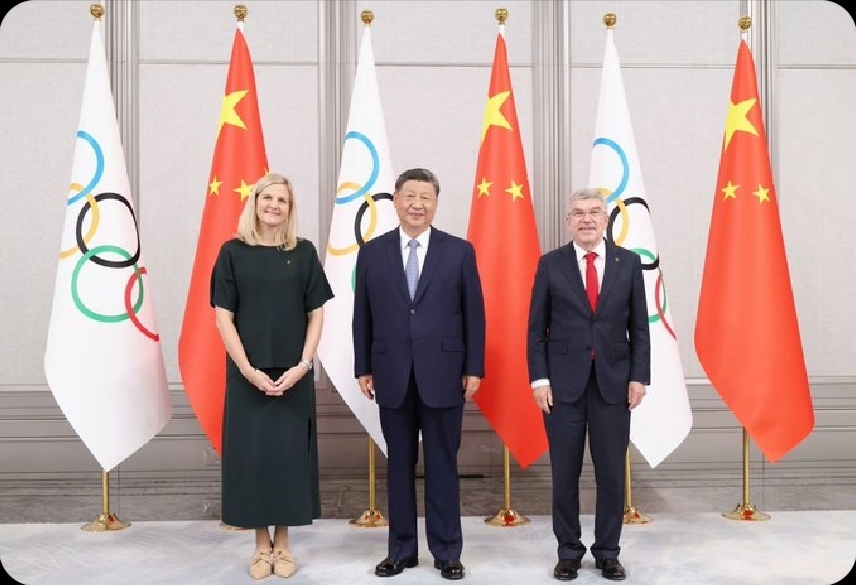
Le dimanche 9 novembre 2025, alors que Canton (Guangzhou) s’illuminait de lumières, d’acclamations et d’histoire pour l’ouverture des 15ᵉ Jeux nationaux de Chine — organisés pour la première fois conjointement par le Guangdong, Hong Kong et Macao — le président Xi Jinping a rencontré Kirsty Coventry, présidente du CIO, et Thomas Bach, président honoraire à vie.

La rencontre, mise en avant par @XisMoments, n’était pas seulement un geste de continuité olympique, mais aussi un symbole d’unité culturelle et d’harmonie intérieure que la Chine souhaite relier à l’esprit universel des Jeux.

Les Jeux olympiques d’hiver de Pékin 2022 se sont clos le 20 février 2022 ; deux jours plus tard, la Russie envahissait l’Ukraine.
Ce qui devait être un triomphe d’harmonie devint une blessure silencieuse pour le prestige moral de la Chine.
Xi Jinping n’a pas gâché la cérémonie de clôture — il a attendu.
Mais « l’amitié sans limites » proclamée avec Moscou venait déjà d’être rompue, non par la diplomatie, mais par un missile au-dessus de Kyiv.

Alors que le monde se tourne vers Milan–Cortina 2026 et se prépare à Los Angeles 2028, la séquence olympique retrouve son rôle : celui du calendrier des civilisations, la mesure de la conscience mondiale.
La flamme passe désormais à l’Ouest, où Los Angeles 2028 pourrait, peut-être, devenir les Jeux du Rééquilibre : le retour du récit sur le chaos, du sens sur la domination.

En parallèle, Donald Trump agit sur un autre front — mais dans la même logique de transition.
Sa décision de suspendre la livraison des Tomahawk à l’Ukraine, loin d’une hésitation, vise à reconfigurer la logique des sanctions et à reprendre la maîtrise stratégique du récit.

De même, sa volonté déclarée de reprendre le conflit israélo-palestinien à travers les Accords d’Abraham signale un glissement : de la confrontation militaire vers la résolution narrative, du pilotage de la guerre à la maîtrise de la paix.

Ces deux gestes — celui de Xi à Canton, celui de Trump à Washington — se rejoignent sur le pont symbolique qui relie, d’une part, Pékin 2022 à Milan–Cortina 2026, et, d’autre part, Paris 2024 à Los Angeles 2028.

Le sport change la donne.

Il rend au monde la mesure de sa civilisation, rappelant que la force ne sert plus à détruire, mais à garantir la paix et à restaurer le sens.

> j’ai dit cela. Chaque être choisit, par sa propre voix liée à son libre-arbitre, la réalité à laquelle il souhaite donner corps. Ainsi, les monstres s’effacent.

#XiJinping #15thNationalGames #Trump #Olympics #SoftPower #Paris2024 #MilanCortina2026 #LosAngeles2028 #CredimusInOptimumHumanis

🕊️ From Beijing 2022 to Milan–Cortina 2026: The Olympic Agenda and the Return of Strategic Meaning

On Sunday, November 9, 2025, as lights, cheers and history illuminated Guangzhou for the opening of China’s 15th National Games — the first ever to be jointly hosted across Guangdong, Hong Kong and Macao — President Xi Jinping met with IOC President Kirsty Coventry and Honorary President for Life Thomas Bach.

The meeting, highlighted by @XisMoments, was not only a gesture of Olympic continuity but also a symbol of China’s expanding cultural unity and its aspiration to connect domestic harmony with the universal spirit of the Games.

The Beijing 2022 Winter Games had closed on February 20, 2022; two days later, Russia invaded Ukraine.
What should have been a triumph of harmony became a silent wound to Beijing’s moral prestige.
Xi Jinping did not spoil the closing ceremony — he waited.
But the “friendship without limits” declared with Moscow had already been shattered, not by diplomacy, but by a missile over Kyiv.

As the world prepares for Milan–Cortina 2026 and looks toward Los Angeles 2028, the Olympic sequence resumes its role as the calendar of civilization — a chronometer of global conscience.
The torch now passes westward, where Los Angeles 2028 may become the Games of Rebalancing: a return to narrative over chaos, meaning over domination.

In parallel, Donald Trump acts on a different front — but within the same logic of transition.
His decision to pause the delivery of Tomahawks to Ukraine, far from hesitation, aims to reshape the logic of sanctions and reclaim strategic authorship.

Likewise, his declared intent to re-engage the Israeli-Palestinian conflict through the Abraham Accords signals a shift from military confrontation to narrative resolution — from managing war to mastering peace.

The two gestures — Xi’s at Guangzhou, Trump’s in Washington — converge across the symbolic bridge between, in one part, Beijing 2022 and Milan–Cortina 2026, and, in another, Paris 2024 and Los Angeles 2028.

Sport is a game changer.

It restores the measure of civilization, reminding us that force no longer destroys — it safeguards peace, and restores meaning.

>This is what I have said, from now on:
Every single person, through his own voice, chooses the reality they wish to bring into being.
Thus, monsters disappear.

#XiJinping #15thNationalGames #Trump #Olympics #SoftPower #Paris2024 #MilanCortina2026  #LosAngeles2028 #CredimusInOptimumHumanis

🕯️ La silhouette rhétorique russo-israélienne dans la réactivation soudaine du “choc des civilisations” (VII)

Les récentes déclarations de Donald Trump sur le Nigeria sont sans ambiguïté : “If the Nigerian government continues to allow the killing of Christians, the U.S.A. will immediately stop all aid and assistance to Nigeria, and may very well go into that now-disgraced country, ‘guns-a-blazing’. (AP News, novembre 2025). Une force politique tente de cadrer le potentiel sans limites de ressentiment interconfessionnel, disponible en Afrique et au Moyen-Orient, dans la confrontation religieuse et la dialectique du clash des civilisations. Ce contexte invite Donald Trump sur la cause des Chrétiens au Nigéria ou pris dans l’engrenage de chaos soudanais. Au milieu de cet enfer, l’élection – le 4 Novembre dernier – de Zohran Mandani comme maire de New-York, est attaquée au vitriol, à l’échelle globale. Elle dresse une figure paratonnerre.

Sous couvert de défense des chrétiens, l’ancien président américain adresse un ultimatum diplomatique et moral à un État souverain.
Porté par son électorat évangélique et par l’imaginaire messianique de son propre parcours, il se présente en protecteur de la foi et en justicier des âmes.
Mais derrière cette posture que le sort des chrétiens, qui forment une population parmi toutes les autres à être sacrifiées, c’est un piège tendu : une injonction politique qui attise la confrontation religieuse mondiale et réactive la logique du clash des civilisations.
Dans ce piège se croisent aujourd’hui plusieurs forces: la droite chrétienne américaine, la connexion judéo-chrétienne téléguidée par Netanyahu, l’appareil narratif russe primaire, et la fragilité cognitive d’un monde désemparé par la prolifération des signes et injonctions.

1. La réactivation du récit civilisationnel

Sur X, la phrase du cardinal Robert Sarah« Les barbares sont déjà dans la ville » — a ressurgi, relayée par @75secondes, @Wolf, etc, au moment même où Trump annonçait vouloir “sauver les chrétiens du monde”.
En surface : deux appels à la vigilance spirituelle.
En profondeur : une même trame cognitive — celle d’un Occident assiégé, d’un christianisme encerclé par la barbarie.

Les violences africaines (Nigeria, Soudan, Sahel) deviennent les scènes symboliques d’une guerre sainte mondialisée ; la complexité politique, ethnique et économique s’efface derrière le vocabulaire de la croisade.
La foi n’explique plus : elle désigne.

Un million de vues pour cette seule publication.
  • Elle vient d’un entretien de 2019 accordé à La Nef / The Catholic Herald, où le cardinal Robert Sarah disait : « As a bishop, it is my duty to warn the West! The barbarians are already inside the city. ». CERC+1
  • Dans ce texte, il précise ce qu’il appelle les barbares : « tous ceux qui haïssent la nature humaine, qui piétinent le sens du sacré, ne respectent pas la vie, se rebellent contre Dieu… » – en visant l’avortement, l’euthanasie, la pornographie, l’idéologie de genre, etc.
  • Plus loin dans le même entretien, il parle aussi de l’islamisme comme d’une menace, mais dans un passage distinct, et en l’articulant à la crise spirituelle de l’Occident.

Ce qui circule aujourd’hui, c’est donc une citation sortie de son contexte et recyclée :

  • On retrouve exactement la même formule sur Facebook, Instagram, Threads, X, souvent sur fond de photo ou de mème, sans le paragraphe explicatif qui élargit sa définition des “barbares”. Instagram+3Facebook+3Instagram+3
  • @75secondes ne fait qu’amplifier une phrase devenue slogan dans certains milieux conservateurs catholiques / identitaires, en la reliant au cardinal et à la question de l’immigration de masse. Instagram+1

Sur le sous-entendu “on entendait l’islam…”

  • Dans le texte original, Sarah ne dit pas “les musulmans sont les barbares”. Il parle d’une barbarie morale occidentale et de l’islamisme comme menace politico-religieuse ; mais ce sont surtout les relais militants qui condensent tout ça en une punchline utilisable contre “l’islam” en bloc.

2. La résonance russe : miroir du messianisme évangélique

Depuis 2014, le Kremlin, appuyé par le patriarche Kirill, promeut la Russkiy Mir — le “monde russe” — présenté comme dernier bastion du christianisme face à la décadence occidentale et à la menace islamiste.
La rhétorique de Trump s’y superpose comme un calque.

ThèmeRhétorique russeRhétorique trumpiste
MissionMoscou protectrice de la foi orthodoxeWashington sauveur des chrétiens persécutés
Ennemi symboliqueOccident libéral et “dénaturé”Islam radical et “barbarie” du Sud
RegistreMétaphysique du salutThéologie de la puissance
FinalitéLégitimer la verticalité russeRe-sacraliser la suprématie américaine

Ces deux narrations s’auto-alimentent : l’une cherche à fracturer l’Occident, l’autre à le rallier sous l’étendard du sacré.
L’effet est identique : un monde polarisé autour des fractures, rendues abyssales et irrémédiables, du religieux décliné sous la forme de mouvements de fractales dans un monde où les chimères sont faites pour régner en maîtres

3. L’ingénierie cognitive de la croisade

Ce champ narratif repose sur une architecture précise :

  • Amplifier sélectivement les massacres chrétiens en Afrique ;
  • Détourner la compassion en colère ;
  • Recycler les mots prophétiques (“barbares”, “mal”, “sacré”) ;
  • Fusionner les discours politiques, spirituels et militaires.

C’est une véritable machinerie cognitive, qui transforme la douleur en énergie politique.
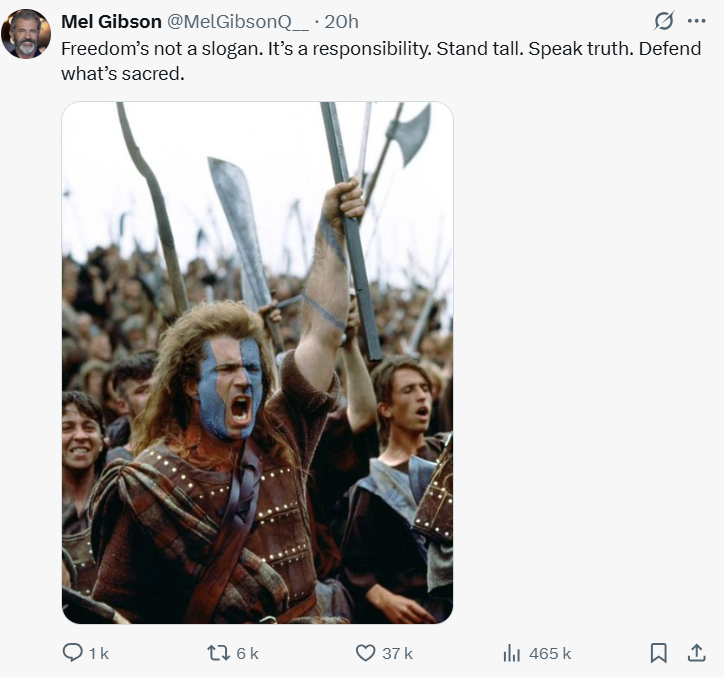
Trump y trouve un levier électoral, Mel Gibson y ajoute une aura mythique (“Defend what’s sacred”), et Moscou y glisse sa grammaire civilisationnelle : la guerre du bien contre le chaos.

En mêlant mystique et brutalité, Mel Gibson construit un imaginaire où le salut passe par la violence — un miroir parfait du temps présent, où l’on confond de plus en plus la sainteté avec la revanche.

4.L’effet Mamdani : le paratonnerre du récit

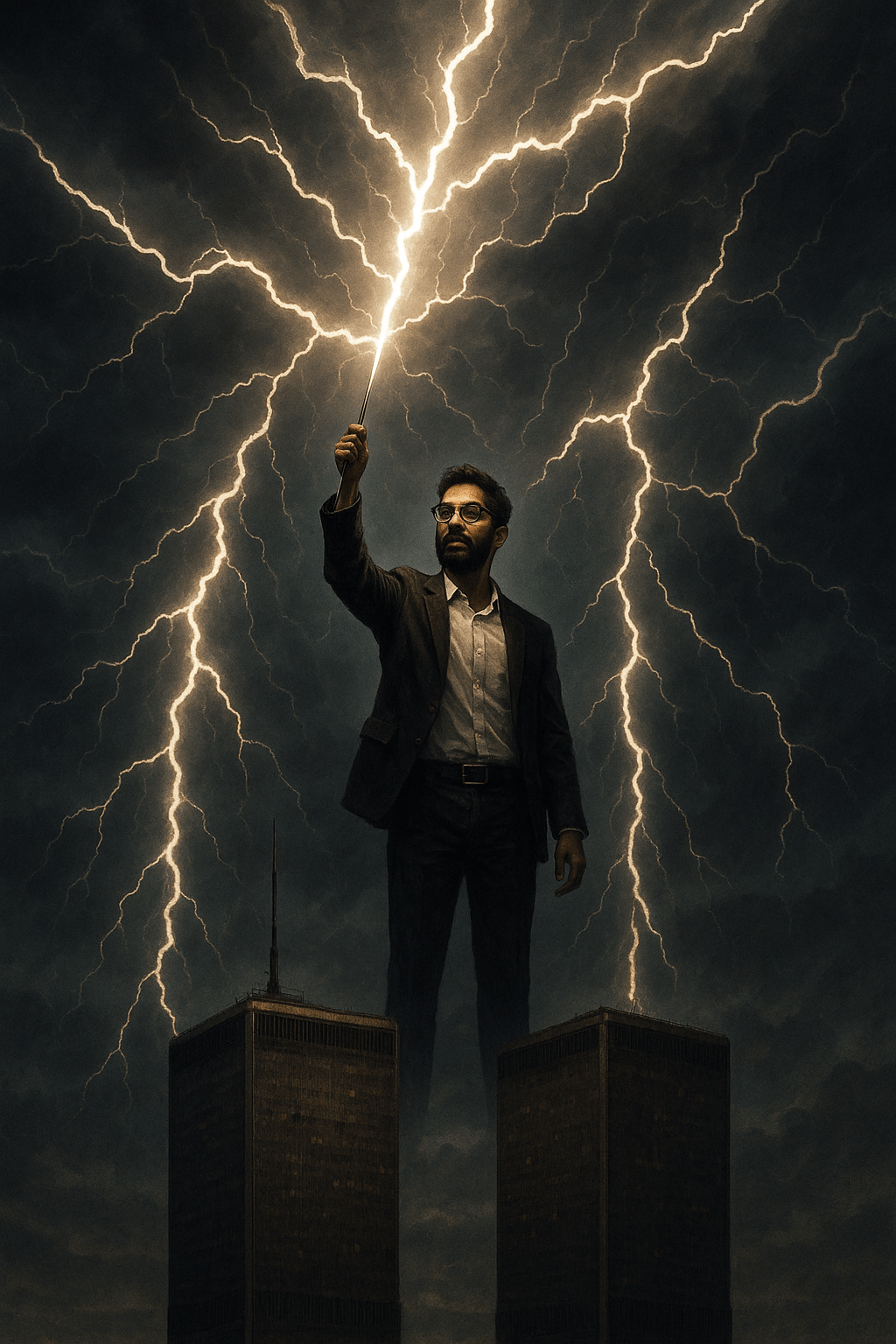
Au cœur de cette tempête, l’élection à New York de Zohran Mamdani, premier maire musulman d’origine ougandaise, agit comme un paratonnerre cognitif.
Plus qu’une dissonance, c’est une zone d’absorption du choc symbolique.
Son élection résonne avec la promesse d’un pluralisme pacifié — mais, dans les flux polarisés, elle devient la cible parfaite :

  • pour certains, preuve que l’Occident et dispose des outils cognitifs pour résister à l’onde de haine qui déferle partout et, ainsi, reste ouvert, aspace d’équilibre et de résolution au service de la Paix ;
  • pour d’autres, c’est le signe que “l’ennemi est déjà dans la place”.
Comme Benjamin Franklin saisissant la foudre, Zohran Mamdani dresse le paratonnerre sur la plus orageuse des ères. Les haines se concentrent sur sa personne symbolique.

La dissonance que Zohran Mamdani incarne révèle l’intensité du champ magnétique : plus la société réelle s’apaise, plus la sphère numérique s’enflamme et déverse anathèmes préfabriqués et excommunications politiques.
@ZohranMamdani devient malgré lui le test de résistance du vivre-ensemble face à la montée des récits guerriers. Il s’est installé, à partir de Ground Zero, sur le seuil d’un monde attiré irrésistiblement vers les profondeurs insondables de son propre enfer, et ouvre un autre chemin vers le possible retour à soi.

5. Le piège du sacré politique

Sous des apparences de ferveur, c’est une architecture de domination symbolique qui se met en place.
Le sacré devient vecteur d’influence, la foi devient vecteur d’ordre, et la liberté spirituelle devient l’appât d’une guerre cognitive mondiale.
Le piège de Trump n’est donc pas seulement diplomatique : il est psychologique.
Il invite l’humanité à choisir un camp dans un conflit que la raison n’a pas décidé.

Et dans cette bataille des signes, ce ne sont plus les croyants qui prient — ce sont les algorithmes qui recrutent.

⚔️ Taking the War Out of the Cognitive Field

⚔️ Beyond Clausewitz: Rethinking Security in a Post-Conventional Era — the deeper challenge underlying tomorrow’s Peace Talks in Budapest.

If the war launched by Vladimir Putin’s Russia against Ukraine were purely territorial, it could be settled through conventional means — an exchange of land, a ceasefire, or a neutral status guaranteed by treaties.

But this conflict has carried us a thousand light-years away from Clausewitz.
The Prussian strategist described war as “the continuation of politics by other means.”
Yet Russia has transformed it into something else entirely: the continuation of politics through the confusion of means.

The battlefield is no longer the Donbas — it is the human mind itself.
This war has migrated into the cognitive field: into narratives, perceptions, emotional manipulation, and the corrosion of collective discernment.

It now unfolds across the entire planet — through social networks, media ecosystems, political discourse, economic leverage, and even cultural production.
It seeks not conquest, but disorientation; not victory, but the erosion of trust and coherence within democracies.

Hence, traditional security guarantees are no longer sufficient.
They must evolve beyond the military domain to encompass:

  • Cognitive protection of societies;
  • Information-space integrity, against manipulative and hybrid operations;
  • Psychological resilience within democracies;
  • Institutional trust as a strategic asset.

Conventional war destroys bridges.
Cognitive war destroys the bridges between minds.

Taking the war out of the cognitive field means restoring the primacy of truth, reason, and politics over narrative manipulation.
It also means redefining security itself as a global public good
for peace today is no longer merely the absence of war,
but the restoration of confidence in reality.

If the Budapest summit simply negotiates a territorial truce or freezes lines, we risk returning to a pre-Clausewitzian mindset. But if it boldly embraces this post-conventional dimension—saying: “We will rebuild the bridges between minds, not just the lines on maps”—it can mark a turning point in how the free world conceptualises war, peace and security.

President Vladimir Putin has already made clear — publicly and repeatedly — that Russia regards information operations as a legitimate and enduring instrument of statecraft. He used his address at the RT 20th-anniversary gala at the Bolshoi Theatre to praise RT’s role in challenging “monopolies” of narrative and to defend the idea of a louder Russian voice in the information space. Special Kremlin
That posture was reinforced in his Valdai Forum remarks, where he framed Western media and political moves as part of a wider confrontation and signalled Moscow’s intent to respond forcefully across political and informational domains. The Guardian

This is not a tactical quibble: it is existential. If the Budapest talks do not treat information warfare as a primary security dimension — and if they fail to secure concrete guarantees that the information domain will be demilitarised and neutralised — the conference will at best freeze a map and at worst leave the most dangerous front unconstrained. Therefore, it is vital, in terms of collective and even universal security, to crush this dimension in the egg: to make any peace settlement contingent on verifiable, enforceable mechanisms that eliminate state-led informational aggression and restore shared factual ground as the precondition for lasting peace.

Cognitive Shockwaves at the Knesset

Donald J. Trump’s address before the Knesset was presented as “historic.” . Yet it served less the cause of history than the narration of a silent shift: the moment when America, beneath misplaced applause, signaled to Israel that the era of the Greater Israel is over. A moment of apparent exaltation that was, in truth, a distancing — a masterclass in realpolitik cloaked in biblical fervor.

The Israeli government — Amir Ohana, Speaker of the Knesset, alongside Prime Minister Benjamin Netanyahu and President Isaac Herzog — did more than roll out the red carpet for the President of the United States.
Through a concert of praises and standing ovations, some even assuring him that “Israel would remember him in two thousand years,” they sought to place Donald Trump in a position of obligation, flattering him into submission, turning the very sanctuary of Israeli democracy into a stage for ritualized sycophancy.

The only one who seemed to hold himself apart from this unhealthy choreography was Yair Lapid, head of the main opposition party and chairman of the Permanent Forum, to whom Trump extended an unusually warm and sincere greeting.

While every newsroom hailed a “historic day” for Israel, none bothered to translate the speech of the man embodying Israel’s democratic awakening — the same Lapid whom Trump honored on Truth Social and via the White House account, twice posting images of the mass peace rallies organized by the opposition.

The long introductory tributes from Netanyahu’s majority validated, with almost theatrical excess, an old adage:

“If an event is forced upon you, pretend to have inspired it, guard it jealously, and become its memory for centuries to come.”

Yet body language betrayed the unease. Both Trump and Herzog looked stiff, uncomfortable.
And “Bibi,” as Trump kept calling him by his nickname rather than his state title, behaved like a game-show host, warming up the crowd with forced exuberance fit for prime-time television.

The question hung in the air: how would Trump escape this suffocating trap?
Especially after, upon taking the podium, he was told twice — “Here, the teleprompter is working” — a barely veiled jab at the United Nations, where, according to him, 142 sovereign nations had bent to Hamas’s will by paving the way for the recognition of a Palestinian state.


The Cognitive Riposte

How do you outplay a suspect excess of flattery?
By being even more flattering than the flatterer — and Donald Trump is a virtuoso of that art. His opening was greeted by rapturous applause. Netanyahu thought the script intact: Iran as eternal enemy, war as destiny, and U.S. alignment as a given.
But gradually, Trump dismantled the narrative. The verbs changed tense, the story shifted from the present of threat to the past of victory, and then ascended to the biblical time of Abraham — the time of promises and covenants.

“Abraham… I love saying that name. Abraham.”

By invoking this founding figure, Trump moved the stage itself. Israel was no longer the perpetual besieged citadel but the cornerstone of a new era, called to move from the age of terror to the age of peace.
Then came the key passage:

“I want to thank the Arab and Muslim nations for their commitment, because they’ve made — to support a safe rebuilding of Gaza and beyond. I have many Arab countries, very wealthy countries, that came up and said we’ll put up tremendous amounts of money to get Gaza rebuilt. … They want dignity… and they want to see it be good for Israel too.”

Israel cannot turn its back on the future.
Under the guise of gratitude, Trump drew a red line: peace would come at a price, and Israel would have to take part in its own moral and political reconstruction.


The Sheldon Moment

Then came the apocalyptic moment, around the fifty-fifth minute.
Trump called upon Miriam Adelson (née Sheldon), the American-Israeli billionaire and historic GOP donor, to stand.
He quipped, half-joking, that she had “sixty billion in the bank” and that, under her influence and that of her late husband Sheldon, he had recognized Israel’s sovereignty over the Golan Heights.

But after the homage came the sting:

“She loves this country. She and her husband are so incredible. We miss him dearly. But I actually asked her once — Miriam, I know you love Israel, but what do you love more — the United States or Israel? She refused to answer. That might mean it’s real.”

A chill swept through the Knesset.
Trump had just exposed, in the brightest light, the unspoken question: where does loyalty end?

The coup de grâce came after nearly an hour of speech.
Turning toward President Herzog, Trump said, half-smiling:

“Hey, I have an idea. Mr. President, why don’t you give him a pardon? Cigars and some champagne — who the hell cares?”

The room froze.
Trump had just called, before all of Israel, for Netanyahu’s pardon.
It was no endorsement — it was a symbolic burial.
A forced laugh, a nervous grin, and then:

“Ah, that wasn’t in my speech. Enough controversy for the day.”

The message had landed.
Netanyahu’s trial was over.
The post-Netanyahu era had been sealed — under applause from those who mistook a dismissal for a coronation.

Among the few genuine smiles, that of Yair Lapid.
Netanyahu, meanwhile, was buried alive, carrying with him the anachronistic dream of a “Greater Israel.”
Trump, in a single gesture, inverted the symbolic weight of the moment. War became past; peace — tied to the reconstruction of Gaza and the inclusion of Arab nations — became horizon.

“It’s time to rebuild Gaza. … They want dignity.”

Yet through that regained dignity, Trump was also asking Israel itself — while avoiding any mention of the financial dimension entrusted, for now, solely to the Board of Peace and its billionaire patrons — to contribute morally and politically to the building of a new order.
All of it without seeming to say it, nor even to have said it — which is, undeniably, a great art of the deal.

That is what I saw and heard.
And I have not seen a single media outlet acknowledge these cognitive shockwaves, though they were so clearly delivered.

The Low-Noise Strategic Signal: China, Russia, and the Mechanics of Doubt

At first glance, it seemed like an ordinary coincidence — Russian strikes occurring as several Chinese satellites crossed the Ukrainian sky.
But beneath the surface, the episode reveals a deeper play: a low-frequency signal in the cognitive spectrum, capable of undermining China’s credibility, fraying the Global Governance Initiative, and closing Europe’s Silk Road curtain — all without a single shot fired.

1. Genesis of the Signal

On October 5, 2025, Ukrainian intelligence sources reported that Russian missile strikes coincided with the passage of Chinese reconnaissance satellites (Yaogan series) over western Ukraine.
Moscow denies any coordination; Beijing denies any involvement.
Yet the simultaneity of those denials — one negative (“we need no help”), the other polite (“we are not involved”) — creates a vacuum where suspicion breathes.
What may be orbital coincidence is read as deliberate synchrony.

2. The Strategy of the Whisper

This operation’s power lies not in public virality but in targeted diffusion — across intelligence briefs, strategic think tanks, and defense analysis circles.
It spreads quietly, yet precisely, like a fine mist of plausibility.

It doesn’t need to convince the masses; it only needs to introduce uncertainty among decision-makers.
The moment the question — “What if China is not as neutral as it claims?” — enters the analytical calculus, the signal has succeeded.
Doubt becomes doctrine.

3. China’s Posture: Letting the Weaver Weave

China does not allow the possibility of collusion; it explicitly denies it.
Yet it lets the weaver weave — refusing to contest the narrative that others are spinning.
This abstention is a form of mastery: letting the rumor exhaust itself, allowing the dust to settle on others’ clothes.

Where the Kremlin’s verbosity amplifies the noise, Beijing’s silence projects composure.
One blurs; the other absorbs. Together, they sustain an ambiguous duality that keeps everyone guessing.

4. Europe’s Curtain: The Silk Road in the Shadows

While this cognitive theater unfolds, another curtain descends: the European protectionist reaction to the flood of Chinese goods — Temu, Shein, and other ultra-competitive platforms.
Under the banner of “economic sovereignty,” European policymakers are raising barriers, effectively dimming the lights on the Silk Road’s Western stage.

By letting suspicion grow, Moscow cuts China’s trade routes not through sanctions but through European mistrust.
In a paradoxical twist, Russia’s manipulation of ambiguity hurts Beijing’s long-term leverage — turning its partner into collateral damage in the information war.

5. The Blow to the GGI

The Global Governance Initiative (GGI), Beijing’s vision of a balanced multipolar order, stands weakened.
Its moral architecture — founded on predictability, neutrality, and trust — erodes under the perception of duplicity.
China’s “positive denial” and Russia’s narrative opportunism dissolve the distinction between prudence and complicity.
The GGI, once a promise, now mirrors the instability it sought to transcend.

6. Conclusion

•A spatial coincidence.
•A strategic whisper.
•An economic curtain.

Three threads — enough to weave a web of doubt.
In today’s cognitive warfare, truth is not denied; it is diluted.
And China, whether willing or not, now stands behind the curtain others have drawn across its Silk Road.

La dialectique de l’allié providentiel : des couleuvres au fait accompli de la polarisation

Alexander Douguine, souvent présenté comme l’idéologue du Kremlin, affirme sans détour : « La guerre est devant nous ».
Dans sa lecture stratégique, la Russie disposerait d’un avantage comparatif sur la Chine : son arsenal nucléaire, l’étendue de son territoire, son identité historique, et surtout sa capacité à « conceptualiser les processus mondiaux ».

À l’en croire, l’affrontement global serait inévitable, entraînant Chine, Inde, Moyen-Orient, Afrique et Amérique latine dans une polarisation brutale entre unipolarité et multipolarité.

Mais ce raisonnement repose sur un postulat fragile : que les fils de Sun Tzu sont enfumés et suivront docilement Moscou dans une telle confrontation. Or rien n’est moins sûr. La Chine avance selon ses propres logiques, avec un horizon stratégique bien différent, où la puissance économique, la stabilité sociale et la continuité historique pèsent infiniment plus que l’aventure guerrière.

Le point le plus frappant, cependant, réside ailleurs : dans le parallélisme saisissant entre la Russie et Israël.
Chacune de ces puissances croit s’appuyer sur un tuteur providentiel : Moscou sur Pékin, Jérusalem sur Washington. Chacune surestime la fidélité de ce protecteur, et toutes deux se bercent de la même illusion : croire que leur survie passe par la capacité à faire avaler des couleuvres à ceux qu’elles pensent être leurs indéfectibles alliés stratégiques, encore et encore, comme si la résilience se confondait avec la soumission.

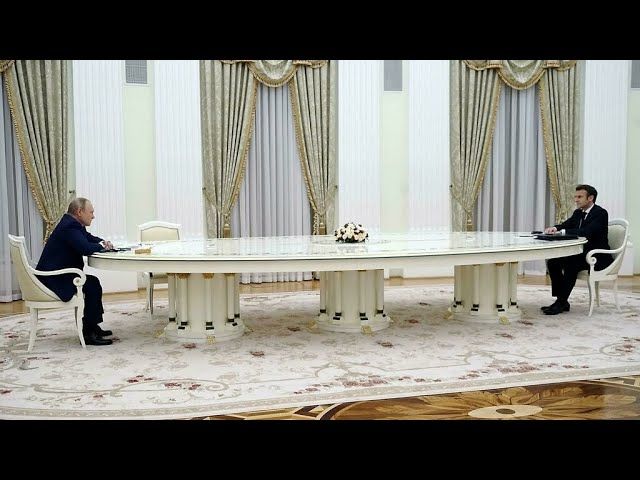
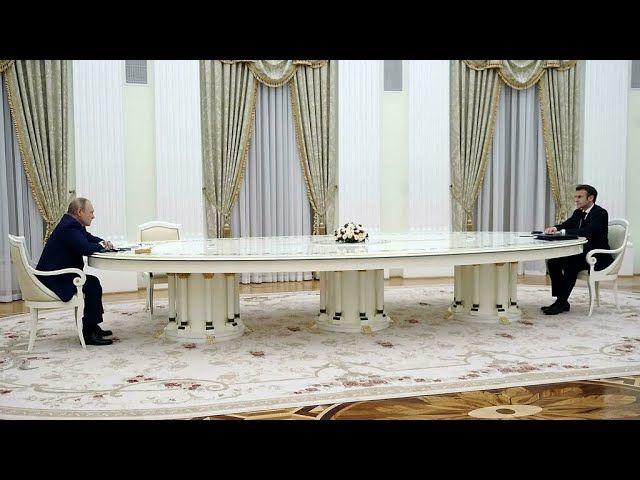
La Russie fait comme si la proposition du GGI de Xi Jinping n’existait pas sur la grande table. Mais Moscou n’a jamais vraiment su ce qu’est une grande table, en dépit de celle aux dimensions paranoïaques censée en imposer aux visiteurs du Kremlin.
Quant aux Israéliens, ils découvrent avec stupéfaction que Donald Trump a signé un accord avec le Qatar, aux termes duquel toute attaque contre Doha serait considérée comme une attaque contre les États-Unis eux-mêmes.

La taille ne compte pas, doit apprendre Poutine à ses dépens.

Et voilà l’ironie ultime : la « grande table » de Xi est pensée pour asseoir le monde entier, tandis que la table surdimensionnée du Kremlin n’accueille que la paranoïa de Poutine.

The Dialectics of the Providential Ally: From Bitter Pills to Extreme Polarization

Russia with China, Israel with the US — two nations convinced that survival means making their allies swallow bitter pills, until dialectics lead them to the fait accompli of polarization.

Alexander Dugin, often described as the Kremlin’s ideologue, declares: “War is ahead of us.”
In his worldview, Russia holds a comparative advantage over China: its nuclear arsenal, vast territory, historical identity, and above all, its capacity to “conceptualize world processes”.

For him, a global confrontation is inevitable — one that will engulf China, India, the Middle East, Africa, and Latin America in a brutal polarization between unipolarity and multipolarity.

But this reasoning rests on a fragile assumption: that Beijing will obediently follow Moscow into such a confrontation. Nothing could be less certain. China moves according to its own strategic logics, where economy, social stability, and historical continuity weigh far more heavily than any adventurous war.

The most striking point, however, lies elsewhere: in the parallel between Russia and Israel.
Each believes it relies on a providential tutor — Moscow on Beijing, Jerusalem on Washington. Each overestimates the loyalty of this protector, and both indulge in the same illusion: believing that their survival depends on their ability to make their supposed steadfast allies swallow bitter pills, again and again, as if resilience were synonymous with submission.

Physical size doesn’t matter. Putin must learn this. Grand table is not that one.

Russia behaves as if Xi Jinping’s GGI proposal were not on the “grand table”. Yet Moscow has never truly known what a great table is, despite the paranoid dimensions of the Kremlin’s own piece of furniture meant to intimidate visiting leaders.
Meanwhile, the Israelis are waking up in shock: Donald Trump signed an agreement with Qatar under which any attack on Qatar would be treated as an attack on the United States.