

What may seem a marginal issue in Israeli politics — the exemption from military service for ultra-Orthodox Jews — is in fact the nerve of Israel’s “existential” war.
It doubles the legitimate right of self-defense with an unresolved internal conflict, buried in silence — that of a nation divided between duty and devotion, between the State and faith.
For a nation cannot remain free if some claim purity while others sacrifice and stain their hands.
The Founding Compromise
At the creation of the State, David Ben-Gurion granted the Haredim (ultra-Orthodox) an exemption from military service, seeking a fragile balance between faith and politics.
They were then only a few hundred yeshiva students; preserving prayer seemed compatible with building the nation.
But what began as a foundational exception has become a systemic privilege.
Today, tens of thousands of men of service age evade the national obligation while receiving public subsidies and wielding major political influence.
They refuse civic struggle yet dictate morality, preach purity while living off the defense ensured by others.
This asymmetry is no longer merely social — it is metaphysical.
It has turned Israeli democracy into a crevasse in the sky — where the horizon of civic virtue and intention escapes justice, and where faith becomes a refuge from duty.
The Shock of October 7, 2023
October 7 was a moral earthquake — a holocaust in the original sense of the word.
At the Nova Festival, pacifists and artists had gathered to celebrate life, not war; unarmed, trusting in peace, they were delivered to fire and slaughter.
Their destruction was not only a crime but a burnt offering, a generation immolated on the altar of others’ illusions.
Soldiers too, caught unprepared, shared that fate — victims of a faith that had replaced responsibility, and of leaders who had mistaken belief for foresight.
That day consumed not only bodies.
It burned the very idea of Israel as a refuge of conscience.
In the desert, beneath smoke and music turned to screams,
the faith of a nation met the judgment of its own negligence.
As long as this anomaly persists, Hamas’s rhetoric will remain structurally legitimized.
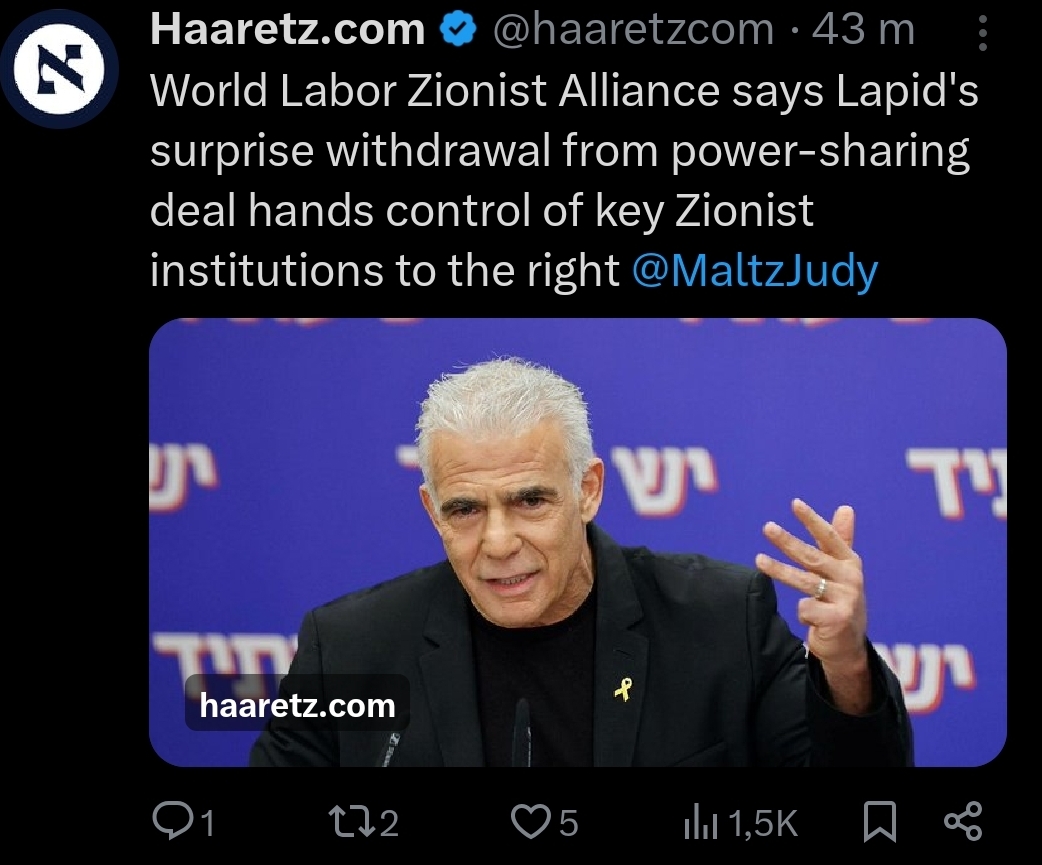
It is against this drift that Yair Lapid stands, confronting — in the name of the Permanent Forum — the gaping ambiguities of the system on which Benjamin Netanyahu relies, and within which the IDF and the entire security apparatus embody an ambivalence so unbearable that it has produced a deep moral trauma among soldiers and within the command itself.
This institutional irregularity is no less inadequate to Israel than Hamas is to the definition of Palestinian sovereignty.
Though opposed, both stem from the same corruption of responsibility:
one distorts it, the other destroys it.
They must be dismantled — the first — and abolished — the second — in a single movement back toward justice.
As long as this anomaly persists, as long as Israel tolerates within itself a caste exempt from civic duty in the name of divine privilege, Hamas’s rhetoric will remain structurally legitimized.
It feeds on that very contradiction:
a mirror enemy, born of the same refusal to assume shared responsibility.
The Meaning of the Struggle
Yair Lapid’s struggle is not religious; it is civic.
He seeks to restore equality in sacrifice and shared responsibility.
He rejects the notion that a sanctified minority can rise above common law
and turn war into a metaphysical affair.
To bring Israel back from Gideon to David, from sacred vengeance to human justice —
that is the very condition of democratic renewal.
October 7 revealed where religious messianism without responsibility leads.
Yair Lapid offers the opposite path:
responsibility as the arbiter of legitimate faith within the City.
Savonarola has no place in the City.


 En attendant la Renaissance