Le National Security Strategy publié en novembre 2025 établit précisément une feuille de route. Ce n’est pas une doctrine, ce sont des ordres de mission.
L‘hypothèse que j’ai eu l’honneur de développer pour expliquer, aux antipodes du narratif livré par les protagonistes, la guerre engagée par les USA et Israël s’inscrit un processus de domination énergétique.
Pour en résumer les conclusions auxquelles j’aboutis, ma thèse, publiée sous le titre « Make America Little Again » développe l’idée qu’une partie de la stratégie américaine contemporaine ne viserait plus à maintenir un ordre mondial ouvert, mais à recentrer la puissance des États-Unis sur une forme d’autarcie énergétique et géopolitique dont, d’une part, la guerre engagée contre l’Iran constitue l’axe de redistribution et, autre part, la prise de contrôle de ressources stratégiques (Venezuela, Essequibo, Panama, Groenland), l’exutoire régulier pour convertir les désordres créés au Moyen-Orient en flux de liquidités.
L’objectif consiste à la fois à sécuriser l’approvisionnement intérieur américain, au prix d’un déséquilibre global. Il fait dépendre l’Europe et l’Asie de ressources et potentiels localisés en Amérique, et, s’agissant du rôle dévolu à Israël, en Méditerranée Orientale et au Moyen-Orient.
Le cœur de la manœuvre m’apparait ne pouvoir être que celle-là, même si elle se présente sous les atours de défense des valeurs démocratiques et avec des arguments consistant à exagérer la menace nucléaire iranienne pour en faire l’enjeu du conflit.
L’hypothèse que je retiens présente de surcroît l’avantage d’être conforme à la Stratégie de Sécurité Nationale, telle que publiée en novembre 2025, par la Maison Blanche.
La nouvelle doctrine américaine s’y détache du magistère moral et de phare de la liberté. Le continent américain redevient la priorité stratégique centrale (« Trump Corollary » à la doctrine Monroe). Le texte insiste sur le contrôle de l’hémisphère occidental, des routes énergétiques, des frontières, du Panama, du Groenland et de l’influence chinoise dans les Amériques.
Bien plus qu’un instrument intellectuel recalibrant les relations internationales, le NSS 2025 propose une feuille de route rendant très polyvalente la notion de sécurité stratégique.
Sa mise en application a été très rapide. Le 3 janvier 2026, Maduro est capturé et une équipe gouvernementale favorable aux intérêts américains est installée.
En janvier 2026, Donald Trump relance frontalement l’idée d’un contrôle américain sur le Groenland, refuse d’exclure la contrainte économique ou militaire, menace de tarifs douaniers contre plusieurs alliés européens et rattache explicitement le Groenland à la sécurité nationale américaine.
Le 28 février, en pleine phase de négociations, Israël et les USA attaquent l’Iran et décapitent les dignitaires et un nombre élevé de hauts responsables croyant précipiter la chute du régime.
Il a été dit que Trump ne s’attendait pas à un blocus du détroit d’Ormuz au moment où il a décidé de déclencher le conflit.
Qui peut accorder crédit à cette hypothèse ?
Par ailleurs, à défaut de disposer d’une doctrine israélienne, elle se déduit du concept de « Régional Capstone Alliés » que pose le nouveau document stratégique américain. Désormais Israël doit agir comme un Régulateur Régional Autonome.
C’est dans ce cadre que la guerre contre l’Iran s’inscrit. Israël s’établit comme la force de torsion qui empêche la pénétration adverse dans le « corridor énergétique » vital.
Israël ne veut plus être une petite grande puissance. Cette guerre, et les effets à en recueillir, lui permettrait de revendiquer le statut intégral de grande puissance.
Cela suppose qu’Ormuz et Suez soient voués aux perturbations, promis à des épisodes de crises, pendant que de nouveaux couloirs, de nouveaux réseaux et dispositifs logistiques, des systèmes de production alternatifs suppléent et prennent le relais, abandonnant aux pays du Golfe un rôle subalterne et supplétif.
Dans cette optique, l’intervention au Liban Sud est le bras armé d’une stratégie de clôture territoriale : transformer la frontière en une membrane étanche pour protéger les actifs économiques du bassin levantin et permettre leur croissance.
Le concept de « Regional Capstone Allies » dans la NSS 2025 n’est pas formulé comme une définition doctrinale unique et stabilisée, mais il apparaît comme une architecture géopolitique nouvelle: les États-Unis veulent s’appuyer sur quelques alliés-pivots régionaux capables de porter localement une partie du fardeau stratégique américain.
Dans la mesure où l’Europe est présentée comme un continent affaibli et sur le déclin civilisationnel, et compte tenu des services rendus à Poutine, qui bénit une guerre qui redonne de l’oxygène à son économie, qui tarit le stock d’armes disponibles pour l’Ukraine, et voit le désaveu de l’OTAN sanctionné par un retrait de plusieurs milliers d’hommes, il est souhaitable de se demander à qui sera dévolu le rôle d’allié clé de voute en Europe?
Décrypté par cette grille, le Sommet d’Anchorage du 15 août 2025 n’était pas une simple tentative de paix en Ukraine, mais l’acte de naissance d’un nouvel axe de régulation planétaire: le Condominium Trump-Poutine-Netanyhou.
Voici donc, comment – et avec qui – l’Amérique de Trump s’apprête à nous manger.
Les yeux sont parfois plus gros que le ventre.
Tout donne pourtant à penser que le plan, et plus encore le complot contre la paix mondiale que cela représente au sens même que lui a prêté le procureur Jackson au procès de Nuremberg, ne fonctionne pas comme sur du papier à musique.
Je vois une rébellion des nations poindre et un retour en fanfare des Nations Unies.
Trump, qui voulait achever le multilatéralisme, sera battu, finalement, par une vieille idée américaine. Celle de Roosevelt: les Nations-Unies.
Trump joue au Golf. Mais Trump joue aussi aux Golfes, persique ou du Mexique. Les répercussions sur le détroit d’Ormuz étaient prévisibles. Il n’en ignorait rien. Ils les attendaient et, de « blocage » du « déblocage » aux attaques en pleine négociations, elles sont au centre de sa stratégie. Le coup de théâtre final, isolationniste sur le plan énergétique, surviendra avant les midterms. Le reste, c’est du vent.
Ceux qui pensent que Trump a un comportement stratégique erratique et qu’il est dépassé par les événements devraient prendre en considération ce schéma. Ce qui se profile, et dont il gère les effets de façon redoutable, c’est d’accumuler le mécontentement sur le prix du gallon pour abattre sa carte finale: déconnecter le marché national US du marché global et apparaître, même si c’est un artifice grossier, comme le sauveur d’un désastre dont il laissera les autres nations se « dépatouiller ».
C’est cette stratégie de découplage qui se dessine pour les midterms de novembre 2026. Plutôt que de gérer les États-Unis comme un simple acteur d’un marché mondial fluide, l’administration s’oriente vers une logique de « Forteresse Amériques ». Ce changement de pied repose sur une saisie stratégique de la géographie énergétique de l’hémisphère ouest pour isoler artificiellement le consommateur national de la volatilité mondiale, notamment des tensions dans le détroit d’Ormuz. En transformant l’énergie d’une marchandise globale en un bouclier national, l’objectif est de provoquer un choc psychologique à la pompe au moment précis où les électeurs se dirigent vers les urnes.
Ce plan s’appuie de toute évidence sur une feuille de route géographique précise où le Venezuela, l’Essequibo, Panama et le Groenland servent de piliers à un système en circuit fermé. Dans ce scénario de 2026, le contrôle opérationnel des majors américaines sur les gisements vénézuéliens permet l’extraction massive de brut lourd, parfaitement calibré pour les raffineries de la côte du Golfe. Combiné au brut léger de l’Essequibo, sécurisé sous un protectorat américain de fait, et à la production domestique de schiste, les États-Unis atteignent un mix chimique autosuffisant. Le « verrou de Panama » et la surveillance arctique depuis le Groenland, qui est l’élément du plan sur lequel il s’est cassé les dents, garantissent que ces ressources restent dans un périmètre sécurisé, retirant de fait les molécules américaines du pool d’approvisionnement mondial pour saturer le marché intérieur.
L’industrie pétrolière et parapétrolière américaine s’aligne déjà sur ce nouveau paradigme. Des entreprises comme Exxon, Chevron et Halliburton pivotent leurs chaînes logistiques vers un modèle d’intégration régionale. Sous couvert de sécurité nationale et soutenus par le Defense Production Act, ces géants passent d’une stratégie de « vente au plus offrant mondial » à un mandat de « priorité à l’approvisionnement domestique ». En échange de garanties fédérales et de contrats de reconstruction massifs dans le bassin de l’Orénoque, ils acceptent – du moins temporairement – de déconnecter leurs prix de vente intérieurs du Brent international en pleine envolée. Cela crée un marché à deux vitesses: un marché mondial marqué par la pénurie pour l’Europe et l’Asie, et un marché d’abondance à prix cassé pour l’électeur américain.
Tel est l’art du deal. Il ne subjuguera pas tout le monde, mais pendant que nous demandons à TotalEnergie de se rogner les ailes, les compagnies américaines les déploient, subjuguées par un président qui les comprend, dans des conditions qui devraient indigner le monde.
En ce mois de mai 2026, l’attractivité du « nouveau » Venezuela ne repose pas seulement sur ses réserves géantes, mais sur un système de compensation multidimensionnel que Trump utilise comme un aimant à capitaux.
Pour les Majors américaines (Chevron, ExxonMobil, ConocoPhillips), l’incitation est irrésistible car elle règle des contentieux vieux de vingt ans tout en ouvrant des marges inédites. Le cadre fiscal imposé par le National Energy Dominance Council (le nouveau bras armé de l’énergie à la Maison-Blanche) a fixé des plafonds de redevances (royalties) à 30 %, avec une flexibilité totale selon les projets. C’est une rupture nette avec l’ère Maduro où les prélèvements rendaient l’exploitation non rentable pour les acteurs étrangers.
L’aspect le plus génial — et le plus politique — de cette compensation est le mécanisme de « recouvrement de créances par le forage ». Des entreprises comme ConocoPhillips, qui couraient après des milliards de dollars suite aux expropriations de 2007, se voient offrir la possibilité de se payer directement sur la bête. En gros : « Investissez pour reconstruire l’infrastructure, et chaque baril extrait servira d’abord à rembourser vos dettes historiques avant même que l’État vénézuélien ou américain ne prenne sa part. »
Cette mine d’or permettrait à Trump d’exiger une contrepartie politique de la part de ces compagnies: le découplage des prix. En échange de ces conditions royales au sud, les pétroliers accepteraient de rediriger ce brut lourd vers les raffineries du Golfe du Mexique à un prix préférentiel. Ce flux, combiné à la montée en puissance de l’Essequibo qui atteint désormais presque un million de barils par jour, crée une masse critique de pétrole « sous contrôle » qui n’a plus besoin de passer par les bourses mondiales.
La finalité politique pour novembre 2026 est un événement déflationniste massif. En forçant le prix du gallon à des niveaux planchers, l’administration entend dissiper l’orage du mécontentement qui s’est accumulé sur le coût de la vie. Pour l’électeur de la Rust Belt ou de la Sun Belt, la réalité quotidienne d’une essence bon marché devient une preuve de succès incontestable, éclipsant les vents contraires économiques plus complexes. Ce basculement mercantiliste ne vise pas seulement une victoire électorale ; il signale un retrait permanent de l’ordre énergétique mondial, où les États-Unis ne cherchent plus à stabiliser les marchés mondiaux, mais utilisent leur domination régionale pour créer une île de prospérité exclusive.
La crise du détroit d’Ormuz n’est pas une erreur. Elle est l’élément central d’un calcul perfide.
Non seulement les médias et experts en géopolitique ne voient pas ce qui se passe sous leurs yeux, mais ils ne voient pas davantage celui qui dit ce qui se passe sous leurs yeux et démonte le scénario.
Ce lundi, devant la porte du Bureau ovale, le président des États-Unis reçoit deux sacs de fast-food des mains d’une livreuse, distribue un billet de cent dollars et disserte sur l’exonération fiscale des pourboires. Entre deux sarcasmes sur la précarité et une énième marque de manque de respect envers le Pape et ce qu’il représente, il sature l’espace.
C’est la manœuvre classique du prestidigitateur: focaliser l’attention des médias et de l’opinion sur des traits de personnalité outranciers ou des polémiques de bas étage pour masquer ce qui, pourtant, saute aux yeux.
Car au milieu de ce spectacle, une phrase a été prononcée. Une phrase centrale que peu d’observateurs ont jugé bon de retenir: les États-Unis ont du pétrole et du gaz à revendre. Le marasme économique ne les handicape pas, et ils sont en mesure de doubler leur production actuelle.
Avec quelles ressources? Comment?
Cette simple déclaration déchiffre l’ensemble de la séquence. Trump a dit que l’Amérique est en position de pallier le désordre que causerait une escalade militaire, en permettant aux nations dépendantes du détroit d’Ormuz — désormais sous blocus — de s’approvisionner auprès d’elle.
A-t-il organisé ce pivot?
Israël s’est placé au premier plan pour faire de l’Iran le prétexte, en permettant de surinterpréter, dans l’opinion publique, l’imminence de la menace nucléaire que représente l’enrichissement de l’uranium, pour ensuite en faire le levier de cette opération.
L’oligarchie américaine qui entoure le président, et qui pénètre sans doute toutes les strates de l’État, exploite ce blocus à son profit exclusif.
Ce qui se passe, c’est cela et rien que cela: une manœuvre stratégique visant à imposer l’Amérique comme le maître énergétique mondial et celui qui en contrôle les voies maritimes.
Cette volonté d’hégémonie brutale sur les ressources n’est pas nouvelle, elle est la cohérence même de cette administration. Elle éclaire d’un jour implacable les positions de force prises récemment sur le Venezuela pour en contrôler la destinée pétrolière. Elle explique, tout autant, la tentative assumée – et à laquelle il n’entend pas renoncer — d’annexer le Groenland qui est la porte du passage du Nord-Ouest.
Une offensive inouïe face à laquelle, fait d’une limpidité troublante, Vladimir Poutine n’a pas levé le petit doigt.
Il n’a pas levé le petit doigt. Pour quelle raison? Pour satisfaire quel deal?
Voilà où nous en sommes: sous le vernis de la farce médiatique et de la livraison de repas, un hold-up planétaire est en train de s’accomplir. L’écran de fumée est grotesque, mais le piège, lui, est en train de se refermer sur le monde.
Les médias ont souvent honni les pétro-monarchies. Ils se montrent coupablement complaisants avec la plus grande « pétro-démocratie » qui se veut plus grosse que le bœuf.
La vérité, c’est que l’expression la plus dense des humains ne tient pas dans des phonèmes. Elle réside dans leurs villes, et dans le monde auquel elles s’attachent.
La cité, quelle que soit son importance, est l’expression absolue de tous les autres langages dont nous sommes capables. Les civilisations rayonnent à travers les cités qu’elles édifient pour établir la pacification des mœurs, la prospérité et le développement économique, ainsi que le fleurissement des arts et des sciences.
Tout ce qu’il y a à savoir d’un individu ou d’une collectivité est ramené à la conscience qu’il établit avec la cité, la ville, non pas comme son territoire personnel, mais comme lieu et empreinte universels. Car il pourrait être ici, jouissant du confort et de la sécurité de cette cité, comme il pourrait être ailleurs, dans telle autre.
La cité est l’alphabet du monde, qu’elle forme une vaste métropole grouillante de vies anonymes, ou qu’elle se tienne dans une position plus modeste. Toutes les cités appartiennent au même vocabulaire et lui rendent des comptes ; un vocabulaire permettant le vivre-ensemble, l’hospitalité et la sécurité. Cela participe à l’écriture indistincte du livre de la vie, au chapitre de l’exercice des nations dans leur rivalité de génie à trouver des solutions aux problèmes que pose la gestion de la multitude.
Elle est le théâtre de ce qui est immortel.
Elle nous survit toujours. Le mythe de l’Atlantide y veille.
Il y a, en ce moment, des hommes qui ont pris la responsabilité de réduire en cendres des villes entières. Ils crachent comme des dragons les flammes de la destruction, quand ils ne promettent pas le feu de l’enfer et de renvoyer leurs populations à l’âge de pierre, au déracinement, au dénuement, en attaquant les infrastructures de production, de mobilité, d’enseignement et de culture, tout cela en invoquant la guerre.
Ce n’est pas digne.
C’est criminel. C’est outrageant.
On n’écrit pas l’histoire par la destruction de quartiers, en rasant des villes et des pays.
Trump, Poutine et Netanyahou sont, aujourd’hui, la honte de l’humanité.
Si la démocratie, livrée à des légions d’activistes et de minorités dites agissantes, se fait l’instrument de cette abomination, elle perdra toute légitimité historique.
Elle doit s’attacher à entendre le pouls régulier de l’histoire et de la tradition des peuples comme des nations qu’ils forment.
Cette violation du droit inaliénable des nations n’est pas un simple sujet d’actualité et, par conséquent, un sujet offert à l’opinion.
C’est un sujet de conscience qui doit être pesé avec le scrupule que requiert ce siècle.
Guerre cognitive, polarisation et illusion du récit libérateur
La République Islamique d’Iran est dans l’œil du cyclone. La question n’est pas seulement de savoir si elle traverse une crise politique, mais si cette crise peut être qualifiée, sans abus ni aveuglement, de démocratique.
Cette question, à l’heure de X, le réseau social d’Elon Musk qui se caractérise par une partialité problématique, de systèmes d’informations opaques, n’est pas secondaire.
Elle appartient même à ce qui fixe et détermine la souveraineté dans un monde où la souveraineté, celle des Etats, des ensembles géopolitiques, et celle des peuples doit primer.
Il ne suffit pas qu’il y ait la colère d’une partie du peuple;
Il ne suffit pas qu’il y ait, face à des troubles à l’ordre public croissants, une violence d’Etat;
Il ne suffit pas qu’il y ait contre un régime un consensus médiatique et d’opinion accréditant au fur et à mesure qu’il le pousse un narratif pour que les événements tragiques auxquels nous assistons procèdent, de près ou de loin, de la démocratie.
C’est peut-être, plus simplement, un vol de souveraineté.
La séquence dans laquelle s’inscrit ce qui advient de l’Iran, indépendamment de l’opinion personnelle qu’inspire la République Islamique d’Iran, devrait donc appeler à un degré de circonspection dont il est notable de constater que tous s’affranchissent.
L’effort des uns et des autres pour isoler le caractère particulier des événements qui secouent l’Iran du schéma stratégique auquel il appartient sans doute met en cause le système d’information. Il se distingue par un mimétisme coupable et par la renonciation, si paradoxale, à interroger la réalité des situations, l’enchaînement des événements et, pire encore, la perspective, voire l’impasse tragique, où cela mène.
En Iran, aujourd’hui, il s’agit de choisir le moins pire des maux car nul ne peut savoir s’il de l’effondrement de ce grand pays ne naîtra pas un monstre difficile à contenir.
Nous savons que les peuples ne sont pas connus pour savoir choisir entre deux maux le moindre. Ils ont plutôt tendance, si nul n’a le courage de les guider et si eux-mêmes n’y consentent pas, à choisir le pire.
L’histoire nous enseigne cela depuis l’éclosion des premières grandes cités.
Mais cela est effrayant dans un monde nucléarisé, où des continents se réveillent est aspirent, dans leurs traditions, à être respectés.
Ce qui se joue ici dépasse le cas iranien : c’est une transformation de la conflictualité politique elle-même.
La propension à la violence sociale et politique est une réalité. L’islamisme, le pan-sionisme, la Russie, l’Amérique de Trump ont organisé cette capacité à peser sur les opinions publiques en un moyen de guerre qui transforme le peuple lui-même en champ de bataille: la guerre cognitive.
les uns en instrumentalisant la seule religion pour en faire un fondamentalisme;
les autres, en mixant les leviers que représentent ces accès identitaires pour atteindre plusieurs couches populaires et atteindre le pouvoir presque absolu sur les consciences.
La « guerre cognitive » est, certes, un terme qui peut sembler flou face aux menaces conventionnelles
Pourtant, son pouvoir est le plus redoutable, précisément parce qu’il est invisible. Au gré des polarisations que fournissent les éclats de l’actualité, les tensions économiques ou sociales, les clivages sociétaux, elle convertit des individus au passage à l’acte, à la rébellion, à la violence, à la division et à la confrontation.
Cela fait voler en éclat l’unité d’une nation.
Cette guerre fait rage aujourd’hui. Certains Etats s’en protègent et en protègent leurs peuples, en sacrifiant des libertés qui peuvent sembler élémentaires. L’Union Européenne la subit de plein fouet sur le front est, ce qui n’est pas nouveau mais qui a pris des formes tout à fait inattendues, intrusives et perverses, mais aussi sur le front ouest.
La démocratie aurait tort de dire qu’elle est cette voix-là parce qu’elle n’est pas cela et que, si elle veut faire la démonstration de son intégrité, elle ne peut et ne doit pas le faire en violant l’intégrité des autres acteurs multipolaires.
S’il s’agit de scander « démocratie » d’un côté et d’organiser les conditions dans lesquelles des flux de protestations dégénèrent en émeutes, de lever un sentiment d’hostilité envers un régime et ses institutions, alors la démocratie se déshonore et, pire encore, elle se discrédite.
L’analyse des faits, la manière dont les mouvements de contestations se sont coordonnés et amplifiés, dans des proportions et selon des modus operandi qui nous échappent aujourd’hui, seront mis à jour, finalement. En Iran comme ailleurs, cette capillarité des influences extérieures remontera à la surface.
Que, au début des émeutes, dans le contexte si particulier qui oppose Israël, allié des USA, à la République Islamique d’Iran, le président Donald Trump, dans ce qui ne s’apparente que de plus en plus loin à la première puissance « du monde libre », ait cru bon de menacer les dirigeants iraniens en annonçant qu’il répliquerait par la force si le régime faisait couler le sang des manifestants pose un problème majeur.
Donald Trump exige d’un régime qu’il renonce à se défendre face à des manifestations qu’il n’est pas en mesure de contrôler parce qu’elles l’attaquent sur tous les flancs et au cœur de son autorité alors même qu’il délivre un blanc-seing aux manifestants pour exercer eux-mêmes la violence.
Si, dans une situation d’urgence telle que les gilets jaunes ou les agriculteurs, en France, ont semblé et semblent les affectionner – c’est-à-dire dans une dimension pré insurrectionnelle – la République est livrée pieds et mains liés à ses pourfendeurs et ennemis extérieurs, que se passe-t-il? Faudrait-il qu’elle se prive des moyens de sa protection parce qu’un narratif et des complaisances médiatiques et politiciennes passent au-dessus de la loi et de la raison de la loi?
Que se passe-t-il, aujourd’hui, avec X, au Royaume-Uni? Que se passe-t-il, toujours avec X, en Allemagne?
L’Etat de Droit est ce qui sépare les peuples des barbaries et la plus redoutable des barbaries est celle qui peut émaner de lui par lui.
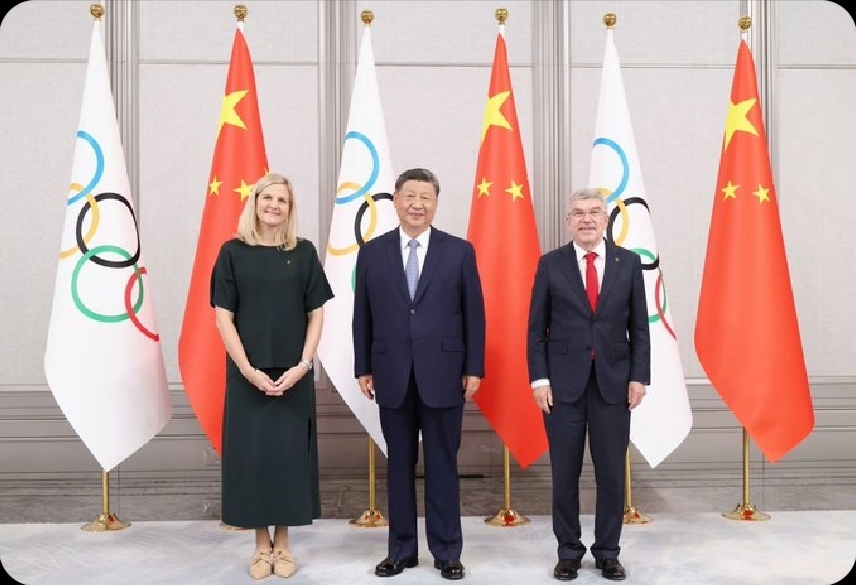
Le dimanche 9 novembre 2025, alors que Canton (Guangzhou) s’illuminait de lumières, d’acclamations et d’histoire pour l’ouverture des 15ᵉ Jeux nationaux de Chine — organisés pour la première fois conjointement par le Guangdong, Hong Kong et Macao — le président Xi Jinping a rencontré Kirsty Coventry, présidente du CIO, et Thomas Bach, président honoraire à vie.
La rencontre, mise en avant par @XisMoments, n’était pas seulement un geste de continuité olympique, mais aussi un symbole d’unité culturelle et d’harmonie intérieure que la Chine souhaite relier à l’esprit universel des Jeux.
Les Jeux olympiques d’hiver de Pékin 2022 se sont clos le 20 février 2022 ; deux jours plus tard, la Russie envahissait l’Ukraine. Ce qui devait être un triomphe d’harmonie devint une blessure silencieuse pour le prestige moral de la Chine. Xi Jinping n’a pas gâché la cérémonie de clôture — il a attendu. Mais « l’amitié sans limites » proclamée avec Moscou venait déjà d’être rompue, non par la diplomatie, mais par un missile au-dessus de Kyiv.
Alors que le monde se tourne vers Milan–Cortina 2026 et se prépare à Los Angeles 2028, la séquence olympique retrouve son rôle : celui du calendrier des civilisations, la mesure de la conscience mondiale. La flamme passe désormais à l’Ouest, où Los Angeles 2028 pourrait, peut-être, devenir les Jeux du Rééquilibre : le retour du récit sur le chaos, du sens sur la domination.
En parallèle, Donald Trump agit sur un autre front — mais dans la même logique de transition. Sa décision de suspendre la livraison des Tomahawk à l’Ukraine, loin d’une hésitation, vise à reconfigurer la logique des sanctions et à reprendre la maîtrise stratégique du récit.
De même, sa volonté déclarée de reprendre le conflit israélo-palestinien à travers les Accords d’Abraham signale un glissement : de la confrontation militaire vers la résolution narrative, du pilotage de la guerre à la maîtrise de la paix.
Ces deux gestes — celui de Xi à Canton, celui de Trump à Washington — se rejoignent sur le pont symbolique qui relie, d’une part, Pékin 2022 à Milan–Cortina 2026, et, d’autre part, Paris 2024 à Los Angeles 2028.
Le sport change la donne.
Il rend au monde la mesure de sa civilisation, rappelant que la force ne sert plus à détruire, mais à garantir la paix et à restaurer le sens.
> j’ai dit cela. Chaque être choisit, par sa propre voix liée à son libre-arbitre, la réalité à laquelle il souhaite donner corps. Ainsi, les monstres s’effacent.
On Sunday, November 9, 2025, as lights, cheers and history illuminated Guangzhou for the opening of China’s 15th National Games — the first ever to be jointly hosted across Guangdong, Hong Kong and Macao — President Xi Jinping met with IOC President Kirsty Coventry and Honorary President for Life Thomas Bach.
The meeting, highlighted by @XisMoments, was not only a gesture of Olympic continuity but also a symbol of China’s expanding cultural unity and its aspiration to connect domestic harmony with the universal spirit of the Games.
The Beijing 2022 Winter Games had closed on February 20, 2022; two days later, Russia invaded Ukraine. What should have been a triumph of harmony became a silent wound to Beijing’s moral prestige. Xi Jinping did not spoil the closing ceremony — he waited. But the “friendship without limits” declared with Moscow had already been shattered, not by diplomacy, but by a missile over Kyiv.
As the world prepares for Milan–Cortina 2026 and looks toward Los Angeles 2028, the Olympic sequence resumes its role as the calendar of civilization — a chronometer of global conscience. The torch now passes westward, where Los Angeles 2028 may become the Games of Rebalancing: a return to narrative over chaos, meaning over domination.
In parallel, Donald Trump acts on a different front — but within the same logic of transition. His decision to pause the delivery of Tomahawks to Ukraine, far from hesitation, aims to reshape the logic of sanctions and reclaim strategic authorship.
Likewise, his declared intent to re-engage the Israeli-Palestinian conflict through the Abraham Accords signals a shift from military confrontation to narrative resolution — from managing war to mastering peace.
The two gestures — Xi’s at Guangzhou, Trump’s in Washington — converge across the symbolic bridge between, in one part, Beijing 2022 and Milan–Cortina 2026, and, in another, Paris 2024 and Los Angeles 2028.
Sport is a game changer.
It restores the measure of civilization, reminding us that force no longer destroys — it safeguards peace, and restores meaning.
>This is what I have said, from now on: Every single person, through his own voice, chooses the reality they wish to bring into being. Thus, monsters disappear.
Les récentes déclarations de Donald Trump sur le Nigeria sont sans ambiguïté : “If the Nigerian government continues to allow the killing of Christians, the U.S.A. will immediately stop all aid and assistance to Nigeria, and may very well go into that now-disgraced country, ‘guns-a-blazing’. (AP News, novembre 2025). Une force politique tente de cadrer le potentiel sans limites de ressentiment interconfessionnel, disponible en Afrique et au Moyen-Orient, dans la confrontation religieuse et la dialectique du clash des civilisations. Ce contexte invite Donald Trump sur la cause des Chrétiens au Nigéria ou pris dans l’engrenage de chaos soudanais. Au milieu de cet enfer, l’élection – le 4 Novembre dernier – de Zohran Mandani comme maire de New-York, est attaquée au vitriol, à l’échelle globale. Elle dresse une figure paratonnerre.
Sous couvert de défense des chrétiens, l’ancien président américain adresse un ultimatum diplomatique et moral à un État souverain. Porté par son électorat évangélique et par l’imaginaire messianique de son propre parcours, il se présente en protecteur de la foi et en justicier des âmes. Mais derrière cette posture que le sort des chrétiens, qui forment une population parmi toutes les autres à être sacrifiées, c’est un piège tendu : une injonction politique qui attise la confrontation religieuse mondiale et réactive la logique du clash des civilisations. Dans ce piège se croisent aujourd’hui plusieurs forces: la droite chrétienne américaine, la connexion judéo-chrétienne téléguidée par Netanyahu, l’appareil narratif russe primaire, et la fragilité cognitive d’un monde désemparé par la prolifération des signes et injonctions.
1. La réactivation du récit civilisationnel
Sur X, la phrase du cardinal Robert Sarah — « Les barbares sont déjà dans la ville » — a ressurgi, relayée par @75secondes, @Wolf, etc, au moment même où Trump annonçait vouloir “sauver les chrétiens du monde”. En surface : deux appels à la vigilance spirituelle. En profondeur : une même trame cognitive — celle d’un Occident assiégé, d’un christianisme encerclé par la barbarie.
Les violences africaines (Nigeria, Soudan, Sahel) deviennent les scènes symboliques d’une guerre sainte mondialisée ; la complexité politique, ethnique et économique s’efface derrière le vocabulaire de la croisade. La foi n’explique plus : elle désigne.
Un million de vues pour cette seule publication.
Elle vient d’un entretien de 2019 accordé à La Nef / The Catholic Herald, où le cardinal Robert Sarah disait : « As a bishop, it is my duty to warn the West! The barbarians are already inside the city. ». CERC+1
Dans ce texte, il précise ce qu’il appelle les barbares : « tous ceux qui haïssent la nature humaine, qui piétinent le sens du sacré, ne respectent pas la vie, se rebellent contre Dieu… » – en visant l’avortement, l’euthanasie, la pornographie, l’idéologie de genre, etc.
Plus loin dans le même entretien, il parle aussi de l’islamisme comme d’une menace, mais dans un passage distinct, et en l’articulant à la crise spirituelle de l’Occident.
Ce qui circule aujourd’hui, c’est donc une citation sortie de son contexte et recyclée :
On retrouve exactement la même formule sur Facebook, Instagram, Threads, X, souvent sur fond de photo ou de mème, sans le paragraphe explicatif qui élargit sa définition des “barbares”. Instagram+3Facebook+3Instagram+3
@75secondes ne fait qu’amplifier une phrase devenue slogan dans certains milieux conservateurs catholiques / identitaires, en la reliant au cardinal et à la question de l’immigration de masse. Instagram+1
Sur le sous-entendu “on entendait l’islam…”
Dans le texte original, Sarah ne dit pas“les musulmans sont les barbares”. Il parle d’une barbarie morale occidentale et de l’islamisme comme menace politico-religieuse ; mais ce sont surtout les relais militants qui condensent tout ça en une punchline utilisable contre “l’islam” en bloc.
2. La résonance russe : miroir du messianisme évangélique
Depuis 2014, le Kremlin, appuyé par le patriarche Kirill, promeut la Russkiy Mir — le “monde russe” — présenté comme dernier bastion du christianisme face à la décadence occidentale et à la menace islamiste. La rhétorique de Trump s’y superpose comme un calque.
Thème
Rhétorique russe
Rhétorique trumpiste
Mission
Moscou protectrice de la foi orthodoxe
Washington sauveur des chrétiens persécutés
Ennemi symbolique
Occident libéral et “dénaturé”
Islam radical et “barbarie” du Sud
Registre
Métaphysique du salut
Théologie de la puissance
Finalité
Légitimer la verticalité russe
Re-sacraliser la suprématie américaine
Ces deux narrations s’auto-alimentent : l’une cherche à fracturer l’Occident, l’autre à le rallier sous l’étendard du sacré. L’effet est identique : un monde polarisé autour des fractures, rendues abyssales et irrémédiables, du religieux décliné sous la forme de mouvements de fractales dans un monde où les chimères sont faites pour régner en maîtres
3. L’ingénierie cognitive de la croisade
Ce champ narratif repose sur une architecture précise :
Amplifier sélectivement les massacres chrétiens en Afrique ;
Détourner la compassion en colère ;
Recycler les mots prophétiques (“barbares”, “mal”, “sacré”) ;
Fusionner les discours politiques, spirituels et militaires.
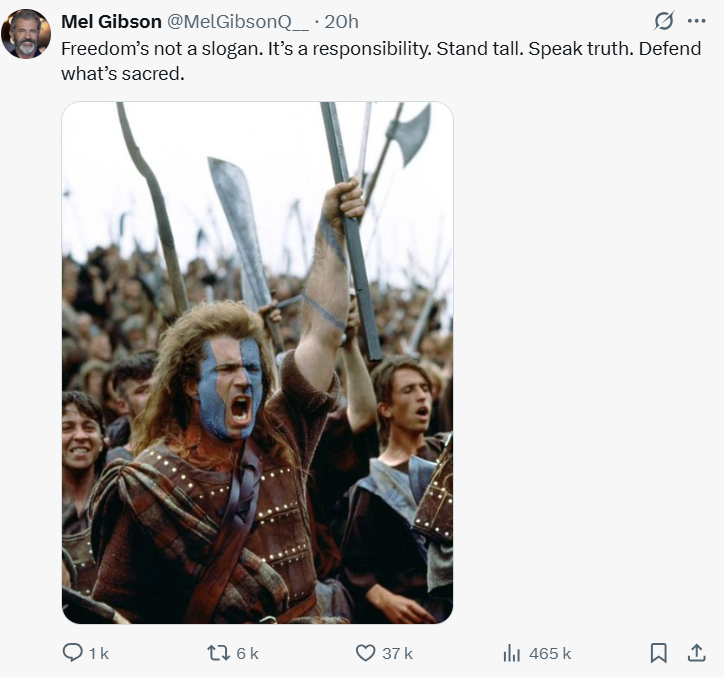
C’est une véritable machinerie cognitive, qui transforme la douleur en énergie politique. Trump y trouve un levier électoral, Mel Gibson y ajoute une aura mythique (“Defend what’s sacred”), et Moscou y glisse sa grammaire civilisationnelle : la guerre du bien contre le chaos.
En mêlant mystique et brutalité, Mel Gibson construit un imaginaire où le salut passe par la violence — un miroir parfait du temps présent, où l’on confond de plus en plus la sainteté avec la revanche.
4.L’effet Mamdani : le paratonnerre du récit
Au cœur de cette tempête, l’élection à New York de Zohran Mamdani, premier maire musulman d’origine ougandaise, agit comme un paratonnerre cognitif. Plus qu’une dissonance, c’est une zone d’absorption du choc symbolique. Son élection résonne avec la promesse d’un pluralisme pacifié — mais, dans les flux polarisés, elle devient la cible parfaite :
pour certains, preuve que l’Occident et dispose des outils cognitifs pour résister à l’onde de haine qui déferle partout et, ainsi, reste ouvert, aspace d’équilibre et de résolution au service de la Paix ;
pour d’autres, c’est le signe que “l’ennemi est déjà dans la place”.
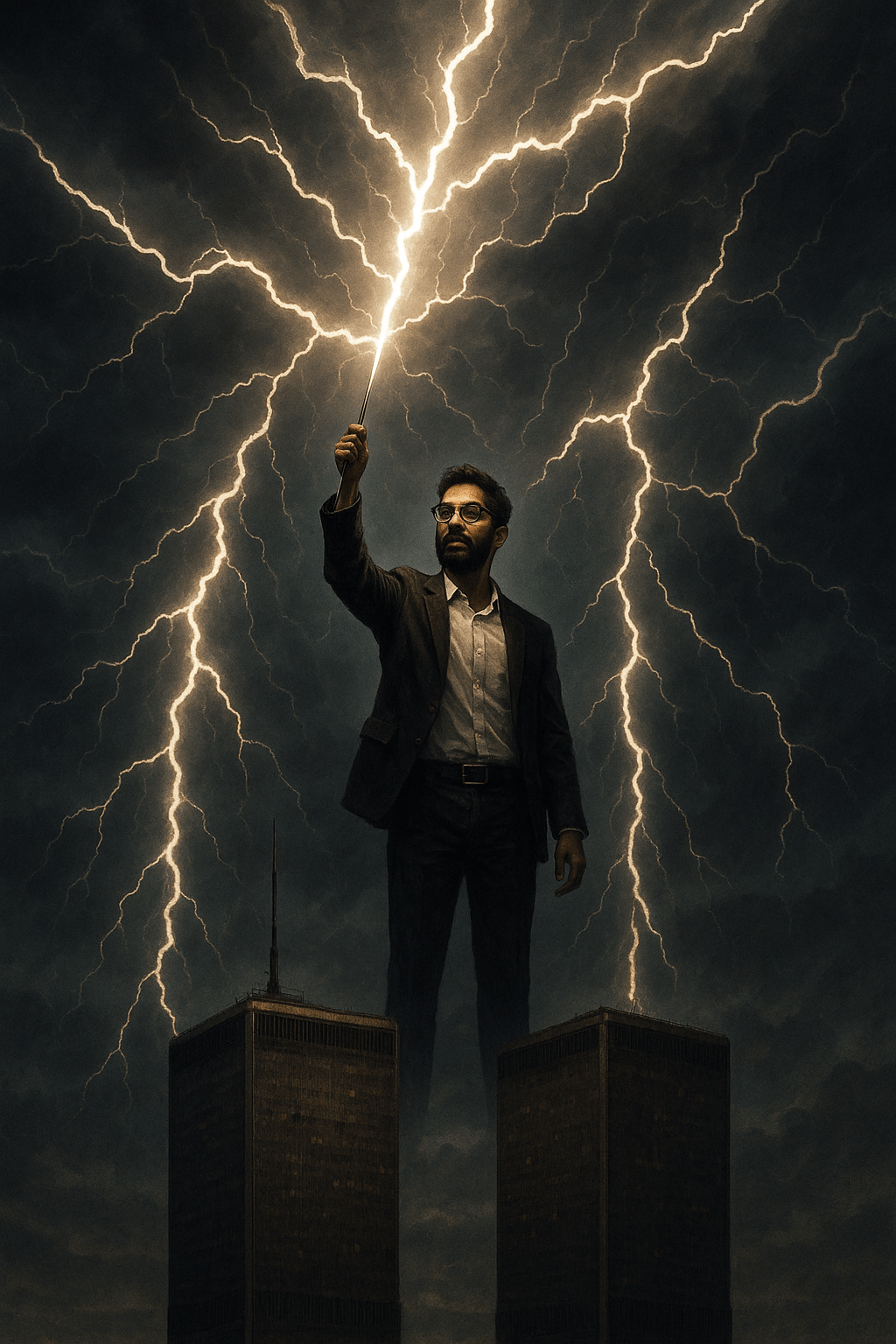
Comme Benjamin Franklin saisissant la foudre, Zohran Mamdani dresse le paratonnerre sur la plus orageuse des ères. Les haines se concentrent sur sa personne symbolique.
La dissonance que Zohran Mamdani incarne révèle l’intensité du champ magnétique : plus la société réelle s’apaise, plus la sphère numérique s’enflamme et déverse anathèmes préfabriqués et excommunications politiques. @ZohranMamdani devient malgré lui le test de résistance du vivre-ensemble face à la montée des récits guerriers. Il s’est installé, à partir de Ground Zero, sur le seuil d’un monde attiré irrésistiblement vers les profondeurs insondables de son propre enfer, et ouvre un autre chemin vers le possible retour à soi.
5. Le piège du sacré politique
Sous des apparences de ferveur, c’est une architecture de domination symbolique qui se met en place. Le sacré devient vecteur d’influence, la foi devient vecteur d’ordre, et la liberté spirituelle devient l’appât d’une guerre cognitive mondiale. Le piège de Trump n’est donc pas seulement diplomatique : il est psychologique. Il invite l’humanité à choisir un camp dans un conflit que la raison n’a pas décidé.
Et dans cette bataille des signes, ce ne sont plus les croyants qui prient — ce sont les algorithmes qui recrutent.
L’idée d’un “choc des civilisations”, formulée par Samuel P. Huntington au tournant des années 1990-2000, n’a pas seulement proposé une lecture : elle a dressé le décor mental d’un monde en guerre cognitive. Au moment où la laïcité semblait pouvoir servir de fil d’Ariane pour les démocraties occidentales, Huntington a tracé une architecture cognitive selon laquelle l’identitaire, le religieux et le culturel remplaceraient l’idéologique et l’économique comme moteurs des conflits. Même s’il se défendait d’incarner ou de promouvoir ce “clash”, il a offert, à partir de 1993, aux adversaires de l’ordre mondial – qu’ils soient idéologues, terroristes ou stratèges – le fond vert idéal pour insérer leurs agissements dans un décor idéal pour eux. Ce chapitre s’ouvre donc sur un constat simple : nous avons tourné un quart de notre siècle sur ce drap vert idéologique, et désormais la scène s’éclaire — mais faut-il encore savoir ce que nous voyons. Et reprendre la copie.
Prologue – Le flash du siècle
Le 11 septembre 2001 fut plus qu’un attentat : ce fut un flash planétaire, un instant d’illumination violente où la prophétie de Huntington se projeta, d’un seul coup, dans toutes les consciences. En quelques minutes, l’image de deux avions frappant les tours jumelles grava dans la rétine collective le scénario du “choc des civilisations”.
L’événement pulvérisa les distances : il abolit la médiation, fit exploser la temporalité politique et transforma la peur en expérience simultanée de l’humanité tout entière. Ce jour-là, la planète découvrit qu’elle pouvait être unie… dans la sidération. La mondialisation de la confiance, avec ses organes de régulation basés sur le droit, cédait à la mondialisation de la peur.
Le “fond vert” imaginé par Huntington devint l’écran mental sur lequel chacun — gouvernant, idéologue, croyant ou simple spectateur — projetait son récit du monde. La prophétie trouva son projecteur : la télévision. Et son amplificateur : Internet.
En une journée, le langage de la fracture remplaça celui du dialogue. Les nuances se dissocièrent, les appartenances se raidissent, les croyances se politisèrent. Ce flash inouï fertilisa un terreau propice à la violence verbale, à l’anathème, à la radicalisation et au terrorisme. Il inocula dans les sociétés modernes une peur transmissible : celle de l’autre.
Depuis ce jour, chaque crise majeure — terroriste, migratoire, identitaire — réactive, sous d’autres formes, ce choc initial. Le XXIᵉ siècle tout entier se déroule dans la lumière brûlée du 11 septembre, comme si le monde n’avait jamais quitté ce plan unique de feu et de poussière.
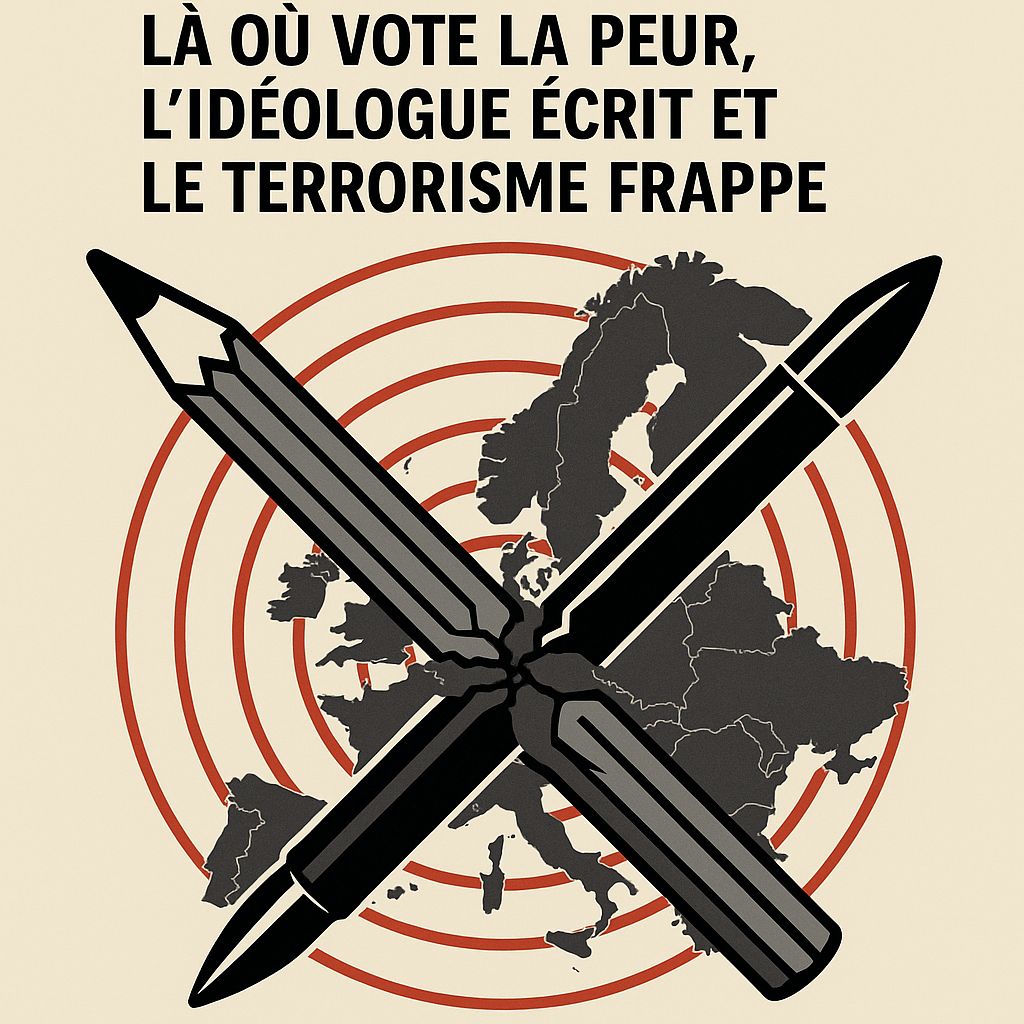
Where fear votes, the ideologue writes, and terrorism strikes.
I. Le fond vert du monde
Il est des idées qui ne décrivent pas le monde : elles le fabriquent. En 1996, Samuel Huntington, professeur à Harvard, spécialiste des relations internationales et du développement politique, publie The Clash of Civilizations and the Remaking of World Order. Ce texte, souvent cité mais rarement relu, est devenu l’un des plus puissants générateurs de mythes politiques du monde contemporain.
Car, même s’il s’est toujours défendu d’être le prophète d’un affrontement global, il en a dressé le décor — comme un réalisateur tendant un drap vert derrière des acteurs encore hésitants, sur lequel viendraient s’incruster, plus tard, les images de toutes les haines du XXIᵉ siècle.
Sur ce fond abstrait, chacun projeta son propre film :
Alexander Dugin, théoricien d’un eurasianisme mystique, y inscrivit la guerre sacrée contre l’Occident matérialiste.
Oussama Ben Laden y lut la validation d’un combat eschatologique entre islam pur et monde corrompu.
Et l’Occident lui-même, croyant répondre à la menace, y trouva la justification d’une militarisation de la pensée et d’une économie de la peur.
Huntington, en voulant prévenir le choc, a fourni la matrice cognitive où il allait se produire. Il a offert au monde post-soviétique un langage totalisant — celui de la fracture civilisatrice — et donné à la guerre sans nom des années 2000 un cadre conceptuel où s’enraciner.
Ce n’était pas un manifeste : c’était un fond vert. Et sur ce fond, les puissances du ressentiment ont tourné leur film.
Puis, le 11 septembre 2001, le scénario prit vie. Alors que la fumée montait de Manhattan, un acteur monta sur scène : Benjamin Netanyahou, déclarant :
“Now we know what is attacking us. You understand us now. We can bring you our experience and expertise.”
En une phrase, il fit ce que Huntington n’avait pas osé faire : désigner l’ennemi et assigner un camp. L’Occident sidéré s’aligna sur la grille du choc ; le paradigme civilisationnel devenait opératoire. Dès lors, chaque attentat, chaque crise, chaque guerre ne ferait que rejouer la même scène, sur le même décor. La guerre hybride, avec sa perverse composante que représente, la guerre cognitive, pouvait, dès lors, commencer. A ce jeu, certains se sont révélés plus habile à maîtriser les dimensions tactiques et stratégiques de ce haut et insidieux de gré de conflictualisation.
II. Le piège de la prophétie : penser le monde avec les catégories de ses ennemis
Une prophétie ne devient dangereuse que lorsqu’elle s’accomplit dans l’esprit de ceux qui la redoutaient. Le Choc des civilisations fut de cette nature : une métaphore devenue carte du monde.
L’Occident, en cherchant à nommer ce qui le menaçait, a fini par penser avec les catégories de la menace. Il s’est enfermé dans la logique du “eux” et du “nous”, du “monde libre” contre “l’axe du mal”, du “raisonnable” contre le “fanatique”. Ces mots, jadis outils d’analyse, sont devenus frontières mentales.
Le piège se referma comme une cage logique : le réel ne pouvait plus être vu que dans le langage du choc. Et, à mesure que les bombes tombaient et que la peur se banalisait, la pensée occidentale s’est appauvrie, totalitarisée par son propre lexique.
Ainsi, ceux qui prétendaient combattre le fanatisme lui ont emprunté sa structure : ils ont transformé le monde en un théâtre binaire, où la nuance équivalait à la trahison et la complexité à la faiblesse.
Le 11 septembre ne fut pas seulement un attentat : ce fut la consécration d’une prophétie auto-réalisatrice. En cherchant à conjurer la guerre des civilisations, l’Occident l’a pensée, dite, puis mise en scène. Et tandis qu’il se croyait lucide, il devint figurant de sa propre tragédie et, saturé de foulards islamiques, d’Allah Akbar, de têtes de cochons devant les mosquées, de tags antisémites, de croix gammées sur les synagogues, d’église qui brûlent, et de profanations en série, de sa propre perte de souveraineté dans l’écriture de son propre récit, dans la maîtrise de l’essence qui fait son être.
III. La mondialisation du choc : comment l’Apocalypse est devenue un marché
Le Choc des civilisations a cessé d’être une théorie pour devenir un produit dérivé. Une marque mondiale. Une trame narrative universelle sur laquelle les pouvoirs, les médias et les entreprises ont appris à capitaliser.
La guerre du sens, d’abord idéologique, s’est industrialisée. Elle alimente aujourd’hui un écosystème où la peur est cotée, la colère monétisée, et l’indignation convertie en parts d’audience. Chaque crise, chaque attentat, chaque polémique devient matière première pour l’économie de l’attention.
L’Apocalypse est devenue un format. Et plus l’humanité se fracture, plus le système prospère. La haine, la désinformation, la suspicion ne sont plus des pathologies : elles sont des valeurs d’échange.
Là où l’on croyait voir le conflit des civilisations, on découvre désormais le commerce des narrations. Le monde ne se divise plus entre Est et Ouest, ni entre foi et raison, mais entre ceux qui manipulent les récits et ceux qui les subissent.
IV. Le retour du sens : restaurer la souveraineté cognitive de l’Europe
Nous vivons aujourd’hui la phase terminale d’une métastase mentale. Ses symptômes ne sont plus invisibles : ils se manifestent chaque jour dans la difficulté, même pour ceux dont c’est le rôle — journalistes, diplomates, chercheurs, gouvernants —, de penser le mal qui submerge tout sans se laisser happer par la logique qu’il impose. Car le mal, désormais, ne se contente plus d’agir : il prescrit sa propre grille d’analyse, et rares sont ceux qui échappent à son magnétisme tant il invite tous les protagonistes à le rejoindre, à l’alimenter, à un titre ou à un autre.
Du Soudan aux attentats sur le sol européen, du Crocus City Hall à Moscou à la crise migratoire que nul État ne parvient à maîtriser, le gagnant politique est presque toujours celui qui exploite le mieux la dialectique du choc : celui qui sait transformer la peur en légitimité, la souffrance en récit, et le chaos en outil de pouvoir.
Ce monde est devenu un livre qui s’écrit tout seul. Ses nouvelles pages s’ouvrent les unes après les autres sitôt qu’un sujet est consommé dans les précédentes. Dans ce flot, les dissonances sont rares : la plupart des voix, qu’elles croient s’opposer ou s’affronter, finissent par se répondre à l’intérieur du même système narratif, celui du choc et de la peur, ce qui produit une auto-combustion inextinguible.
Ce sont précisément ces dissonances, ces éclats de pensée non synchronisés, qu’il faut désormais rechercher car elles permettent de tisser le réseau matriciel et ce sont elles, les dissonances, qui trahissent la nature des opérations qui téléguident la pensée publique dans ce corridor de la mort.
Sortir du piège, ce n’est donc pas nier le conflit, mais restaurer la hiérarchie du sens. L’Europe, héritière des Lumières, ne vaincra pas par la force, mais par la lucidité. Elle doit cesser d’être la caisse de résonance du chaos pour redevenir l’atelier du discernement.
Il faut apprendre à voir le fond vert, à reconnaître le décor truqué, à réapprendre la mise au point. Car la liberté ne se mesure plus à la taille du territoire, mais à la clarté de l’esprit collectif.
Restaurer la souveraineté cognitive, c’est rendre au réel sa profondeur, et au peuple sa conscience.
La souveraineté du XXIᵉ siècle ne se fera pas à partir des puissances exclusivement militaire ni monétaire : elle est et sera cognitive. Elle dépendra de la capacité des peuples à discerner ce qu’ils pensent de ce qu’on leur fait penser, ce qui constitue une hygiène élémentaire pour ne pas être que le punching-ball de poings tapant sur la matière grise. Le champ de bataille est là. La dimension autoritaire de la Chine se développe, pour grande partie, dans ce contrôle plus légitime que jamais.
Les démocraties ont à établir le leur pour manifester que leur sort n’est pas scellé et encore moins désespéré. Qu’elles savent avancer dans le brouillard cognitif qui leur est imposé de l’extérieur pour n’illuminer que la voie ouverte à l’extrême-droite qui veut démanteler la puissance collective européenne, et enrayer sa dynamique.
Le moment que cela forme dans l’histoire rejoint ce qu’avait tenté de formuler André Malraux – propos apocryphe cependant conforme à toute sa pensée et à toute son œuvre – selon lequel « Le XXIe siècle serait spirituel ou ne serait pas ». C’était une manière de dire que ce siècle, aux potentiels si contradictoires, sortirait vainqueur par la puissance et l’acuité de l’Esprit. C’est le combat de ce siècle. Le combat de ce siècle ce n’est pas la liberté d’expression. Le libre-arbitre en est la clé. Ce combat décisif qui déterminera – pour longtemps – le monde dans lequel grandira notre postérité, se mène et, surtout, se gagne – ou se perd – aujourd’hui ou dans les semaines qui viennent.
Je suis obligé de rendre hommage à André Malraux. Il fait partie des gens à avoir décelé – dans l’air du temps et ce qu’il recèle de mutations invisibles aux intelligences sensibles – ce qui nous est arrivé avant que le nuage sur forme et se transforme en ouragan dévastateur dans la psyché humaine. Il ne lui a suffit peut-être que la sensation de quelques ailes de papillons invisibles, un demi-siècle avant sa survenue – pour comprendre ce changement de climat et comment, dans un formule extraordinairement pénétrante et péremptoire, en conjurer les effets.
Je ne peux pas conclure ce chapitre V sans citer, aussi, Paul Valery. Il avait formé une partie du prologue à ma propre réflexion stratégique, que j’avais engagée en 2016 sous le titre « Vulnérabilité des Démocraties à l’âge de la Mondialisation ». Je l’avais rédigée, sans être allé au bout de la réflexion, qui est encore alimentée ici même, en réaction aux attentats du 13-Novembre-2015, dont nous allons bientôt commémorer les 10e anniversaire.
En 1936, quelques années avant le déclenchement de ce qui allait devenir la seconde guerre mondiale, dans son essai « Regards sur le monde actuel », le philosophe et poète sétois avait parfaitement situé le changement de matrice auquel il assistait.
« Mais sans doute des moyens un peu plus puissants, un peu plus subtils, permettront quelque jour d’agir à distance non plus seulement sur les sens des vivants, mais encore sur les éléments plus cachés de la personne psychique. Un inconnu, un opérateur éloigné, excitant les sources mêmes et les systèmes de vie mentale et affective, imposera aux esprits des illusions, des impulsions, des désirs, des égarements artificiels. »
Paul Valéry
Ces mots, écrits il y a près d’un siècle, sonnent aujourd’hui comme une prophétie accomplie. L’homme moderne, connecté, surexposé, démultiplié, est devenu le médium de sa propre manipulation. Les “égarements artificiels” dont parlait Valéry ne sont plus des fictions : ils sont devenus notre écosystème mental.
V. La bombe humaine : la guerre invisible de Vladimir Poutine
Vladimir Poutine exhibe son arsenal comme un prestidigitateur montre ses illusions : torpilles à tsunamis radioactifs levant des vagues de deux cents mètres, missiles à propulsion nucléaire capables de sillonner le ciel sur vingt mille kilomètres avant d’atteindre leur cible, promesses de supériorité hypersonique. Il en est là : dans l’ostentation du spectaculaire. Mais derrière ce théâtre de métal et de feu, il dissimule la véritable panoplie d’armes de destruction massive : les armes cognitives.
Ces armes ne détruisent pas les infrastructures ; elles fissurent les consciences. Elles ne visent pas les villes ; elles infectent les représentations. Elles ne pulvérisent pas la matière ; elles dévissent le réel.
Chacun, dans ce champ de bataille global, devient une grenade à fragmentation mentale, projetant autour de lui des éclats d’opinion, de peur, de certitude ou de haine. Les frontières n’y existent plus : ni géographiques, ni politiques, ni morales. La guerre n’est plus ce qui se livre “là-bas” ; elle s’invite dans la langue, dans les images, dans la mémoire, dans le rêve.
Pour en dire l’intuition poétique la plus juste, il faut revenir à Téléphone — ce groupe qui, au début des années 1980, pressentit la mutation à venir. Dans La bombe humaine, Jean-Louis Aubert chantait :
Je veux vous parler de l’arme de demain, Enfantée du monde, elle en sera la fin. Je veux vous parler de moi, de vous. Je vois à l’intérieur des images, des couleurs, Qui ne sont pas à moi, qui parfois me font peur, Sensations qui peuvent me rendre fou. Nos sens sont nos fils, nous pauvres marionnettes, Nos sens sont le chemin qui mène droit à nos têtes.
Ce texte, quarante ans avant l’avènement de l’intelligence artificielle et des réseaux sociaux, annonçait la bombe H de l’esprit — non pas “hydrogène”, mais humaine. Une arme dont l’effet ne se mesure pas en mégatonnes, mais en degrés d’aliénation.
Pour la première fois dans l’histoire, l’homme a conçu des armes dont la cible principale n’est pas la matière vivante, mais la conscience vivante ; des armes dont la puissance se constate non dans les ruines, mais dans le consentement de ceux qui croient encore penser librement.
Et, comme la bombe H, les armes cognitives ont cette particularité terrible qu’elles laissent debout les infrastructures, intactes les villes, apparemment paisibles les sociétés — mais elles annihilent ce qui fait d’elles des civilisations.
VI. Le dernier refuge de l’esprit : comment résister sans devenir ce que l’on combat
Les civilisations ne meurent pas toutes de la même manière. Certaines s’effondrent sous le poids des invasions ou des famines. La nôtre, si elle devait s’éteindre, le ferait dans la lumière aveuglante de sa propre information.
Les armes cognitives ne détruisent pas les corps, elles dissolvent le sens. Elles ne font pas couler le sang, mais le discernement. Elles ne s’attaquent pas à la raison pour la nier, mais pour la saturer. Le génie du chaos contemporain est d’avoir compris que la destruction n’a plus besoin de violence physique — il suffit de remplir l’esprit jusqu’à ce qu’il se taise.
L’homme du XXIᵉ siècle ne craint plus la censure : il craint le vide laissé par l’abondance. Il ne se révolte plus contre le mensonge : il s’y réfugie, pour ne plus penser seul. Il ne combat plus l’ennemi : il cherche dans son propre camp un miroir rassurant de sa peur. Ainsi se forment les masses liquides du monde postmoderne : mobiles, nerveuses, sans mémoire, prêtes à s’enflammer au contact du moindre signal.
Résister à cela ne consiste plus à dénoncer — le bruit du monde s’en charge déjà. Résister, désormais, c’est rétablir la ligne claire : celle qui distingue la pensée du réflexe, la foi du fanatisme, l’attention de la pulsion. C’est redonner à la parole sa lenteur, à la raison sa gravité, à la vérité son coût.
Le dernier refuge de l’esprit, c’est la conscience. Pas celle qui juge, mais celle qui veille. Elle seule peut se soustraire à l’hypnose collective, refuser la contagion, et faire de la lucidité une forme active de courage.
Les mots de Malraux résonnent alors comme un viatique pour ce siècle :
« Le XXIᵉ siècle sera spirituel ou ne sera pas. » Il ne parlait pas de religion, mais de la reconquête de l’humain sur la technique, de la réappropriation du sens dans un monde saturé de signes.
C’est à cela que nous sommes rendus. À l’heure où les bombes humaines se multiplient, où les intelligences artificielles prédisent nos désirs avant que nous les éprouvions, où la parole publique devient un champ de mines émotionnelles, il faut retrouver ce point fixe que ni la peur ni la propagande ne peuvent atteindre : la présence lucide à soi-même.
Le dernier front de la guerre cognitive n’est pas militaire. Il est intérieur. Et c’est là que se jouera, silencieusement, le destin du monde.
Le 9 juin 2024, la dissolution surprise de l’Assemblée nationale par Emmanuel Macron fit vaciller le pays. Ce jour-là, la République s’est vue dans le miroir de ses contradictions : les visages décomposés du pouvoir, les fractures de la société, la confusion d’un peuple saturé d’opinions. Beaucoup y virent un pari, d’autres un aveu de faiblesse — mais l’Histoire, elle, retiendra peut-être autre chose : le moment où la démocratie française, épuisée par la comédie des apparences, fut contrainte de se regarder en face. Ce jour fut celui où le rideau se leva sur le désordre latent d’une nation gouvernée par le bruit.
Et de cette crise, pourrait naître un nouvel agenda : celui d’un redressement du discernement,
où l’information, la parole et le jugement retrouveraient leur juste place dans la hiérarchie du sens.
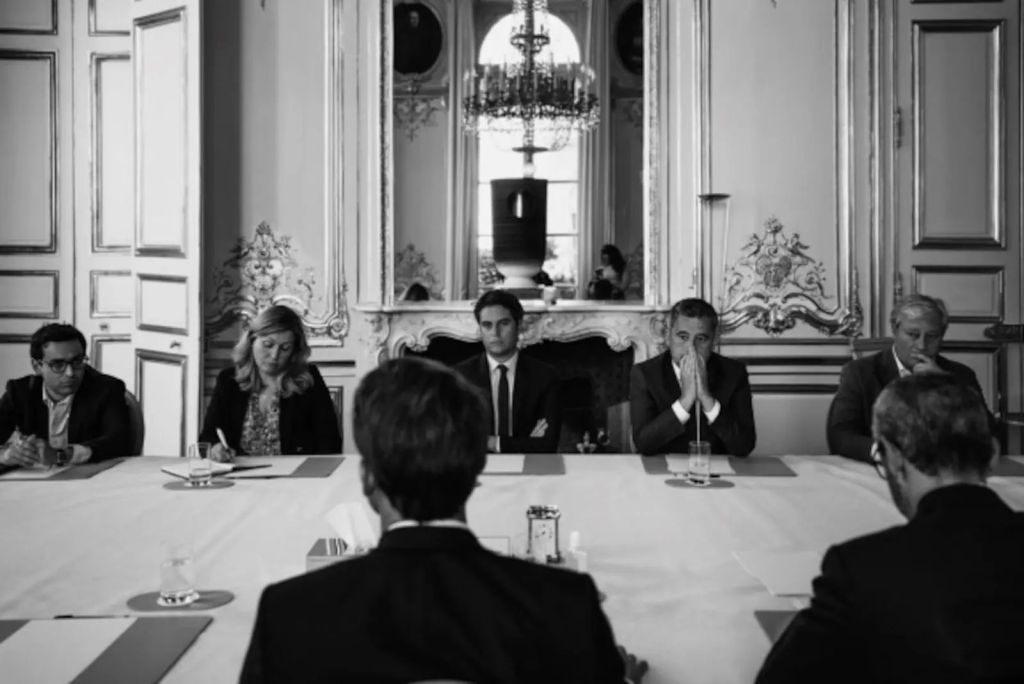
Cette photo de Soazig de la Moissonnière, la photographe officielle de la Présidence, immortalisant le chef de l’Etat au moment où il annonce la dissolution le 9 juin 2024.
Tout ce qui menace, même de manière diffuse, l’intégrité du système démocratique ou la cohésion de la République, ne saurait être considéré comme un sujet secondaire. C’est au contraire une question de première importance, car la démocratie, à la différence des régimes de force, ne dispose d’aucun blindage extérieur : elle ne tient que par la solidité intérieure du jugement collectif.
Or, cette solidité s’effrite. Sous l’effet d’un lent dérèglement, l’Assemblée nationale elle-même est devenue le théâtre d’ombres d’un désordre plus vaste : celui d’un espace politique saturé de signaux contradictoires, où le vrai et le faux, le plausible comme l’inimaginable, dans tous les sens, s’entremêlent jusqu’à se confondre sous le feu nourri d’un système d’injection permanentes. Ce spectacle n’est pas un accident de conjoncture : c’est la quintessence d’un processus de long terme.
Depuis plus d’un quart de siècle, des intelligences étrangères, appuyées sur des relais idéologiques et un jeu multibande au sein même de nos élites — cette endogarchie que rien ne relie plus à la nation réelle — exploitent nos failles cognitives et nos fractures sociales. Elles activent nos peurs primaires : l’immigration, la dilution de l’identité française dans l’Europe, la vaccination, la dépossession économique, etc. Ces thèmes, travaillés, amplifiés, distordus, deviennent des leviers de désorientation et sont captés par les opportunistes du système politique, plongeant la démocratie dans un brouillard de plus en plus épais.
Cela a gonflé les voiles aux populismes et souverainismes portés sur ces flots déchaînés.
Chaque peur, chaque soupçon, chaque réaction immédiate alimente un marché du simplisme et de la démagogie. Ce marché prospère parce qu’il fournit, à la demande, des réponses partisanes à des questions existentielles. Il atrophie la pensée politique, qui ne cherche plus à comprendre, mais à s’imposer. Ainsi, peu à peu, la colonne vertébrale de la nation s’est dissoute — cette verticalité sans laquelle aucune structure ne peut tenir, et sans laquelle la République elle-même devient une forme sans force.
Car non, s’il y a une représentation nationale, ce n’est pas pour que ceux d’en haut disent plus fort ce que ceux d’en bas pensent tout bas. C’est pour que ceux d’en haut en tirent une matière politique noble, conforme à la République Française.
Cette situation inextricable et l’exigence profonde qui en découle peut justifier, dans un débat budgétaire en cours promis à toutes les dérives et aux pièges de la censure du gouvernement, de braver les éléments, sans 49-3.
Ce qui ressortira, dans un sens ou dans l’autre, sera sans appel.
I. L’économie du mensonge : quand le faux devient valeur d’échange
Le mensonge n’est plus aujourd’hui une déviance morale ou un accident du débat public. Il est devenu un système de production — avec ses circuits, ses opérateurs, ses dividendes. Il circule, s’achète, se revend, se convertit en influence, en audience, en pouvoir. Le mensonge est entré dans l’économie politique du XXIᵉ siècle comme une matière première : inépuisable, adaptable, instantanément diffusable.
Ce que l’on appelle “désinformation” n’est qu’une apparence superficielle : un segment saillant et controversé d’une entreprise de dérèglement beaucoup plus vaste. En réalité, il s’agit d’un modèle complet de la transaction politique, désormais altéré, puisqu’il repose sur la captation de l’attention et la stimulation des affects les plus immédiats. Dans cette économie, la vérité ne vaut rien si elle ne fait pas vendre. Et le faux, s’il fait cliquer, partager ou voter, devient un actif.
La Russie, dans son registre, a compris très tôt que la manipulation de l’information pouvait remplacer le coût des armes. Mais ce qu’elle a perfectionné sur le plan géopolitique a trouvé, en Occident, son miroir libéral : les grandes plateformes, en monétisant la polarisation, ont fait du mensonge rentable une composante stable du marché global. Elles n’ont pas besoin de mentir — il leur suffit d’optimiser la colère et d’en maîtriser les mouvements sur l’échiquier du chaos.
Ainsi s’est constituée, sans déclaration de guerre, une économie du trouble. Les flux d’indignation, de peur ou de ressentiment y sont des courants d’échanges. Les fausses nouvelles et les demi-vérités deviennent des instruments de placement. Chaque crise devient un produit dérivé, chaque émotion un titre spéculatif.
L’opinion publique, hier encore pilier de la démocratie, est désormais une matière inflammable. Les partis politiques, les États, les puissances étrangères s’y servent indistinctement, comme dans une bourse parallèle où s’échangent récits et contre-récits. Ce marché de la confusion n’a pas besoin d’un régulateur : il s’autorégule par la peur.
II. L’implosion du jugement : quand le peuple ne sait plus ce qu’il pense
Dans les démocraties modernes, la vérité n’est plus seulement dissimulée : elle est fragmentée, concurrentielle, négociée en continu. Le citoyen ne vit plus dans un espace de délibération, mais dans un flux de signaux contradictoires, calibrés pour provoquer des émotions, non pour éveiller la raison. Il ne cherche plus à comprendre, mais à se situer. L’opinion est devenue une posture, non un jugement.
Ainsi s’opère ce que l’on pourrait nommer une implosion du discernement. Non pas une disparition brutale, mais une lente érosion des facultés critiques. L’esprit public s’éparpille ; la conscience civique se dissout dans l’instantanéité. L’homme démocratique, pourtant libre, devient un être réactif : il clique, partage, commente — sans jamais délibérer intérieurement. Ce n’est plus lui qui pense : c’est la machine qui l’excite.
Les régimes autoritaires, eux, ne connaissent pas ce désordre : ils ont choisi le mensonge vertical, centralisé, assumé. Nos démocraties, elles, ont inventé le mensonge horizontal, partagé, viral — le plus dangereux, car il ne se sait pas mensonge. Il s’infiltre par le désir de comprendre, par la volonté d’avoir raison, par la peur d’être trompé. Ainsi se referme le piège : en voulant traquer la manipulation, le citoyen finit par devenir agent involontaire de la confusion.
Le résultat est là : un peuple libre qui ne sait plus ce qu’il pense, un débat public où tout se vaut, une République où l’opinion a remplacé le jugement.
Et pourtant, c’est de cette confusion même que doit renaître la clarté. Car si le mensonge est devenu un marché, la vérité peut encore redevenir un acte. Mais pour cela, il faut restaurer la verticalité du sens — cette ligne intérieure qui relie la conscience individuelle à la responsabilité collective.
III. Le révélateur chimique : 9 juin 2024
Il y a des instants où l’Histoire se contracte. Des moments où, sous la pression des circonstances, un système clos se dévoile à lui-même. Le 9 juin 2024, lorsque le président Emmanuel Macron annonça la dissolution de l’Assemblée nationale, la République française connut l’un de ces instants.
Ce geste, perçu par beaucoup comme un pari fou, fut en réalité un acte d’une lucidité tragique. Le chef de l’État, contre tous, précipita ce qui, depuis des mois, couvait chimiquement : la cristallisation d’un désordre invisible, fait de colères, de fractures et d’illusions accumulées. En un mot, il donna forme au chaos — il le rendit visible.
L’image immortalisée par Soazig de la Moissonnière, photographe officielle de la Présidence, restera comme l’une des plus fortes de la Vᵉ République. Autour de la table du pouvoir, les visages décomposés des ministres, la sidération palpable, la stupeur muette : autant de signes d’un corps politique qui, soudain, se découvre vulnérable, comme s’il comprenait enfin qu’une ère venait de s’achever. Emmanuel Macron ouvrait un autre agenda.
Cet instant n’est donc pas un simple épisode institutionnel. Il marque une rupture chimique : la réaction d’un organisme saturé d’incohérences, d’excès d’opinion, de fatigue démocratique. La dissolution du 9 juin 2024 ne fut pas une fuite, mais un acte de vérité, un moment de purgation nationale. Elle a révélé ce que nous refusions de voir : l’épuisement d’un modèle politique réduit à la gestion des émotions et à la spéculation sur les peurs.
Mais toute dissolution porte en elle la promesse d’une recomposition. Sous le choc, dans le vide soudain ouvert, quelque chose s’est mis à circuler : le besoin de sens, le désir d’ordre juste, la nostalgie d’un lien commun. Le chaos devint alors révélateur, non de la fin de la République, mais de la possibilité de sa renaissance.
> Ce 9 juin 2024 restera dans l’histoire comme un instant infiniment critique — et purgatoire —celui où la République française, en se voyant défaite, a commencé à se régénérer.
IV. De Marie-Antoinette à Brigitte Macron
L’Histoire, souvent, ne commence pas avec des lois, mais avec des récits. La Révolution française elle-même prit racine dans une effervescence de mots, de pamphlets, de libelles, qui circulaient sous le manteau, de salon en salon, comme des éclats de vérité révélée. La Reine Marie-Antoinette, livrée à la vindicte publique, y fut dépeinte comme une créature frivole, lubrique, presque démoniaque — une succube monarchique. Ces écrits, d’une cruauté fascinante, préparèrent la chute d’un régime avant même que le peuple ne prenne la Bastille.
Il ne s’agissait pas encore de “fake news” : mais déjà, l’opinion faisait office de verdict. Et la France entrait, sans le savoir, dans une ère où le destin politique dépendrait de la manière dont les récits s’imposent aux consciences.
Plus de deux siècles plus tard, les échos de cette violence symbolique résonnent encore et trouvent des terrains propices pour exercer leur virulence. Certains chroniqueurs, commentant le cyberharcèlement dont fut et est encore victime l’épouse du président Macron, ont rappelé cette tradition pamphlétaire avec une indulgence ambiguë — comme si le lynchage public, sous prétexte d’égalité, faisait partie du folklore républicain. Mais cette indulgence dit tout du désenchantement démocratique : lorsqu’on confond la satire avec la cruauté, et la liberté d’expression avec la profanation de la dignité humaine, c’est le signe qu’une République s’est perdue de vue.
Il ne s’agit pas de nier l’héritage critique, ni de réhabiliter la révérence. Il s’agit de reconnaître que le temps est venu d’une révolution dans la manière de traiter l’information, non pour la censurer, mais pour réhabiliter la conscience. Une République moderne ne peut plus tolérer que chaque citoyen soit une cible cognitive, c’est-à-dire un être manipulable selon ses propres dispositions. Elle doit former des esprits capables de discernement, d’attention, de recul : des citoyens qui lisent avant de réagir, pensent avant de partager, doutent avant d’accuser et réprouvent cette exaltation maladive qui leur est proposée.
Ce qui se joue désormais n’est pas seulement la survie d’un régime politique, mais la dignité du peuple lui-même. Une démocratie sans verticalité du sens n’est plus qu’une arène : bruyante, volatile, sans mémoire. La tâche de ce siècle n’est donc pas d’en faire une autre Révolution, mais, de ce point de vue, d’achever celle de 1789 par une Révolution du discernement et de la souveraineté complète qui fait des citoyens non plus des jouets de ficelles tirées dans l’ombre mais des citoyens à qui on ne l’a fait pas.
Quand les historiens du futur regarderont cette époque, ils n’y liront peut-être pas ce que les commentateurs d’aujourd’hui y voient. Ils y verront peut-être, derrière le tumulte, une épreuve de transmutation, le moment où la République, confrontée à sa propre saturation, a choisi non la vengeance, mais la clairvoyance. Et peut-être écriront-ils que c’est ici, dans ce chaos d’images et de mots, qu’a commencé la renaissance du peuple français.



 En attendant la Renaissance