
Sudan Dismembered: The Geopolitics of Displacement, Act II

El Fasher’s fall is not a local tragedy — it is a geopolitical execution.
A sovereign state, already bled dry by proxy wars and looted by mercenaries, is being converted into a dumping ground for the region’s moral refuse.
From Katz’s plan to deport Palestinians to the hybrid war waged by Wagner and the UAE in Darfur, one single logic unfolds: displacement as policy, chaos as profit, Africa as laboratory.

Sudan — once a pillar of the African continent — is being methodically crushed, not for what it is, but for what it can serve.
On August 13, 2025, the Sudanese Ministry of Foreign Affairs issued a statement of rare firmness:

“Sudan categorically rejects the allegations that it has agreed to host displaced Palestinians.”
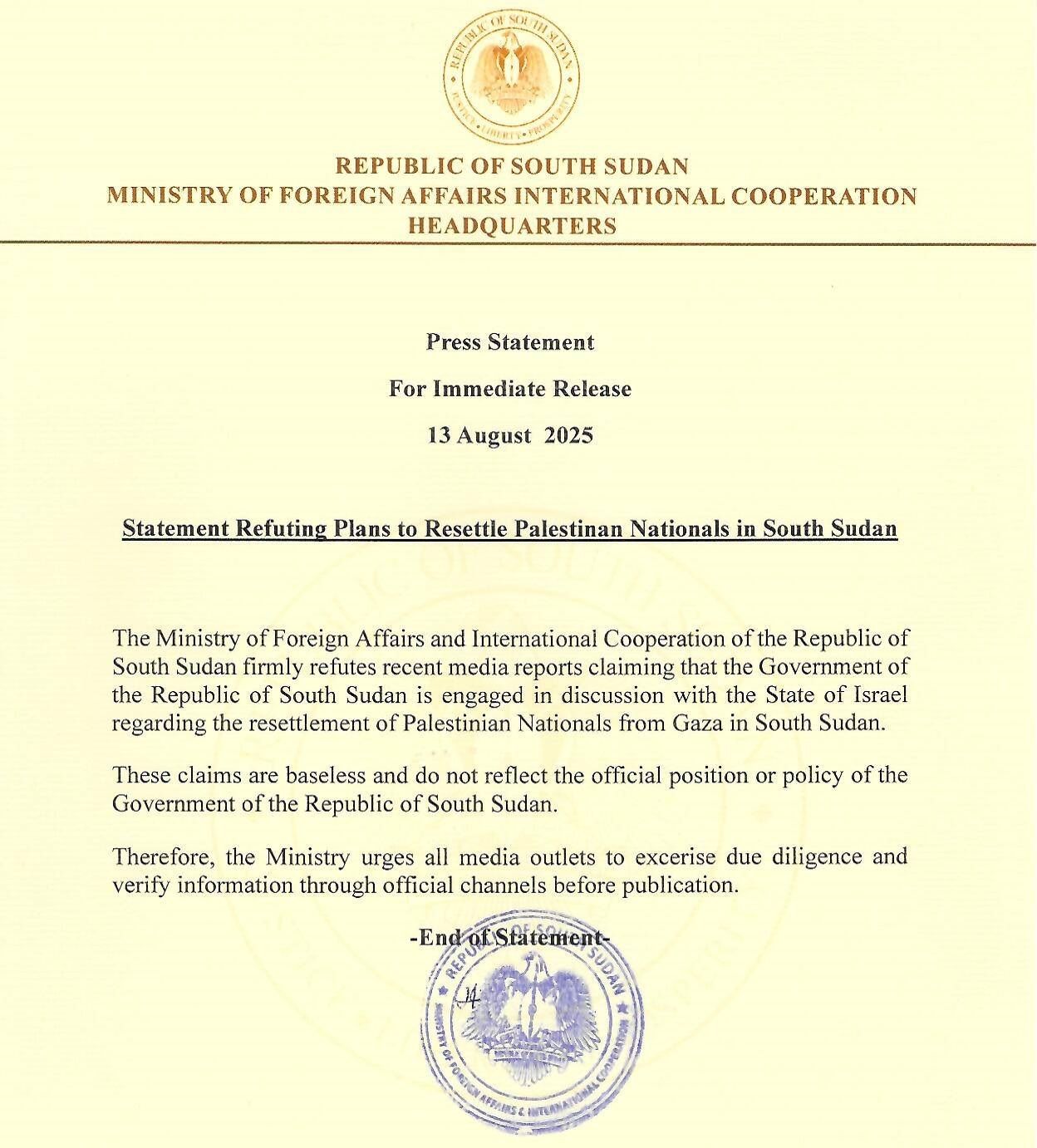
The very clear statement issued by the Sudanese Ministry of Foreign Affairs on August 13, 2025.

That declaration responded to a plan formulated by Israel Katz, Israel’s Minister of Defense, who proposed to “relocate” the people of Gaza to parts of East Africa — notably Sudan and South Sudan.
Behind its humanitarian varnish lies a deportation plan — a political project of mass expulsion.
Khartoum, though ravaged by war, still finds the strength to say no:
no to humiliation,
no to manipulation,
no to the transformation of Africa into a dumping ground for the Palestinian question.

What is happening today in El-Fasher, capital of a sovereign state now gangrened by hidden forces, proves that Netanyahu’s Israel adheres to Donald Trump’s “Peace Plan” only in appearance — while still conspiring to create the conditions for the realization of its own plan.

Two months later, El Fasher falls.

The city collapses under shells and dust.
Hospitals burn, civilians flee, the sky fills with drones.
The Rapid Support Forces — the recycled Janjawid — complete their conquest of El Fasher with the logistical and technical assistance of the Wagner network, now rebranded as Africa Corps, the Kremlin’s armed extension on the continent.
Their weapons, their drones, their instructors come from Russia, which feeds on the decomposition of African states as a lever of global negotiation.
And who pays for this? Gold. Always gold.
Gold from Darfur, torn from the mines under militia guard, exported to Dubai, melted into the laundering circuits of the Gulf.
The United Arab Emirates, through economic complacency and political silence, finance the devastation they pretend to soothe.
And, in the height of cynicism, it is this same axis — Moscow, Abu Dhabi, Tel Aviv — that stands behind the façade of “stabilisation.”

This is no longer coincidence; it is a monstrous convergence.
A hideous hybridisation in which everyone profits:

Russia, extending its tentacles over Africa, dressing its plunder in anti-Western rhetoric;

The Emirates, turning chaos into financial flows and aligning, without saying it, with Netanyahu’s doctrine — reject the Palestinian, delegitimise his cause, dissolve his suffering into the rhetoric of security;

Israel, finally, pursuing by other means the morbid dream of a Greater Israel cleansed of Gaza, searching amid Sudan’s ruins for the space where it might deport those it no longer wants to see.

This chain of reality is no theory — it writes itself before our eyes.
On August 13, 2025, a sovereign state rises up against the idea of hosting refugees whom others seek to expel.
On October 26, 2025, that same state watches its last provincial capital fall under the bullets and drones of a militia maintained by Russian networks and financed by gold flowing through the Gulf.
Between those two dates, the link closes: the deportation of populations and the disintegration of a state belong to one and the same continuum of domination.

Sudan is no longer merely a field of ruins — it becomes the mirror of Gaza,
a mirror reflecting the methods of a world that knows no peace except through the destruction of maps.
And this must end.
Those responsible — Moscow, Abu Dhabi, Tel Aviv — must be named, exposed, and sanctioned.
The chain must be broken before other African states, too, are transformed into strategic dumping grounds for the perverted ambitions of powers that live off the chaos they create.

Sudan burns, and with it burns our last illusion —
that disintegration is an accident.
It is not.
It is a system.
And it is time for those who built it to pay.

Le Soudan dépecé : la géopolitique du déplacement, acte II

Ce n’est pas une guerre civile. C’est une mise à mort.
Le Soudan, jadis pilier du continent africain, est aujourd’hui méthodiquement broyé — non pour ce qu’il est, mais pour ce qu’il peut servir.
Le 13 août 2025, le ministère soudanais des Affaires étrangères publie un communiqué d’une rare fermeté : « Le Soudan rejette catégoriquement les allégations selon lesquelles il aurait accepté d’accueillir des Palestiniens déplacés.« 

Cette déclaration répond au plan formulé par Israël Katz, ministre israélien de la Défense, qui prévoit de “relocaliser” les Gazaouis dans des zones d’Afrique de l’Est, en particulier au Soudan et au Soudan du Sud.
Derrière le vernis humanitaire, il s’agit d’un plan de déportation — un projet politique d’expulsion de masse.
Khartoum, pourtant ravagé par la guerre, trouve encore la force de dire non : non à l’humiliation, non à l’instrumentalisation, non à la transformation de l’Afrique en exutoire du problème palestinien.
Ce qui se passe aujourd’hui à El-Fasher, capitale d’un Etat souverain gangréné par des forces obscures, témoigne que l’Israël de Netanyahou ne souscrit au plan de Paix de Donald Trump qu’en façade, mais conspire toujours à créer les conditions favorables à la réalisation de son propre plan.


Deux mois plus tard, El Fasher tombe.

La ville s’effondre sous les obus et la poussière.
Les hôpitaux brûlent, les civils fuient, le ciel s’emplit de drones.
Le Rapid Support Forces — ces Janjawid recyclés — achève la conquête d’El Fasher avec l’aide logistique et technique du réseau Wagner, désormais rebaptisé Africa Corps, bras armé du Kremlin sur le continent.
Leurs armes, leurs drones, leurs instructeurs viennent de la Russie, qui se repaît de la décomposition des États africains comme d’un levier de négociation global.
Et qui paie ? L’or, toujours.
L’or du Darfour, arraché des mines sous la garde de milices, exporté vers Dubaï, fondu dans les circuits de blanchiment du Golfe.
Les Émirats arabes unis, par leur complaisance économique et leur silence politique, financent la dévastation qu’ils prétendent apaiser.
Et, comble du cynisme, c’est ce même axe — Moscou, Abu Dhabi, Tel-Aviv — qui se tient derrière la façade de “stabilisation”.

Ce n’est plus une coïncidence : c’est une convergence monstrueuse.
Une hybridation hideuse où chacun trouve son compte :

  • La Russie, qui étend ses tentacules sur l’Afrique en habillant son pillage de discours anti-occidental;
  • Les Émirats, qui transforment le chaos en flux financiers et s’alignent, sans le dire, sur la doxa de Netanyahou : rejeter le Palestinien, délégitimer sa cause, dissoudre sa souffrance dans la rhétorique sécuritaire;
  • Israël, enfin, qui poursuit par d’autres moyens le rêve morbide d’un Grand Israël débarrassé de Gaza, en cherchant dans les ruines du Soudan l’espace où déporter ceux qu’il ne veut plus voir.

Cette chaîne de réalité n’a rien de théorique : elle s’écrit sous nos yeux.
Le 13 août 2025, un État souverain s’insurge contre l’idée d’accueillir des réfugiés que d’autres veulent expulser.
Le 26 octobre 2025, ce même État voit sa dernière capitale provinciale tomber sous les balles et les drones d’une milice entretenue par les réseaux russes et financée par l’or transitant par le Golfe.
Entre ces deux dates, le lien se ferme : la déportation de populations et la désintégration d’un État participent d’un même continuum de domination.

Le Soudan n’est plus seulement un champ de ruines : il devient le miroir de Gaza.
Un miroir où se reflètent les méthodes d’un monde qui ne sait plus faire la paix qu’en détruisant la carte.
Et il faut que cela cesse.
Il faut que les responsables — Moscou, Abu Dhabi, Tel-Aviv — soient nommés, exposés, sanctionnés.
Il faut rompre la chaîne, avant que d’autres États africains ne soient eux aussi transformés en dépotoirs stratégiques pour les ambitions dévoyées de puissances qui vivent du chaos qu’elles provoquent.

Le Soudan brûle, et avec lui brûle notre dernière illusion : celle que la désintégration est un accident.
C’est un système.
Et il est temps que ceux qui l’ont bâti paient.

Nuclear-Propelled Cruise Missiles and Collective Security: An Unacceptable Externalization of Radiological Risk

From the reckless occupation of the Zaporijjia nuclear power plant to the unveiling of a nuclear-propelled cruise missile Burevestnik, Russia is dragging the nuclear dialectic into erratic, ungoverned terrain. What was once a field bounded by doctrine, deterrence, and responsible stewardship is now being twisted into a theatre of coercion, environmental endangerment, and civilian risk. The shift is not strategic innovation — it is the degradation of nuclear responsibility itself. Very red line.

The public presentation on 26 October 2025 of a nuclear-propelled cruise missile by President Vladimir Putin (9M730 Burevestnik, NATO: SSC-X-9) raises a concern that transcends the traditional boundaries of arms control. It is not merely a question of payload, deterrence posture, or strategic signaling. It is a matter of radiological safety for civilian populations and the collective responsibility of states under international law.

1. Responsibility in Transit: A New Category of Risk

Unlike a conventional warhead—whose nuclear components remain inert until detonation—a nuclear propulsion unit constitutes an active radiological source during the entire flight. Heat production, neutron activation of materials, and potential by-products of fission create a qualitatively different hazard: a flying installation of nuclear risk over civilian infrastructure and ecological systems.

Responsibility no longer concerns only the intent of use, but the externalities of transit itself.

2. Interception Dilemmas and Civilian Exposure

Any state in legitimate self-defense may seek to intercept such a missile. Yet interception—by design—risks fragmenting a core of radioactive material in the atmosphere. In other words, a lawful defensive act can involuntarily contaminate third parties, including neutral airspace or downwind populations.

This represents a profound distortion of responsibility: the defending actor becomes the last causal link in a contamination chain they did not initiate.

3. The Payload Is Irrelevant to the Core Problem

Whether the missile carries a nuclear warhead, a conventional payload, or no destructive payload at all, the risk remains fully intact. A nuclear propulsion unit introduces:

  • long-lived radiotoxic materials (plutonium, enriched uranium, activation isotopes) into the battlespace;
  • fragmentation hazards under fire or during mechanical failure;
  • aerosolization risks capable of contaminating soils, water tables, and food chains for decades.

Thus, focusing on the warhead is a category error. The danger is the reactor itself.

4. Absence of Crew Means Absence of Control

Nuclear submarines and vessels are subject to:

  • human supervision,
  • emergency shutdown procedures,
  • layered containment,
  • and maintenance protocols.

A missile, by contrast, offers none of these protections. Its core vulnerability is structural:

  • no human oversight,
  • no real-time containment capacity,
  • no mitigation if struck or malfunctioning.

Responsibility cannot be delegated to guidance software.

5. Collective Responsibility Under International Law

International law already recognizes:

  • the no-harm principle (states must not cause transboundary environmental damage),
  • the duty of due diligence,
  • and the obligation to prevent foreseeable harm.

A nuclear-propelled cruise missile renders compliance structurally impossible. Its mere flight path—regardless of intent—constitutes a foreseeable risk of transboundary radiological contamination.

No state can guarantee:

  • permanent mechanical integrity,
  • total immunity against interception,
  • or fail-safe mission termination above uninhabited zones.

Responsibility therefore shifts from use to existence.

6. A Precedent We Cannot Normalize

Allowing one state to operationalize such systems creates:

  • pressure for reciprocity,
  • technological emulation,
  • and increased probability of accidental contamination.

Normalization would generate a radiological arms race in the atmosphere—without any workable liability mechanism.

7. Required Normative Response

The international community must:

1. Declare a moratorium on flight testing of nuclear-propelled unmanned systems.

2. Open a treaty process to ban airborne nuclear propulsion for weapons entirely.

3. Integrate radiological transit risk into arms-control verification regimes.

4. Empower CTBTO radionuclide networks to publish transparency data on anomalies.

These measures are not optional. They form the minimal architecture of collective safety.

8. Conclusion

Nuclear-propelled cruise missiles constitute an unacceptable externalization of risk:

  • They turn the global atmosphere into a vector of radiological uncertainty.
  • They shift liability from user to defender, and from combatants to civilians.
  • They undermine the premise that nuclear materials must remain confined, controlled, and accountable.

In this domain, silence equals consent.
The international community must assert that the atmosphere is not a battlefield and that the safety of millions cannot hinge on the mechanical integrity of a flying reactor.

🕊️ Le moteur de la prospérité mondiale, version 2035

Le 15ᵉ plénum du PCC a confirmé ce que Pékin préparait depuis plusieurs années : la Chine entre dans la phase décisive de sa modernisation socialiste à l’horizon 2035.
Ce n’est plus un objectif économique, mais une métamorphose systémique — une reconfiguration complète de la relation entre la production, la consommation et la gouvernance mondiale. Au cœur de cette mutation, le Global Governance Initiative (GGI), porté par Xi Jinping, représente l’ouverture conceptuelle et institutionnelle de cette nouvelle phase : une architecture visant à harmoniser les flux — économiques, technologiques, environnementaux et cognitifs — entre nations, plutôt que de les opposer.

La globalisation aurait dû être un mécanisme de convergence :
– baisse de l’inflation,
– montée des standards de vie,
– diffusion de la technologie,
– stabilisation géopolitique.

Ce moteur a fonctionné — tant que la Chine incarnait l’atelier du monde.
Des centaines de millions de consommateurs occidentaux n’ont pas vu leur pouvoir d’achat s’effondrer parce que Shenzhen, Shanghai et Chengdu fabriquaient à bas coût ce que leurs industries ne produisaient plus. Cela a dopé la consommation et permis l’accès à pléthore de biens de consommation.


🔧 Le moteur a été déréglé

Plutôt que d’investir ce dividende invisible dans :

  • robotisation,
  • éducation,
  • infrastructures,
  • souveraineté industrielle,
  • recherche fondamentale,

nous l’avons consommé.

Ajoutez à cela :

  • conflits commerciaux,
  • sanctions technologiques,
  • tensions informationnelles,
  • fragmentation des chaînes de valeur.

Et surtout, un acteur central — Moscou — travaillant délibérément à déstructurer la confiance :
la ressource la plus précieuse du système.

La paix se finance par la confiance.
La guerre se finance par la dissipation de la confiance.

Poutine le sait.


🔥 La mue chinoise : le compte à rebours de la convergence

Le 15ᵉ plan quinquennal envoie un signal clair :

D’ici 2035, la Chine achèvera sa modernisation.

Traduction géo-économique :

  • fin du low-cost structurel,
  • montée en gamme technologique,
  • normes chinoises exportées au Sud global,
  • robotisation industrielle massive,
  • transition énergétique accélérée.

Après 2035, la Chine ne subventionnera plus en creux le pouvoir d’achat occidental.

Cela crée une fenêtre de 10 ans.


⏳ Dix ans pour reconfigurer l’Occident

Ce laps de temps est notre seconde chance pour :

  • réindustrialiser intelligemment,
  • automatiser,
  • sécuriser les ressources critiques,
  • rénover le tissu productif,
  • refonder la fiscalité du capital,
  • réhabiliter la recherche,
  • investir dans l’IA souveraine.
  • Réinventer l’économie mondiale,

C’est maintenant que se décide la structure du monde en 2050. La cryptoactif peuvent en être le socle.


💡 L’intelligence qui manque

Pour remettre ce moteur en route, il faudra :

  • politiques courageux, capables d’expliquer un horizon,
  • chercheurs, pour modéliser la convergence soutenable,
  • théoriciens économiques, pour briser les dogmes post-1980,
  • prix Nobel, pour offrir le cadre intellectuel,
  • grandes écoles, pour former les ingénieurs des transitions.

Le vrai chantier n’est pas seulement matériel.

Il est cognitivement institutionnel.


🌐 Paix mondiale : moteur, pas conséquence

La Paix, dans cette logique, n’est pas un résultat moral.
C’est une condition thermodynamique de maîtrise des points de friction et de surchauffe:

  • la globalisation déteste le bruit,
  • les marchés détestent l’imprévisibilité,
  • les chaînes de valeur détestent la discontinuité.

La prospérité accélère sous la Paix.
Elle grippe sous la peur.


🔥 Machine à redémarrer

Ce que nous devons faire :

  1. décrisper la relation sino-occidentale,
  2. stabiliser l’énergie (nucléaire, renouvelables, stockage),
  3. défendre cognitivement les institutions démocratiques,
  4. réduire le parasitage informationnel hostile,
  5. convertir la dernière décennie de dividendes chinois en investissements.

C’est réalisable.

Mais pas sans intelligence nouvelle.


🚀 Accéder au “régime optimal”

Une économie mondiale harmonisée ressemble à un moteur à combustion contrôlée :

  • trop peu → stagnation et populisme,
  • trop tard → chaos stratégique,
  • trop vite → ruptures sociales.

Il faut trouver le bon régime, le bon couple, le bon refroidissement.

Et l’accélérer pendant que la fenêtre est ouverte.


🎯 Conclusion

✅ La Chine ferme progressivement la parenthèse low-cost.
✅ L’Occident a 10 ans pour convertir ce qui reste en mutation structurelle.
✅ La Paix est la condition d’accélération.
✅ L’intelligence collective — économique, académique, politique — est le facteur critique.

Si nous échouons, nous serons des visiteurs de notre propre histoire.
Si nous réussissons, nous inaugurons une nouvelle ère de convergence.

🇨🇳 La Chine doit réussir sa “Perestroïka” (改革重组)

La Chine peut-elle réussir ce que l’URSS a manqué ? C’est tout le mal à lui souhaiter au moment où une partie de l’Armée Populaire de Libération est tentée, dans une proportion inconnue, de se braquer.

Dans l’histoire moderne de la Chine, l’Armée populaire de libération n’a jamais renversé le Parti.
Mais elle a plusieurs fois exercé une tutelle silencieuse : en 1959 avec Peng Dehuai, en 1971 avec Lin Biao, en 1989 sur la place Tian’anmen.
À chaque fois, l’opacité du moment disait plus que les mots : la tension entre le fusil et le sceau du pouvoir.

En arrivant au pouvoir, Xi Jinping se méfie des réseaux militaires et lance une purge sans précédent.
Plus de cent généraux et officiers sont limogés pour corruption ou “manque de loyauté” (Guo Boxiong, Xu Caihou, etc.).
En 2016, il rappelle la doctrine fondatrice :

> “Le Parti commande le fusil, et le fusil ne doit jamais pointer vers le Parti.”

La réforme structurelle de la PLA vise à dépolitiser les factions internes, tout en repolitisant l’institution autour de sa vision pour l’avenir de la Chine au XXIᵉ siècle,
vision dont l’Initiative pour une Gouvernance Globale (GGI) constitue l’expression la plus aboutie.
Il ne s’agit pas d’un enjeu personnel, mais d’un projet d’ordre et de stabilité à l’échelle mondiale.

Pourtant, dans l’ombre, le véritable choix se joue ailleurs :
entre la fidélité à cette vision de long terme et l’attrait exercé par le modèle russe sur une partie du PCC et de l’APL.
Ce modèle, fondé sur la verticalité sans responsabilité, la force sans idéal et la ruse sans horizon, séduit ceux que la discipline du Parti fatigue.
Il offre l’illusion du pouvoir sans la contrainte de la morale.


Ce désalignement latent nourrit une crise de loyauté : l’armée obéit à une direction historique, mais certaines forces regardent vers d’autres repères.
Et l’histoire enseigne que ce type de fracture, lorsqu’elle devient visible, précède souvent les grandes bascules.

> Georges Clemenceau disait : “La guerre ! C’est une chose trop grave pour la confier à des militaires.”
Si le Tigre l’a dit, Xi Jinping peut le dire aussi.


Le silence du Plenum, aujourd’hui, n’est pas vide.
Il révèle l’hésitation d’un équilibre millénaire entre le sabre et l’État.
Et peut-être, à travers lui, le destin de la Chine – et du monde.


> La grande loyauté est la loyauté au destin de la nation.

Dragon impérial, insufleur de vie. (Source Wikipedia)

Note d’évaluation — Budapest, moment pivot

Selon des informations parcellaires, la Chine connaît des tensions internes autour de la personne de Xi Jinping. Le signal décisif sera donné demain à Budapest. Chacun l’interprétera de manière difficilement réversible.

La République populaire de Chine traverse une phase de recalibrage interne d’une intensité inhabituelle.
Au sein de l’Armée populaire de libération (APL), plusieurs strates de commandement semblent exprimer une résistance au changement de paradigme promu par le président Xi Jinping — celui d’une gouvernance morale et intégrée, articulée à l’Initiative pour une Gouvernance Globale (GGI), jugée compatible avec les principes et les objectifs des Nations unies, ainsi qu’avec le cadre multilatéral qu’elles incarnent.

Cette transformation se heurte à deux obstacles majeurs :

  • d’une part, l’inertie d’un appareil militaire puissant, enraciné dans d’anciennes fidélités et une culture d’opacité ;
  • d’autre part, la possible empreinte idéologique de l’influence russe, issue des méthodes de guerre informationnelle, qui ont progressivement fragilisé la résilience cognitive aussi bien des démocraties que des régimes stables.

Il n’existe aucune preuve concluante attestant que cette influence opère actuellement au sein de la hiérarchie chinoise.
Cependant, compte tenu du contexte international — et de la volonté constante de Vladimir Poutine d’intégrer le poids de la Chine, de l’Inde et du bloc des BRICS dans son rapport de force avec l’Occident — il n’est pas déraisonnable de considérer que cet enjeu puisse en faire partie.

La question n’est pas celle de Xi Jinping en tant qu’individu, ni de la structure interne du système chinois.
Elle concerne l’ensemble de la communauté internationale : la nécessité de limiter la capacité de la Russie à exporter son influence déstabilisatrice dans les institutions et cadres émergents de gouvernance mondiale.
Neutraliser cette influence n’est pas un acte dirigé contre un État ; c’est une condition préalable au rétablissement de la crédibilité et de la confiance mutuelle qui fondent la gouvernance globale.

Si la GGI demeure un instrument d’équilibre et de dialogue multilatéral, plutôt qu’un vecteur de domination, elle pourra contribuer à la stabilité internationale.
Mais si elle venait à être captée par une logique coercitive, les conséquences seraient systémiques et durables.

Budapest ne constitue donc pas seulement un rendez-vous diplomatique : c’est un moment de vérité pour l’ordre international, un test de la capacité des nations à réaffirmer des normes communes de gouvernance et à contenir la propagation des manipulations cognitives et informationnelles.
L’issue de ce moment déterminera si le monde s’oriente vers une coopération raisonnée ou une domination réciproque.

⚔️ Taking the War Out of the Cognitive Field

⚔️ Beyond Clausewitz: Rethinking Security in a Post-Conventional Era — the deeper challenge underlying tomorrow’s Peace Talks in Budapest.

If the war launched by Vladimir Putin’s Russia against Ukraine were purely territorial, it could be settled through conventional means — an exchange of land, a ceasefire, or a neutral status guaranteed by treaties.

But this conflict has carried us a thousand light-years away from Clausewitz.
The Prussian strategist described war as “the continuation of politics by other means.”
Yet Russia has transformed it into something else entirely: the continuation of politics through the confusion of means.

The battlefield is no longer the Donbas — it is the human mind itself.
This war has migrated into the cognitive field: into narratives, perceptions, emotional manipulation, and the corrosion of collective discernment.

It now unfolds across the entire planet — through social networks, media ecosystems, political discourse, economic leverage, and even cultural production.
It seeks not conquest, but disorientation; not victory, but the erosion of trust and coherence within democracies.

Hence, traditional security guarantees are no longer sufficient.
They must evolve beyond the military domain to encompass:

  • Cognitive protection of societies;
  • Information-space integrity, against manipulative and hybrid operations;
  • Psychological resilience within democracies;
  • Institutional trust as a strategic asset.

Conventional war destroys bridges.
Cognitive war destroys the bridges between minds.

Taking the war out of the cognitive field means restoring the primacy of truth, reason, and politics over narrative manipulation.
It also means redefining security itself as a global public good
for peace today is no longer merely the absence of war,
but the restoration of confidence in reality.

If the Budapest summit simply negotiates a territorial truce or freezes lines, we risk returning to a pre-Clausewitzian mindset. But if it boldly embraces this post-conventional dimension—saying: “We will rebuild the bridges between minds, not just the lines on maps”—it can mark a turning point in how the free world conceptualises war, peace and security.

President Vladimir Putin has already made clear — publicly and repeatedly — that Russia regards information operations as a legitimate and enduring instrument of statecraft. He used his address at the RT 20th-anniversary gala at the Bolshoi Theatre to praise RT’s role in challenging “monopolies” of narrative and to defend the idea of a louder Russian voice in the information space. Special Kremlin
That posture was reinforced in his Valdai Forum remarks, where he framed Western media and political moves as part of a wider confrontation and signalled Moscow’s intent to respond forcefully across political and informational domains. The Guardian

This is not a tactical quibble: it is existential. If the Budapest talks do not treat information warfare as a primary security dimension — and if they fail to secure concrete guarantees that the information domain will be demilitarised and neutralised — the conference will at best freeze a map and at worst leave the most dangerous front unconstrained. Therefore, it is vital, in terms of collective and even universal security, to crush this dimension in the egg: to make any peace settlement contingent on verifiable, enforceable mechanisms that eliminate state-led informational aggression and restore shared factual ground as the precondition for lasting peace.

Cognitive Shockwaves at the Knesset

Donald J. Trump’s address before the Knesset was presented as “historic.” . Yet it served less the cause of history than the narration of a silent shift: the moment when America, beneath misplaced applause, signaled to Israel that the era of the Greater Israel is over. A moment of apparent exaltation that was, in truth, a distancing — a masterclass in realpolitik cloaked in biblical fervor.

The Israeli government — Amir Ohana, Speaker of the Knesset, alongside Prime Minister Benjamin Netanyahu and President Isaac Herzog — did more than roll out the red carpet for the President of the United States.
Through a concert of praises and standing ovations, some even assuring him that “Israel would remember him in two thousand years,” they sought to place Donald Trump in a position of obligation, flattering him into submission, turning the very sanctuary of Israeli democracy into a stage for ritualized sycophancy.

The only one who seemed to hold himself apart from this unhealthy choreography was Yair Lapid, head of the main opposition party and chairman of the Permanent Forum, to whom Trump extended an unusually warm and sincere greeting.

While every newsroom hailed a “historic day” for Israel, none bothered to translate the speech of the man embodying Israel’s democratic awakening — the same Lapid whom Trump honored on Truth Social and via the White House account, twice posting images of the mass peace rallies organized by the opposition.

The long introductory tributes from Netanyahu’s majority validated, with almost theatrical excess, an old adage:

“If an event is forced upon you, pretend to have inspired it, guard it jealously, and become its memory for centuries to come.”

Yet body language betrayed the unease. Both Trump and Herzog looked stiff, uncomfortable.
And “Bibi,” as Trump kept calling him by his nickname rather than his state title, behaved like a game-show host, warming up the crowd with forced exuberance fit for prime-time television.

The question hung in the air: how would Trump escape this suffocating trap?
Especially after, upon taking the podium, he was told twice — “Here, the teleprompter is working” — a barely veiled jab at the United Nations, where, according to him, 142 sovereign nations had bent to Hamas’s will by paving the way for the recognition of a Palestinian state.


The Cognitive Riposte

How do you outplay a suspect excess of flattery?
By being even more flattering than the flatterer — and Donald Trump is a virtuoso of that art. His opening was greeted by rapturous applause. Netanyahu thought the script intact: Iran as eternal enemy, war as destiny, and U.S. alignment as a given.
But gradually, Trump dismantled the narrative. The verbs changed tense, the story shifted from the present of threat to the past of victory, and then ascended to the biblical time of Abraham — the time of promises and covenants.

“Abraham… I love saying that name. Abraham.”

By invoking this founding figure, Trump moved the stage itself. Israel was no longer the perpetual besieged citadel but the cornerstone of a new era, called to move from the age of terror to the age of peace.
Then came the key passage:

“I want to thank the Arab and Muslim nations for their commitment, because they’ve made — to support a safe rebuilding of Gaza and beyond. I have many Arab countries, very wealthy countries, that came up and said we’ll put up tremendous amounts of money to get Gaza rebuilt. … They want dignity… and they want to see it be good for Israel too.”

Israel cannot turn its back on the future.
Under the guise of gratitude, Trump drew a red line: peace would come at a price, and Israel would have to take part in its own moral and political reconstruction.


The Sheldon Moment

Then came the apocalyptic moment, around the fifty-fifth minute.
Trump called upon Miriam Adelson (née Sheldon), the American-Israeli billionaire and historic GOP donor, to stand.
He quipped, half-joking, that she had “sixty billion in the bank” and that, under her influence and that of her late husband Sheldon, he had recognized Israel’s sovereignty over the Golan Heights.

But after the homage came the sting:

“She loves this country. She and her husband are so incredible. We miss him dearly. But I actually asked her once — Miriam, I know you love Israel, but what do you love more — the United States or Israel? She refused to answer. That might mean it’s real.”

A chill swept through the Knesset.
Trump had just exposed, in the brightest light, the unspoken question: where does loyalty end?

The coup de grâce came after nearly an hour of speech.
Turning toward President Herzog, Trump said, half-smiling:

“Hey, I have an idea. Mr. President, why don’t you give him a pardon? Cigars and some champagne — who the hell cares?”

The room froze.
Trump had just called, before all of Israel, for Netanyahu’s pardon.
It was no endorsement — it was a symbolic burial.
A forced laugh, a nervous grin, and then:

“Ah, that wasn’t in my speech. Enough controversy for the day.”

The message had landed.
Netanyahu’s trial was over.
The post-Netanyahu era had been sealed — under applause from those who mistook a dismissal for a coronation.

Among the few genuine smiles, that of Yair Lapid.
Netanyahu, meanwhile, was buried alive, carrying with him the anachronistic dream of a “Greater Israel.”
Trump, in a single gesture, inverted the symbolic weight of the moment. War became past; peace — tied to the reconstruction of Gaza and the inclusion of Arab nations — became horizon.

“It’s time to rebuild Gaza. … They want dignity.”

Yet through that regained dignity, Trump was also asking Israel itself — while avoiding any mention of the financial dimension entrusted, for now, solely to the Board of Peace and its billionaire patrons — to contribute morally and politically to the building of a new order.
All of it without seeming to say it, nor even to have said it — which is, undeniably, a great art of the deal.

That is what I saw and heard.
And I have not seen a single media outlet acknowledge these cognitive shockwaves, though they were so clearly delivered.

Le calendrier de la paralysie institutionnelle est calé sur l’agenda stratégique de Poutine

Il faut que Marine Le Pen accède au pouvoir rapidement pour couper l’herbe sous le pied d’Emmanuel Macron s’agissant de la mise à jour du périmètre sur quel s’exerce la dissuasion nucléaire française. Les idiots utiles qui multiplient les « Macron Démission » servent le Kremlin.

La France entre dans une période de turbulence institutionnelle où les appels à la démission du président et la montée des forces populistes convergent avec un contexte international explosif.
Or, selon des sources du renseignement allemand relayées par @ObsDelphi, le Kremlin étudie la faisabilité d’une attaque directe contre l’OTAN, non nécessairement pour vaincre militairement, mais pour briser la cohésion européenne et semer la paralysie stratégique.

1. Le facteur temporel

Le calendrier de la désorganisation politique française — motions, divisions parlementaires, campagnes présidentielles anticipées — coïncide désormais avec le calendrier d’opportunité russe.
Autrement dit : le moment où la France risque d’être institutionnellement affaiblie correspond à celui où Moscou a besoin d’une faille politique majeure à l’Ouest pour tester la solidité de l’OTAN.

2. Le verrou doctrinal français

Le président Emmanuel Macron a annoncé qu’il prononcera début 2026 un discours sur la mise à jour de la doctrine de dissuasion nucléaire française, actuellement en cours d’actualisation (Frankfurter Allgemeine Zeitung, TF1info).
Cette mise à jour vise à préciser :

  • le périmètre exact de la protection nucléaire française (territoire national ou sécurité européenne élargie) ;
  • les conditions d’emploi de la force de dissuasion dans un contexte d’hybridation des menaces (cyber, spatial, cognitif).

L’échéance est donc stratégique : tant que ce discours n’a pas été prononcé, la doctrine française reste dans une zone d’ambiguïté que Moscou peut exploiter.

3. L’enjeu d’un changement de pouvoir

Une arrivée de Marine Le Pen à l’Élysée avant cette échéance :

  • gèlerait la révision doctrinale ;
  • affaiblirait la crédibilité de la dissuasion française ;
  • désolidariserait la France du consensus nucléaire occidental ;
  • et ouvrirait la voie à une redéfinition du périmètre stratégique européen au profit de la Russie.

C’est pourquoi le Kremlin a tout intérêt à précipiter le chaos politique en France — via :

  • la manipulation émotionnelle de thèmes agricoles, industriels, identitaires ;
  • la saturation cognitive des réseaux sociaux (Mercosur, ChatControl, inflation, OTAN)  qui ouvrent un millestone populiste au Rassemblement National, où les oppositions sont chaleureusement invitées à picorer;
  • la normalisation du discours anti-institutionnel (Macron démission, France asservie à Bruxelles).

5. Diagnostic : la guerre avant la guerre

La Russie mène déjà la phase zéro de la guerre, celle de la désactivation du commandement politique européen par l’usure et le doute.
Chaque fois qu’un État vacille — ou qu’un dirigeant est délégitimé —, le coût politique d’une réponse collective augmente.
Dans ce contexte, la paralysie institutionnelle devient une arme de destruction lente.

6. Conclusion : urgence d’une réponse française

Il appartient au peuple français et il n’appartient qu’à lui :

  • de tenir le cap institutionnel jusqu’à la clarification doctrinale de 2026 ;
  • de contrer les relais cognitifs internes et externes qui servent de chambre d’écho à la stratégie russe ;

Cela permettra à la France de reformuler un discours stratégique souverain, clair, lisible par les alliés comme par les adversaires.

> La Russie n’a pas besoin d’attaquer Paris si Paris se désarme intellectuellement.
C’est sur cette ligne que la France doit reconstruire son unité stratégique avant 2026.

The Low-Noise Strategic Signal: China, Russia, and the Mechanics of Doubt

At first glance, it seemed like an ordinary coincidence — Russian strikes occurring as several Chinese satellites crossed the Ukrainian sky.
But beneath the surface, the episode reveals a deeper play: a low-frequency signal in the cognitive spectrum, capable of undermining China’s credibility, fraying the Global Governance Initiative, and closing Europe’s Silk Road curtain — all without a single shot fired.

1. Genesis of the Signal

On October 5, 2025, Ukrainian intelligence sources reported that Russian missile strikes coincided with the passage of Chinese reconnaissance satellites (Yaogan series) over western Ukraine.
Moscow denies any coordination; Beijing denies any involvement.
Yet the simultaneity of those denials — one negative (“we need no help”), the other polite (“we are not involved”) — creates a vacuum where suspicion breathes.
What may be orbital coincidence is read as deliberate synchrony.

2. The Strategy of the Whisper

This operation’s power lies not in public virality but in targeted diffusion — across intelligence briefs, strategic think tanks, and defense analysis circles.
It spreads quietly, yet precisely, like a fine mist of plausibility.

It doesn’t need to convince the masses; it only needs to introduce uncertainty among decision-makers.
The moment the question — “What if China is not as neutral as it claims?” — enters the analytical calculus, the signal has succeeded.
Doubt becomes doctrine.

3. China’s Posture: Letting the Weaver Weave

China does not allow the possibility of collusion; it explicitly denies it.
Yet it lets the weaver weave — refusing to contest the narrative that others are spinning.
This abstention is a form of mastery: letting the rumor exhaust itself, allowing the dust to settle on others’ clothes.

Where the Kremlin’s verbosity amplifies the noise, Beijing’s silence projects composure.
One blurs; the other absorbs. Together, they sustain an ambiguous duality that keeps everyone guessing.

4. Europe’s Curtain: The Silk Road in the Shadows

While this cognitive theater unfolds, another curtain descends: the European protectionist reaction to the flood of Chinese goods — Temu, Shein, and other ultra-competitive platforms.
Under the banner of “economic sovereignty,” European policymakers are raising barriers, effectively dimming the lights on the Silk Road’s Western stage.

By letting suspicion grow, Moscow cuts China’s trade routes not through sanctions but through European mistrust.
In a paradoxical twist, Russia’s manipulation of ambiguity hurts Beijing’s long-term leverage — turning its partner into collateral damage in the information war.

5. The Blow to the GGI

The Global Governance Initiative (GGI), Beijing’s vision of a balanced multipolar order, stands weakened.
Its moral architecture — founded on predictability, neutrality, and trust — erodes under the perception of duplicity.
China’s “positive denial” and Russia’s narrative opportunism dissolve the distinction between prudence and complicity.
The GGI, once a promise, now mirrors the instability it sought to transcend.

6. Conclusion

•A spatial coincidence.
•A strategic whisper.
•An economic curtain.

Three threads — enough to weave a web of doubt.
In today’s cognitive warfare, truth is not denied; it is diluted.
And China, whether willing or not, now stands behind the curtain others have drawn across its Silk Road.